

A corollario della storia della Buby (che potete leggere a questi link: https://pitlaneitalia.com/2026/07/09/buby-from-argentina-part-1-1957-1967/ e https://pitlaneitalia.com/2026/07/23/buby-from-argentina-part-2-1967-2000/) ecco la storia della gamma Collector’s Classics, che si sviluppò tra la fine degli anni ’80 e l’inizio degli anni ’90.
Collector’s Classics Range
By Fedor Eliseev and Fernando Rey
Photos by Fernando Rey
By the mid-1980s, Buby had reached the top of the model car market in South America. However, the events taking place within the country had a severe impact. After the tragic 1976–83 Dirty War and the military dictatorship, many companies were forced to cease their activities. The new government lifted import restrictions, and a huge number of European and American products flooded the Argentine market. The national industry found itself in a very difficult position. People who had dreamed of owning world-famous brands could finally buy them and were willing to pay higher prices for them.
The model industry found itself in the same situation. Nevertheless, Haroldo Mahler began looking for a new business model.
In the mid-1980s, he acquired several 1/43 castings from another major Argentine manufacturer, Galgo, and marketed them under the Buby name. These rather simple and obsolete miniatures could not generate sufficient profit. Eventually, new models became necessary to attract customers.
Don Haroldo decided to focus on export products in order to survive. He turned his attention to post-war American classic cars in 1/43 scale because, firstly, he was very fond of them (Buby had originally started with American car miniatures); secondly, this segment was very promising at the time, and companies such as Brooklin, Durham Classics, Franklin Mint and Vitesse were the major players in this market. All of them, except Vitesse, were very expensive, and many collectors could not afford to buy these miniatures. Therefore, the answer for Haroldo Mahler was obvious: to offer a high-quality range of 1/43 scale models of the most famous American cars of the 1950s at a reasonable price.
Work on the new range began in 1987 at Buby’s most modern plant in Don Torcuato, where production would subsequently take place. To establish the new line of 1950s American model cars, Haroldo Mahler enlisted Sergio Goldvarg, a renowned artisan who had served as a company advisor during the mid-1980s.


Sergio suggested naming the new line of post-war American cars Collector’s Classics.
Soon, the first samples were ready. They were designed by engineer Krescevic, who had extensive experience and had, for example, created all the models in the JET collection during the 1970s. Incidentally, he would go on to design every miniature in the Collector’s Classics range until the end of the project. The new models were precision die-cast miniatures. They were highly accurate, richly detailed and met all the quality standards of the time. The headlights were made of clear plastic, and the wheels were particularly well executed. The plastic interior was finely detailed, while the dashboard, steering wheel and gear lever were all accurately reproduced. The plastic baseplate featured an individual serial number, the Collector’s Classics logo and the name of the assembler.
The marketing strategy for the new collection was particularly interesting. Every casting was planned in several versions: hardtop, convertible with the top down, convertible with the top up and an Indy 500 Pace Car version (whenever the real vehicle had actually served as a pace car). The models were packed in attractive cardboard boxes decorated with illustrations of famous automobile emblems and Buby’s logo, designed as a Golden Age automobile from the 1920s–30s, in which the letters H and M can be seen in honour of Haroldo Mahler.
The packaging style resembled that of expensive white metal models. In addition, every model was supplied with an original certificate personally signed by Don Haroldo.
The certificate listed all the available variants of the model and the production quantity for each of them. A total of 22,000 examples of each model, including all variants, were planned.
The first model in the series, the 1955 Chevrolet Bel Air convertible with the top down, was introduced in the autumn of 1988.


The very first production model, assembled in Don Torcuato and carrying serial number 00001 on its baseplate, was presented by Haroldo Mahler to Sergio Goldvarg as a wedding gift. Today this miniature remains in Goldvarg’s personal collection, and I hope that when Sergio eventually opens his museum, collectors will have the opportunity to see it.


The following year, the 1955 Bel Air range was expanded with the convertible top-up, hardtop and Indy 500 Pace Car versions, whose livery was produced using tampo-printing technology. Incidentally, this technique was used for all the emblems and badges in the Collector’s Classics range. Without doubt, this technical solution proved far more durable than decals.
The next casting in the Collector’s Classics range also appeared in 1989. Buby introduced the 1953 Ford Sunliner in the four traditional versions: convertible with the top down, convertible with the top up, hardtop and Pace Car.


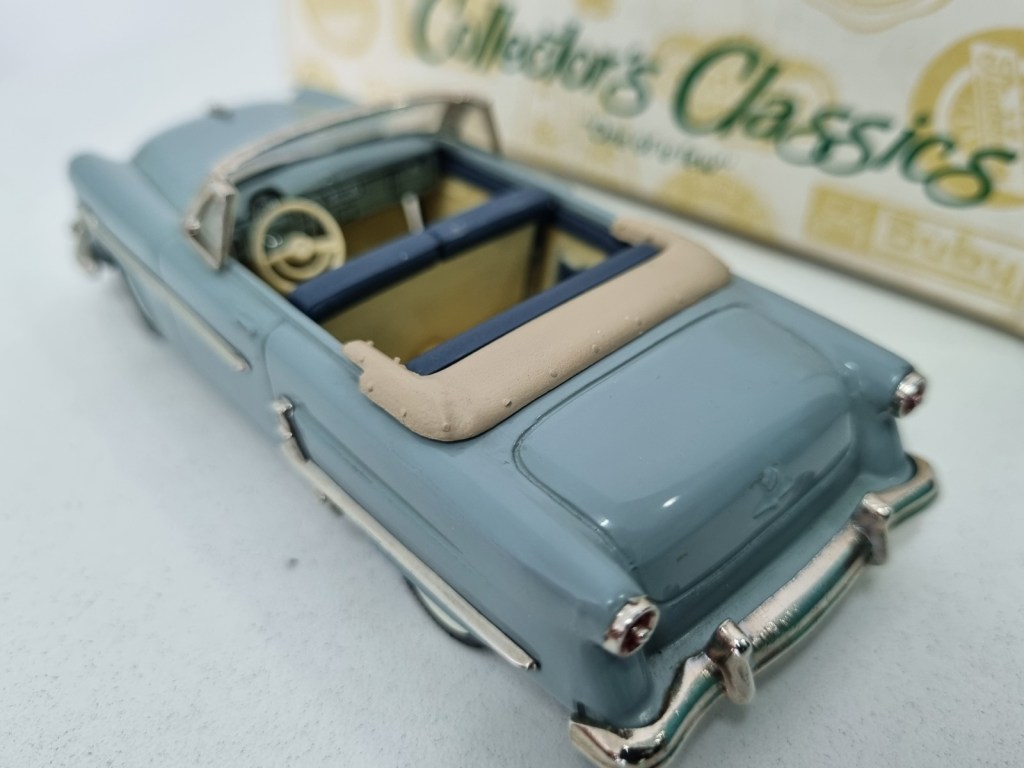


The Pace Car versions, in addition to their special livery, featured a rear-mounted spare wheel that was absent from the standard road-going versions in the Collector’s Classics range.


The third model in the Collector’s Classics series was the 1954 Mercury Monterey. Although this car was never used as an Indianapolis Pace Car, it was nevertheless produced by Buby as a convertible with the top down, a convertible with the top up and the remarkable Sun Valley version fitted with its distinctive glass roof.


In addition to the certificate, the new models also included a special Collector’s Club newsletter in which Buby shared its future plans. Collectors were also given the opportunity to complete a special application form included in every model’s box and take part in a raffle to win a model offered by Don Haroldo.
The Collector’s Classics range quickly earned a good reputation among enthusiasts of American model cars. The miniatures offered a high level of quality at a reasonable price. For example, in 1990 they retailed for approximately 25 USD, whereas comparable white metal models typically cost around 50 USD. White metal manufacturers, however, could offer a much wider selection of models, although Buby made every effort to expand its range more rapidly than it had done in previous years. The Argentine manufacturer also took part in the prestigious Nuremberg Toy Fair, where the world’s leading model companies presented their latest products.
In 1991 the Argentine company introduced two new castings: the 1956 Packard Caribbean and the 1956 DeSoto Fireflite. The prototypes chosen for these Argentine miniatures represented the luxury segment of the American automobile market. For Packard, however, the Caribbean was one of the company’s final models, as the marque would cease production just two years later.


These spectacular models featured particularly attractive colour schemes. For both the Caribbean and the Fireflite, Buby adopted striking three-tone paint combinations. The 1956 Caribbean range included a hardtop, a convertible with the top up and a convertible with the top down, while the 1956 Fireflite range also featured an Indy 500 Pace Car version.


Another innovation was the De Luxe Edition, presented in acrylic display cases. The original design of the display base allowed the model to be secured without screws by means of special retaining lugs that engaged the front and rear axles. The display base also featured an elegant Collector’s Classics badge on one side. At the front was a metal plaque bearing the full name of the model.


In addition to the certificate and the Collector’s Club newsletter, the De Luxe Edition also included a printed information sheet containing the technical specifications of the real vehicle.


The year 1991 also brought less encouraging news. Despite the success of the Collector’s Classics range, Buby continued to experience serious financial difficulties, which became increasingly severe. One of the company’s two factories in Córdoba was forced to close. Manufacturing in Argentina had become very expensive, and Haroldo Mahler apparently entered into negotiations with factories in Uruguay to relocate part of the company’s production. Whatever the outcome of those discussions, production continued to take place in Argentina during the following year.
Another serious problem was the high cost of licensing agreements demanded by the automobile manufacturers.
Don Haroldo nevertheless continued to fight for the company’s survival. In 1992, Buby introduced three new models in the Collector’s Classics range: the 1956 DeSoto Adventurer, the 1946 Lincoln Continental and the 1964 Studebaker Avanti.
The DeSoto Adventurer was the luxury version of the Fireflite and was based on the same casting. The differences consisted of exclusive luxury wheel covers and Adventurer emblems applied to the body. Buby produced only the hardtop version, finished in two colour combinations: white and gold, and black and gold. Only 3,000 examples were manufactured, making it one of the rarest models in the entire Collector’s Classics range today.


The Lincoln Continental was the first Collector’s Classics casting to move back into the 1940s. The Continental, Lincoln’s flagship model, had first appeared before the Second World War and was powered by a V12 engine, the last twelve-cylinder engine ever produced by the company. Production resumed in 1946, with the car receiving a redesigned front end, and it was this version that Buby chose to reproduce.


The Collector’s Classics Lincoln Continental was offered in three versions: convertible with the top down, convertible with the top up and an Indy 500 Pace Car. Unfortunately, a hardtop version was never included in Buby’s plans.
The Studebaker Avanti brought Buby into the 1960s. Designed by Raymond Loewy, the Avanti became the last automobile developed by the Studebaker Corporation. It was an extraordinary car and continued to be produced even after Studebaker itself had disappeared. Buby’s highly accurate miniature faithfully reproduced the elegant lines of the original and was fitted with whitewall tyres. As with the rest of the Collector’s Classics range, a production run of 22,000 units was officially announced, although it is impossible to know whether all of them were actually assembled. Licensing problems negatively affected Buby’s sales, and many dealers terminated their agreements with the Argentine company.


Haroldo Mahler remained optimistic. According to the company’s new strategy, Buby would develop three distinct lines of precision models:
- Post-war American cars of the 1940s and 1950s;
- The most famous American cars of the 1960s;
- The best-known and most beautiful European cars of the 1950s and 1960s.
In pursuit of this strategy, Buby announced plans to expand the Collector’s Classics range with new castings of the 1951 Chrysler New Yorker and a 1952 Hudson, although unfortunately it is not known which Hudson model was intended.
To launch the European series, Don Haroldo planned to produce a model of the 1956 Mercedes-Benz 220 S.
The range devoted to the great American cars of the 1960s was named Buby’s Classics, and the colour of the cardboard packaging changed from dark yellow to turquoise. The 1969 Chevrolet Camaro RS, introduced in 1993, became the first model in this new series. (According to another version, all future models were intended to be rebranded under the Buby’s Classics name.)
To produce the Buby’s Classics range, Don Haroldo established new partnerships with manufacturers in China. Although the models continued to be designed in Argentina, production was entrusted to a Chinese factory.
The Camaro RS was planned in four versions: convertible with the top down, convertible with the top up, Indy 500 Pace Car and coupé. In reality, only the convertible with the top down entered series production. The other versions were assembled only as prototypes.


Buby also designed three different types of wheels for this model: standard hubcaps, standard hubcaps with whitewall tyres, and a more elaborate version featuring red-striped tyres fitted with alloy-style wheels. Only the second version entered regular production.
The 1969 Camaro RS was not supplied with a certificate. All information regarding the production series and year of manufacture was printed directly on the baseplate.


A total of 3,600 examples of this model were produced.


To further expand its range, Haroldo Mahler also planned to introduce a NASCAR version of the 1955 Chevrolet Bel Air, based on the original 1988 Collector’s Classics casting and featuring the two-door sedan body style.
Unfortunately, only prototype samples were ever assembled.


Buby’s financial situation had by then become extremely difficult. The company was no longer able to pay licensing royalties to the American automobile manufacturers and, as a consequence, could no longer market its American car models in either the United States or Europe. To avoid the risk of legal action, Don Haroldo was forced to abandon both the Collector’s Classics and the Buby’s Classics projects. All future developments were cancelled, and Buby attempted to concentrate exclusively on the South American market. In early 2000, the company finally ceased operations.

There is little doubt that the Collector’s Classics range would still enjoy considerable success today. Even now, there is no abundance of accurately produced post-war American cars in die-cast form. This sector of the market is now largely dominated by expensive Chinese resin models, which have largely replaced white metal production, as well as by various lower-quality partwork series.
In any case, the Collector’s Classics range established Buby as a company with an international reputation, and collectors from all over the world continue to appreciate it today.
| Catalogue number | Model | Year | Country of production |
|---|---|---|---|
| C 1-1 D | 1955 Chevrolet Bel Air Convertible Coupe Top Down | 1988 | Argentina |
| C 1-1 H | 1955 Chevrolet Bel Air Hardtop Coupe | 1989 | Argentina |
| C 1-1 U | 1955 Chevrolet Bel Air Convertible Coupe Top Up | 1989 | Argentina |
| C 1-1 PC | 1955 Chevrolet Bel Air Indianapolis Pace Car | 1989 | Argentina |
| C 1-2 PC | 1953 Ford Sunliner Indianapolis Pace Car | 1989 | Argentina |
| C 1-2 D | 1953 Ford Sunliner Convertible Coupe Top Down | 1990 | Argentina |
| C 1-2 U | 1953 Ford Sunliner Convertible Coupe Top Up | 1990 | Argentina |
| C 1-2 H | 1953 Ford Crestline Victoria Hardtop Coupe | 1990 | Argentina |
| C 1-3 H | 1954 Mercury Monterey Sun Valley Hardtop | 1990 | Argentina |
| C 1-3 U | 1954 Mercury Monterey Convertible Top Up | 1990 | Argentina |
| C 1-3 D | 1954 Mercury Monterey Convertible Top Down | 1990 | Argentina |
| C 1-4 D | 1956 Packard Caribbean Convertible Top Down | 1991 | Argentina |
| C 1-4 U | 1956 Packard Caribbean Convertible Top Up | 1991 | Argentina |
| C 1-4 H | 1956 Packard Caribbean Hardtop | 1991 | Argentina |
| C 1-5 H | 1956 DeSoto Fireflite Hardtop | 1991 | Argentina |
| C 1-5 PC | 1956 DeSoto Fireflite Indianapolis Pace Car | 1991 | Argentina |
| C 1-5 D | 1956 DeSoto Fireflite Convertible Top Down | 1991 | Argentina |
| C 1-5 U | 1956 DeSoto Fireflite Convertible Top Up | 1991 | Argentina |
| C 1-6 PC | 1946/48 Lincoln Continental Indianapolis Pace Car | 1992 | Argentina |
| C 1-6 U | 1946/48 Lincoln Continental Convertible Top Up | 1992 | Argentina |
| C 1-6 D | 1946/48 Lincoln Continental Convertible Top Down | 1992 | Argentina |
| C 1-7 | 1956 DeSoto Adventurer | 1992 | Argentina |
| C 2-1 | 1964 Studebaker Avanti | 1992 | Argentina |
| BO-2-D | 1969 Chevrolet Camaro RS Top Down | 1993 | China |
| == | 1969 Chevrolet Camaro SS Indianapolis Pace Car | Test samples only | — |
| == | 1969 Chevrolet Camaro RS Top Up | Test samples only | — |
| == | 1969 Chevrolet Camaro Sport Coupe | Planned only | — |
| == | 1969 Chevrolet Camaro Z28 | Planned only | — |
| == | 1969 Chevrolet Camaro Rally Sport | Planned only | — |
| == | 1955 Chevrolet Bel Air NASCAR | Test samples only | — |
| == | 1951 Chrysler New Yorker | Planned only | — |
| == | 1958 Buick Riviera Limited | Planned only | — |
| == | 1952/53 Hudson | Planned only | — |
| == | 1956/59 Mercedes-Benz 220 S | Planned only | — |


2 pensieri riguardo “Collector’s Classic (1988-1993)”