La 1000 Miglia entra nelle sale del Ministero delle Imprese e del Made in Italy con una mostra dedicata alla storia della Freccia Rossa e al suo ruolo sociale, tecnico e sportivo. Dal 25 maggio al 13 giugno 2026, Palazzo Piacentini a Roma ospiterà Le 1000 Miglia d’Italia. La costruzione di un’eccellenza nazionale dal 1927, iniziativa promossa da 1000 Miglia Srl, società dell’Automobile Club Brescia.
La cerimonia d’inaugurazione ufficiale è prevista per il 26 maggio. L’ingresso sarà libero per tutta la durata dell’esposizione.
L’allestimento ripercorre oltre novant’anni di storia della corsa nata nel 1927, quando la 1000 Miglia prese il via sul classico tracciato Brescia-Roma-Brescia su strade aperte al traffico, completato in meno di 24 ore. La mostra vuole raccontare l’evoluzione della manifestazione non solo come evento sportivo, ma come espressione del Made in Italy, tra industria automobilistica, innovazione tecnologica, cultura del territorio e capacità produttiva nazionale.
Il percorso espositivo è articolato in due sezioni tematiche. La prima, Sulle strade d’Italia, racconta il dinamismo della gara e il legame con il territorio attraverso gigantografie e materiali storici che ripercorrono il rapporto tra la “corsa più bella del mondo” e il paesaggio italiano. La seconda, Nel cuore del tempo, propone un approccio più riflessivo, con materiali e testimonianze che illustrano l’evoluzione della 1000 Miglia come simbolo nazionale.
La mostra è stata realizzata con materiali sostenibili ed è accessibile anche in lingua inglese e tramite comunicazione aumentativa alternativa (CAA), con un’impostazione orientata all’inclusività.
La curatela è affidata a Elena Pala, storica del Dipartimento “Federico Chabod” dell’Università degli Studi di Milano.
“La 1000 Miglia non è solo un evento sportivo, ma un ecosistema industriale d’eccellenza”, ha dichiarato Fulvio D’Alvia, amministratore delegato di 1000 Miglia Srl. “È il simbolo di una filiera che unisce alta precisione meccanica, design e capacità organizzativa riconosciuta a livello internazionale”.
Per Aldo Bonomi, presidente dell’Automobile Club Brescia, la manifestazione rappresenta anche uno strumento di valorizzazione culturale e territoriale: “La cultura del motore può diventare un potente strumento di formazione e promozione del territorio”.
Beatrice Saottini, presidente di 1000 Miglia Srl, ha sottolineato invece il valore simbolico del legame tra Brescia e Roma: “La 1000 Miglia ha sempre avuto nella Capitale il suo giro di boa più scenografico. Vedere la Freccia Rossa celebrata a Palazzo Piacentini è motivo di particolare orgoglio”.
La scelta della sede non è casuale. Palazzo Piacentini porta infatti la firma di Marcello Piacentini, lo stesso architetto che progettò Piazza della Vittoria a Brescia, luogo storico legato alla punzonatura delle vetture della corsa, creando un collegamento simbolico tra la città lombarda e Roma.
L’esposizione anticipa la 44ª edizione della rievocazione storica, che prenderà il via il 9 giugno da Brescia. Il percorso 2026 si svilupperà in cinque tappe con soste a Padova, Montecatini Terme, Roma e Rimini, lungo un tracciato a forma di otto con incrocio a Ferrara, prima del ritorno a Brescia previsto per il 13 giugno.
L’appuntamento rappresenta anche una tappa di avvicinamento al centenario della manifestazione, che sarà celebrato nel 2027.
Informazioni pratiche Titolo:Le 1000 Miglia d’Italia. La costruzione di un’eccellenza nazionale dal 1927 Sede: Palazzo Piacentini – Ministero delle Imprese e del Made in Italy, Roma Inaugurazione: 26 maggio 2026 Apertura al pubblico: dal 25 maggio al 13 giugno 2026 Orari: nei fine settimana e nei giorni festivi (incluso il 2 giugno) dalle 10:00 alle 18:00; apertura straordinaria l’11 giugno fino alle 24:00 in occasione dell’arrivo della 1000 Miglia a Roma in Via Veneto Curatrice: Elena Pala Promotore: 1000 Miglia Srl Ingresso: libero
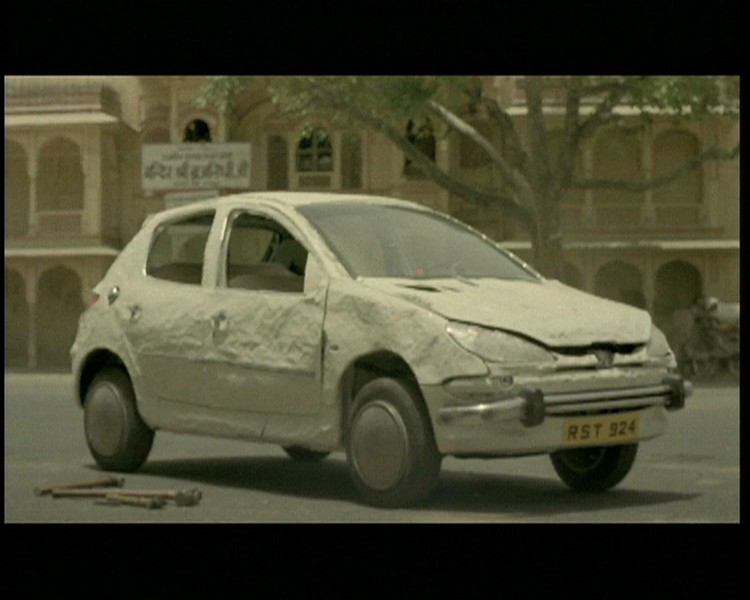
A oltre vent’anni dalla sua prima messa in onda, lo spot “The Sculptor” della Peugeot 206 continua a rappresentare uno dei momenti più riconoscibili nella storia della comunicazione automobilistica internazionale.
Lanciato il 30 giugno 2002, il celebre film pubblicitario – ideato in Italia e sviluppato dall’agenzia EuroRSCG (oggi Havas) – conquistò nel 2003 il Leone d’Oro al Festival di Cannes, imponendosi come uno dei più premiati e memorabili spot del settore, con oltre venti riconoscimenti a livello globale.
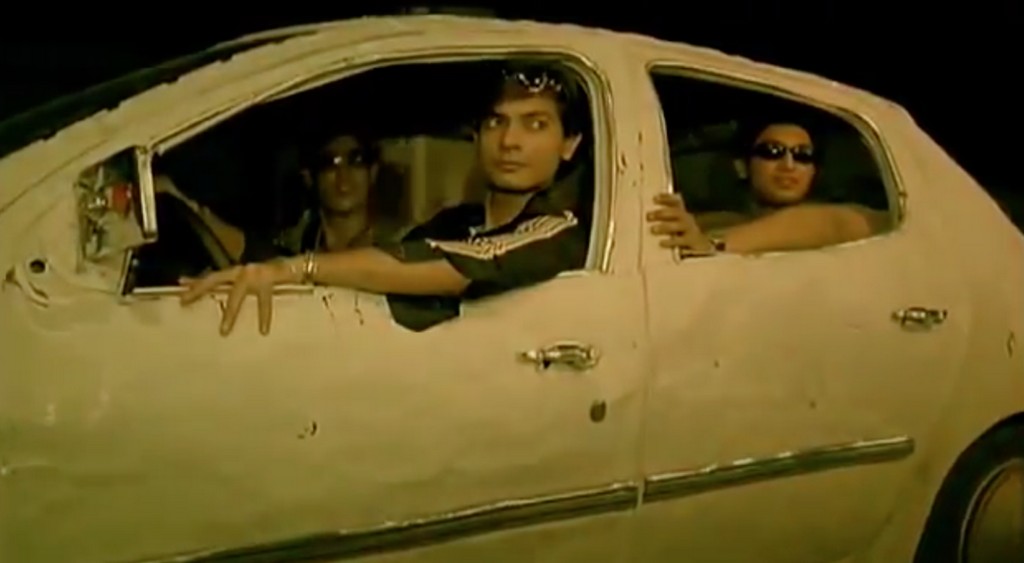
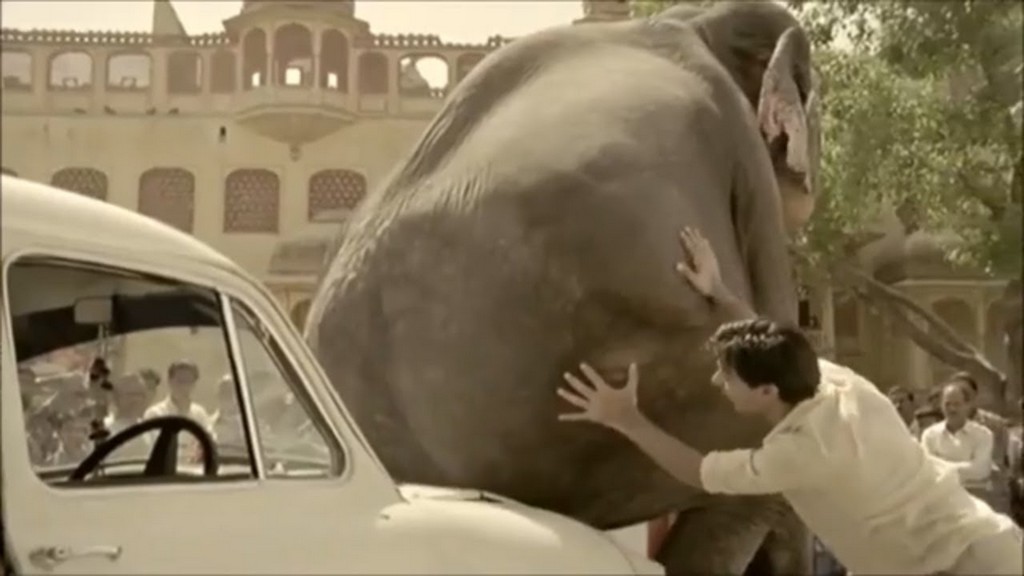
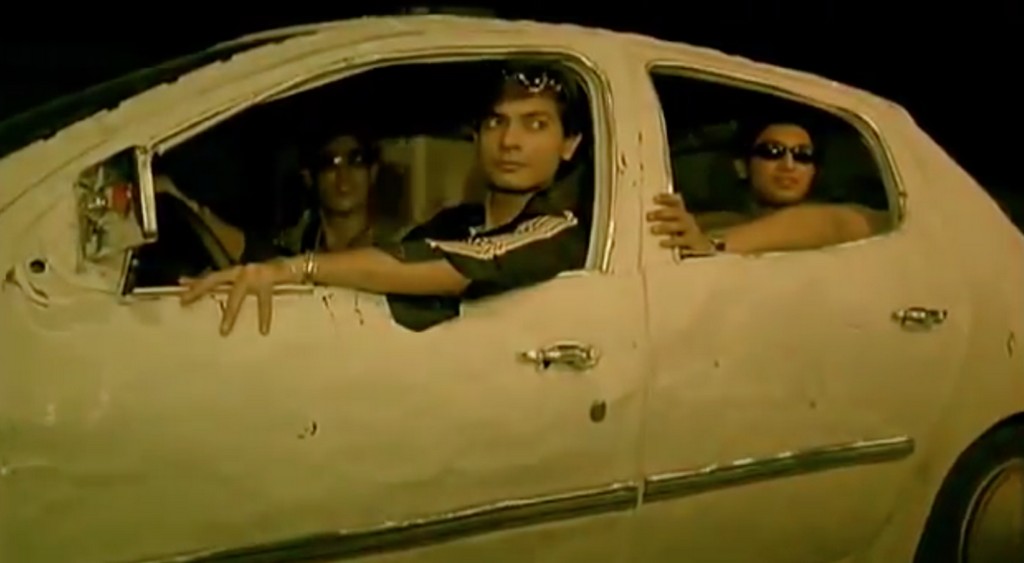
Protagonista della narrazione è un giovane indiano disposto a tutto pur di possedere una Peugeot 206, fino a costruirsela artigianalmente partendo da una vecchia vettura, con l’aiuto simbolico di un elefante. Un’idea tanto semplice quanto dirompente, capace di rompere gli schemi tradizionali della pubblicità automotive: per la prima volta, infatti, l’auto non è quasi mai mostrata direttamente, ma evocata attraverso il desiderio e l’ingegno del protagonista.
Elemento centrale del successo fu proprio questa scelta narrativa innovativa, unita a una costruzione visiva potente e immediatamente riconoscibile: la musica, il ritmo delle lavorazioni, il contrasto tra giorno e notte e l’ironia della storia contribuirono a creare un racconto universale, capace di superare barriere culturali e linguistiche.
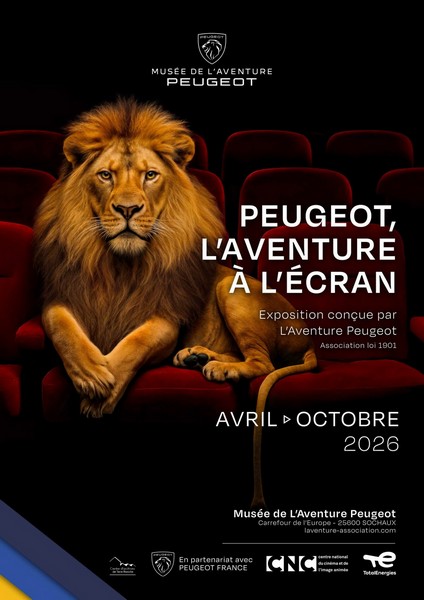
Ma non c’è solo l’India: dalle vivaci strade di Marsiglia a Los Angeles, passando per le vie di Parigi, le auto Peugeot hanno lasciato il segno nella storia del cinema e della televisione. Attraverso modelli iconici, aneddoti dal dietro le quinte e una ricca esperienza scenografica, il museo L’Aventure Peugeot di Sochaux ha recentemente presentato una nuova ed eccezionale mostra che, fino al prossimo 30 ottobre, delizierà sia i curiosi che gli appassionati di automobili e del mondo del cinema.
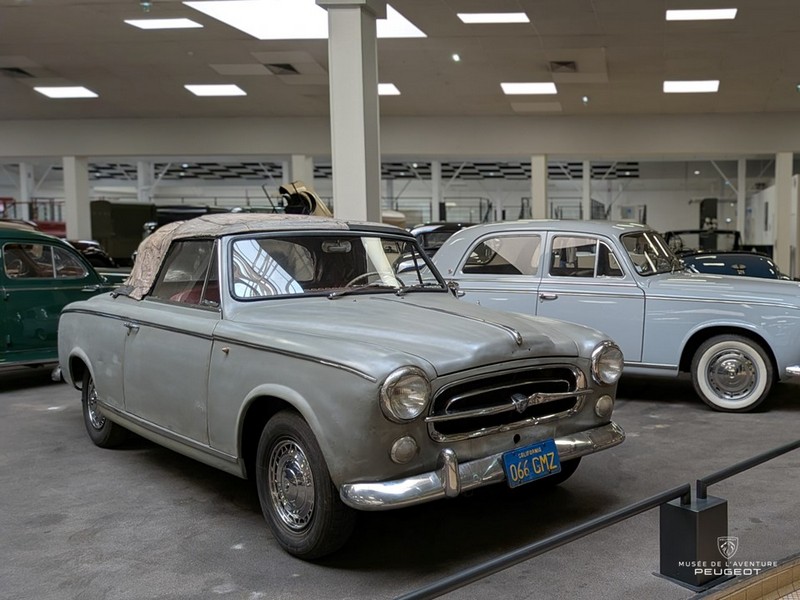
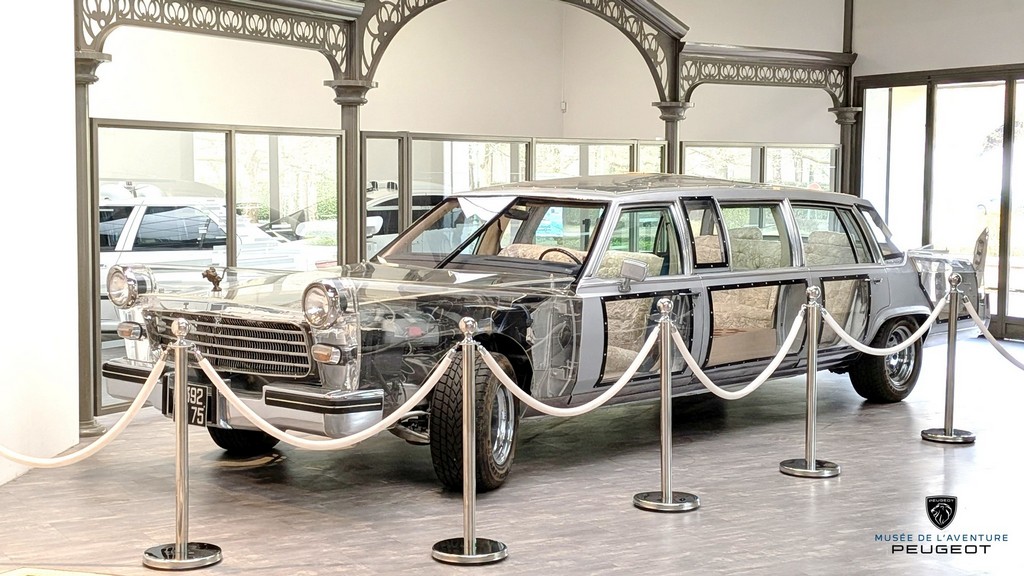
Divisa nelle aree “cinema”, “pubblicità” e “La saga di Taxi”, la mostra ospita alcuni dei modelli più iconici della storia Peugeot legati al piccolo e grande schermo, dalla imponente “Peugeot LimoVian”, la limousine trasparente del film di Michel Gondry “L’écume des jours”, alle 406 e 407 delle diverse release di “Taxxi”, dalla celebre 403 Cabriolet del Tenente Colombo alla maestosa Type 184 Landaulet di “Midnight in Paris”, passando per la 206 del film “Michel Vaillant”, e poi ancora biciclette, scooter e proprio la leggendaria 206 dello spot televisivo “The Sculptor”.
“The Sculptor” s’inseriva all’interno della piattaforma creativa “Enfant Terrible”, pensata per raccontare la Peugeot 206 come un’auto dal carattere forte, desiderabile al punto da spingere chi la sogna a fare qualsiasi cosa pur di averla. Un posizionamento che si rivelò vincente, contribuendo non solo alla notorietà del modello, ma anche a prolungarne il ciclo di vita commerciale in diversi mercati.
Ancora oggi, lo spot è considerato un riferimento nella comunicazione pubblicitaria: un esempio di come creatività, storytelling e coraggio possano trasformare un messaggio commerciale in un fenomeno culturale.
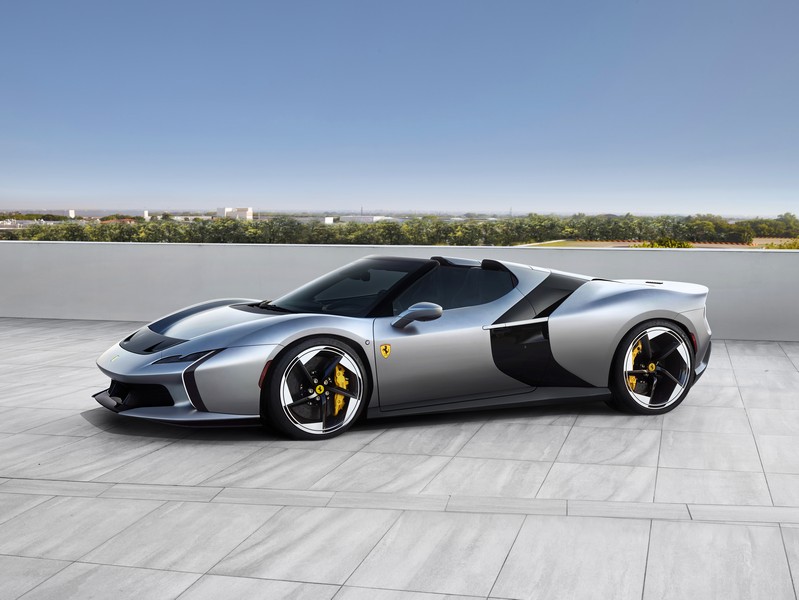
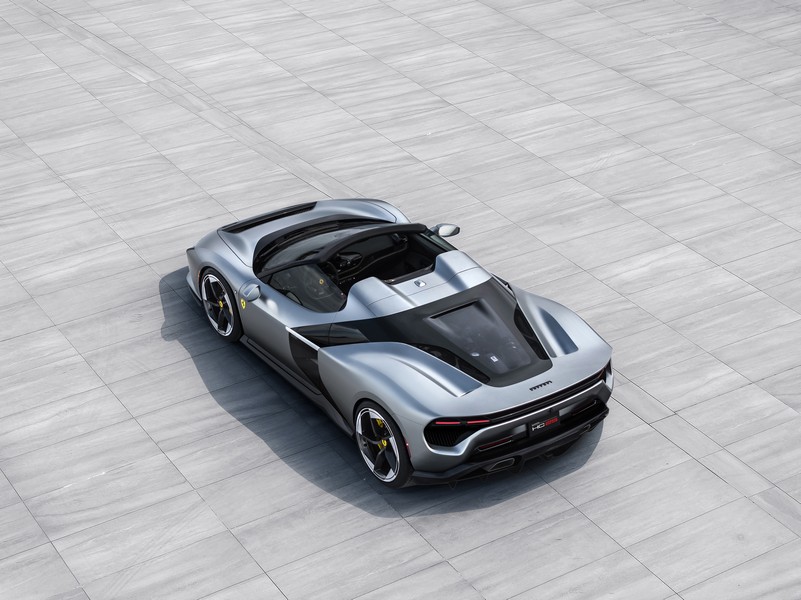
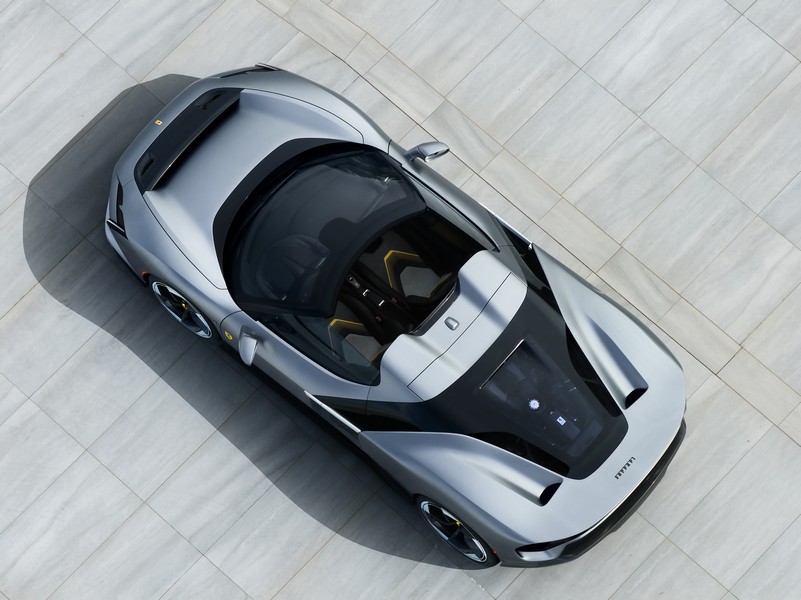
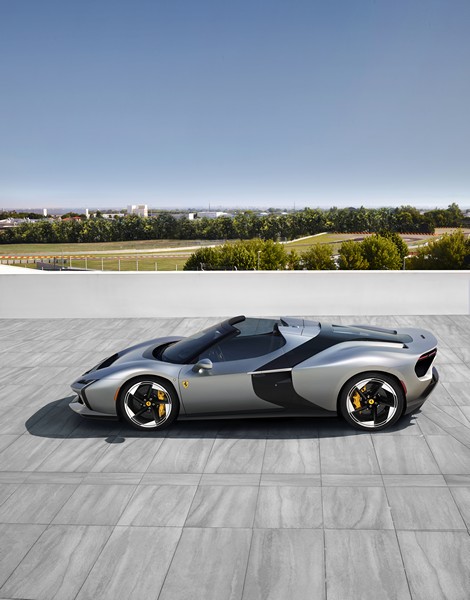
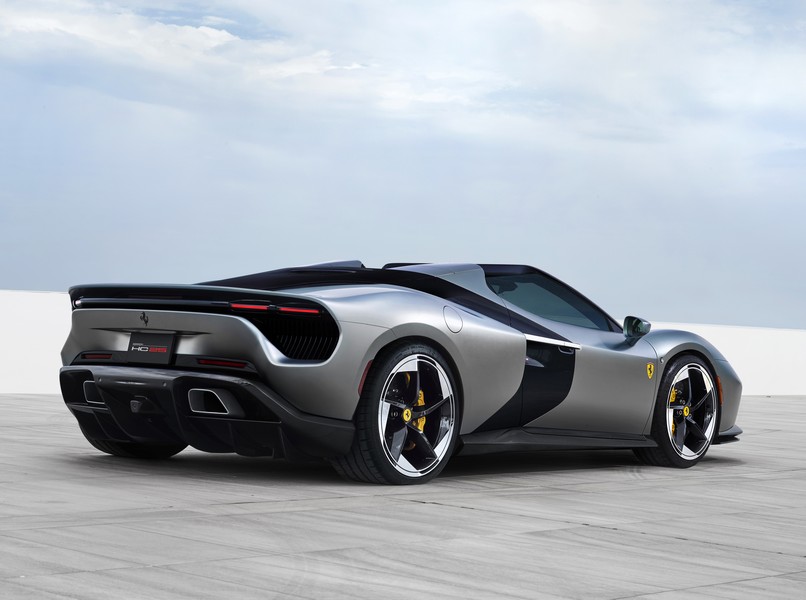
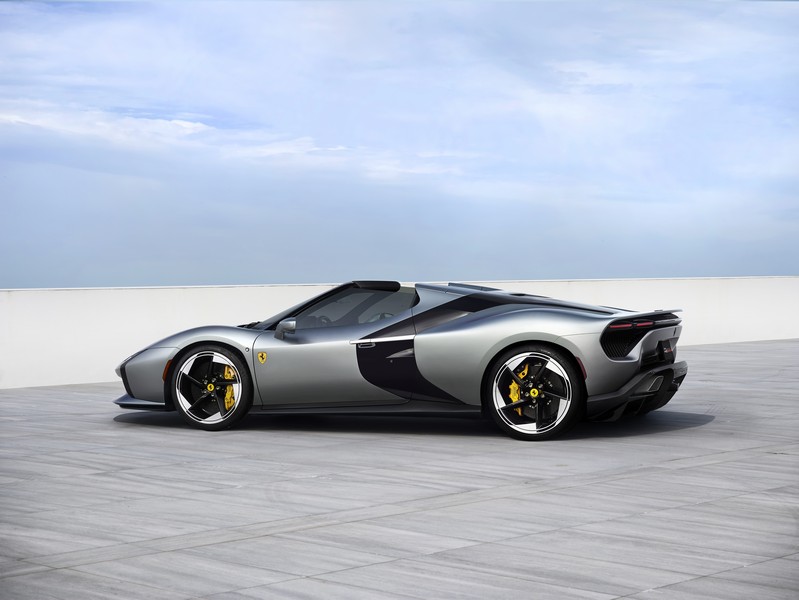
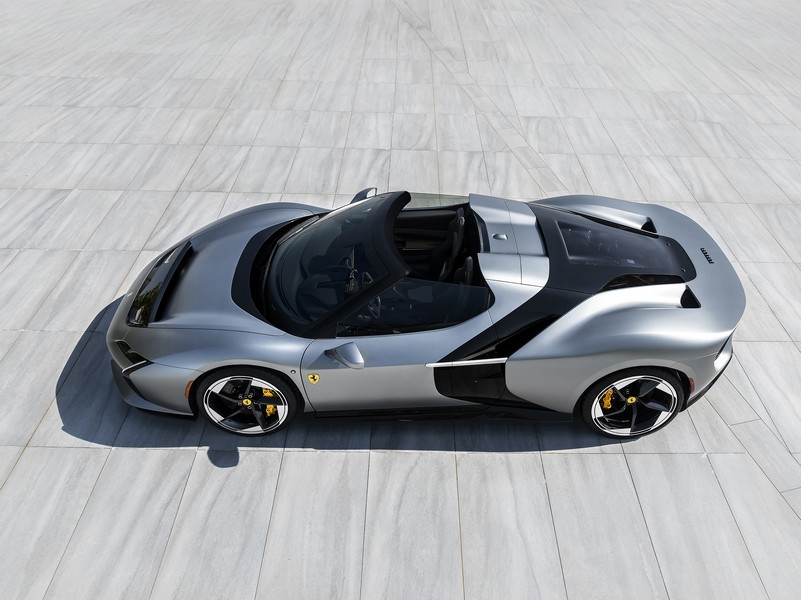
E’ stata presentata una nuova Ferrari della serie One-Off appartenente al programma Progetti Speciali, la HC25 nell’ambito dei Ferrari Racing Days (FRD) che sono tenuti presso il Circuit of the Americas (COTA), in Texas. L’auto, disegnata dal Ferrari Design Studio sotto la direzione di Flavio Manzoni, è una vettura V8 a motore centrale-posteriore a combustione interna che si basa sulla F8 Spider da cui eredita impostazione, telaio e motorizzazione termica. La HC25 entra così a far parte del segmento PIù esclusivo della gamma, il quale racchiude auto tratteggiate prima e realizzate poi a partire dalle richieste di un cliente.
La particolarità principale della HC25 è rappresentata dalla volontà di reinterpretare le forme e i codici estetici delle spider Ferrari a motore centrale-posteriore con uno sguardo dirompente sul futuro. Sviluppata sulla piattaforma della F8 Spider – ultima vettura a cielo aperto del Cavallino Rampante a montare il V8 turbo non ibridizzato in posizione centrale-posteriore – se ne discosta in modo netto. Questa One-Off si può leggere come un trait d’union che da un lato conclude la storia della piattaforma V8 a motore centrale-posteriore e dall’altro si proietta nel corso avveniristico intrapreso da Ferrari con i suoi modelli di punta Ferrari 12Cilindri e F80. Le forme sono pure e semplici, ritmate da fianchi verticali delimitati da creste ben segnate, linee ben incise e andamenti geometrici.
La HC25 è caratterizzata da una forte impronta grafica: il doppio volume genera un gioco di incastri visivo dove l’anteriore e il posteriore agiscono come due corpi distinti, uniti da una fascia centrale di giunzione avvolgente e di natura fortemente tridimensionale. Tale elemento si presenta come un nastro funzionale nero che incorpora nel suo sviluppo le funzioni essenziali della termica, in termini di ingresso aria verso le masse radianti e di evacuazione del calore, del gruppo motopropulsore.
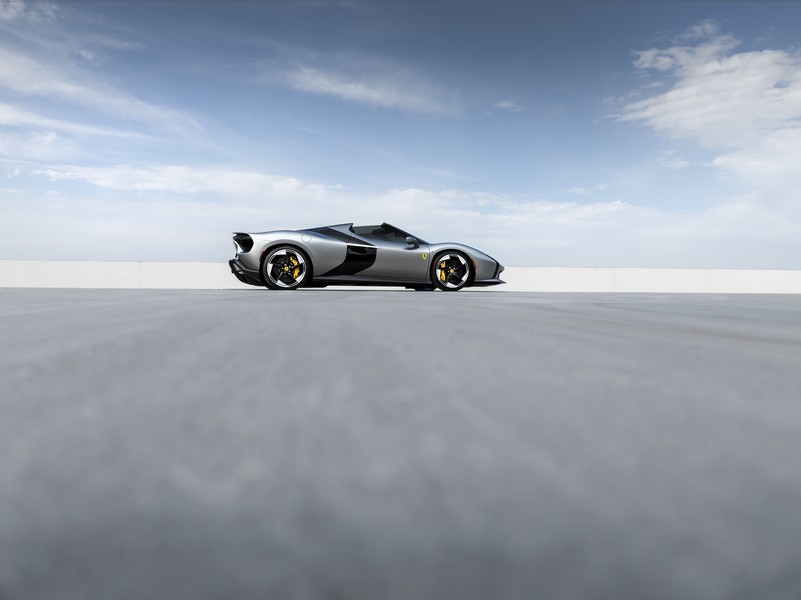
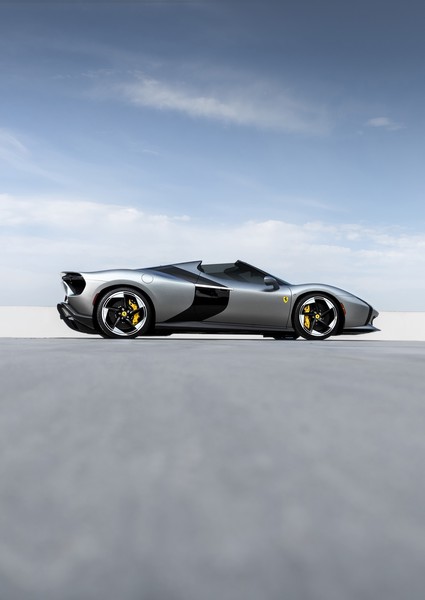
La fiancata prende slancio dal movimento a freccia della fascia, che parte dalla base delle ruote posteriori verso l’anteriore, per curvare in verticale sulla porta fino alla maniglia scolpita e da lì ripartire all’indietro fondendosi nel lunotto posteriore. Questo movimento è studiato per esaltare i muscoli posteriori, quasi a voler dare una spinta verso l’anteriore, spostando dinamicamente in avanti il corpo della cabina. La maniglia della porta non appare come tale a prima vista, inserendosi in una lunga stecca realizzata in alluminio fresato dal pieno che si slancia come un ponte tra le due sponde del corpo carrozzeria diviso dal nastro nero centrale.
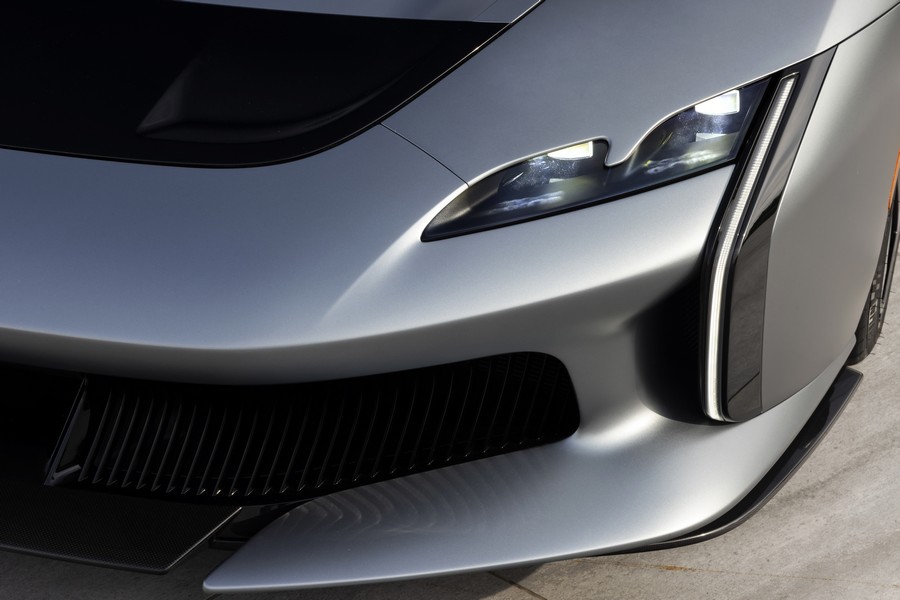
Le proporzioni della HC25 sono curate in modo da limitare l’impatto della vetratura e abbassare otticamente la spalla che circonda la silhouette della vettura. I gruppi ottici si fondono nel disegno senza snaturarlo. All’anteriore, il proiettore è stato creato ad hoc sviluppando moduli mai utilizzati su nessun’altra Ferrari, in modo da avere una lente molto sottile e caratterizzata da un’indentatura centrale che si collega perfettamente al design sdoppiato dei fanali posteriori. I DRL (Daytime Running Light) trovano qui per la prima volta un’impostazione in verticale e sfruttano il bordo anteriore dei parafanghi che conferisce una originale forma a boomerang.
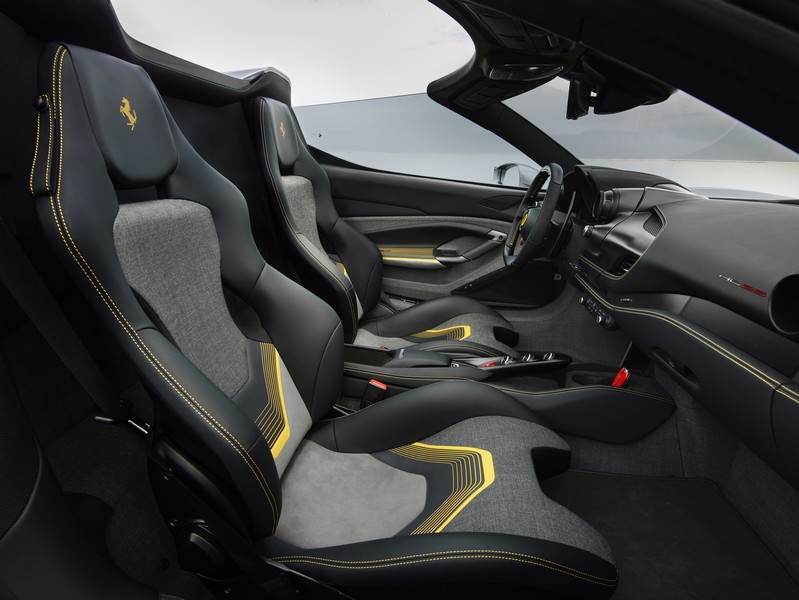
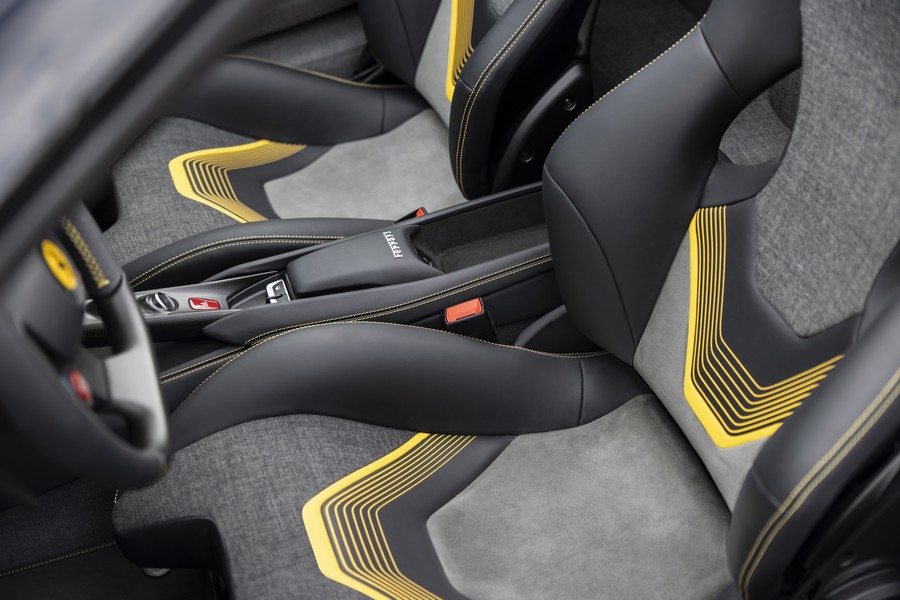
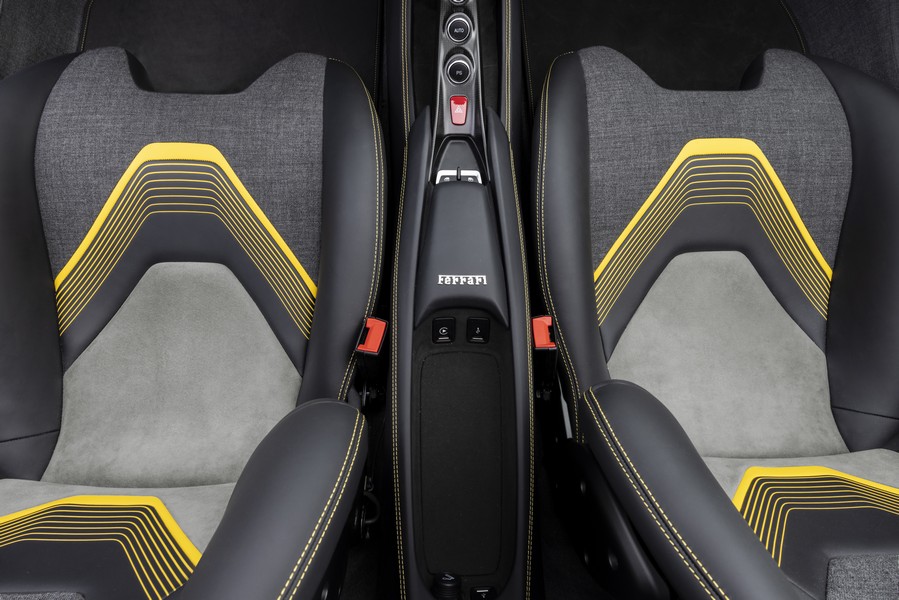
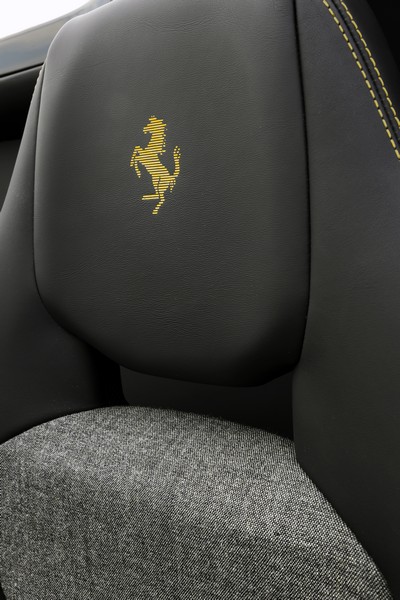
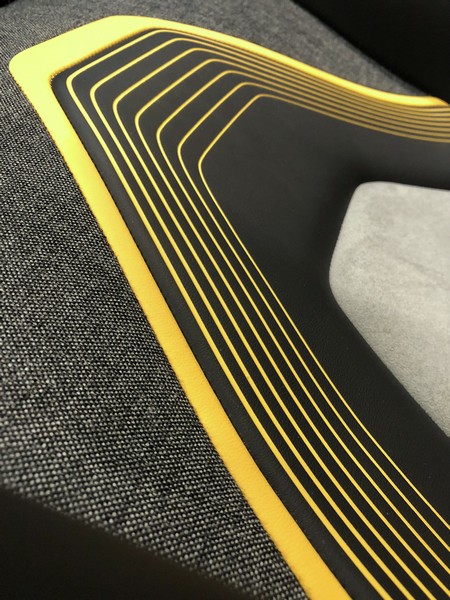
Giocando sull’accostamento tra superfici lucide e opache, si è creata una interazione ideale tra il corpo vettura, trattato in colore Moonlight Grey opaco per dare solidità e pienezza alla carrozzeria, e la fascia nera lucida che lo attraversa, creando un contrasto netto e deciso. Gli accenti gialli dei loghi Ferrari e delle pinze freno trovano eco nelle finizioni dell’abitacolo, dove si nota lo stesso dialogo tra il grigio sofisticato del tessuto tecnico e le grafiche gialle che riprendo le forme a boomerang presenti sia sulla fiancata che nei DRL. I cerchi esprimono uno stile personale e audace; il loro design a cinque razze mette in evidenza la corolla esterna diamantata con una doppia cintura scavata sul canale esterno che ingrandisce otticamente il cerchio stesso. Le razze, dinamiche e sottili, sono scure per enfatizzare il diametro.
PROGETTI SPECIALI
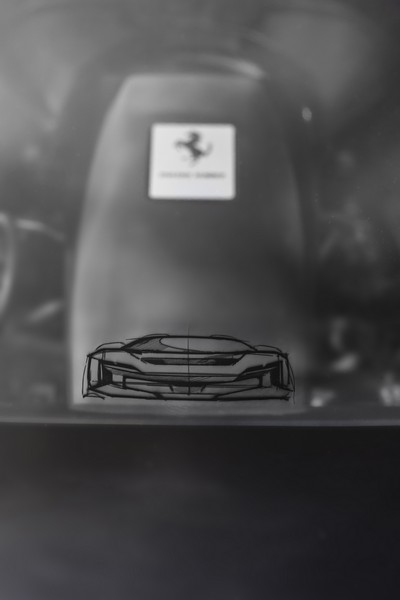
Il programma Progetti Speciali è volto alla creazione di vetture Ferrari chiamate One-Off e caratterizzate da un design esclusivo elaborato sulla base delle richieste del cliente, che diventa così proprietario di un modello prodotto in esemplare unico. Ciascun progetto parte dall’idea del committente, sviluppata insieme a un team del Ferrari Design Studio; dopo aver definito gli aspetti di design si passa alla realizzazione di dettagliati disegni tecnici e di un modello in scala, prima di iniziare la costruzione della vettura. Il processo richiede un paio d’anni circa, durante il quale il cliente viene coinvolto in tutte le fasi di sviluppo e verifica progettuale.
HC25 – SCHEDA TECNICA
MOTOPROPULSORE
Tipo V8 – 90° – Turbo – Carter secco
Cilindrata totale 3902 cm3
Potenza massima* 720 cv a 7000 giri/min.
Coppia massima 770 Nm a 3250 giri/min.
Potenza specifica 185 cv/l
Regime massimo 8000 giri/min.
Rapporto di compressione 9,6:1
DIMENSIONI E PESI
Lunghezza 4758 mm
Larghezza 2006 mm
Altezza 1183 mm
Passo 2650 mm
Carreggiata anteriore 1699 mm
Carreggiata posteriore 1678 mm
Capacità vano baule 200 litri
Capacità serbatoio 78 litri
PNEUMATICI E CERCHI
Anteriore 245/35 ZR 20 J9.0
Posteriore 305/35 ZR 20 J11.0
FRENI
Anteriore 398 x 223 x 38 mm
Posteriore 360 x 233 x 32 mm
TRASMISSIONE E CAMBIO
Cambio F1 a doppia frizione e 7 rapporti
CONTROLLI ELETTRONICI
eDiff3, F1-Trac, ABS/EBD prestazionale con Ferrari Pre-fill, FrS SCM-E, FDE+, SSC 6.1
Mi piacevano, i modelli Marsh. Il mio primo acquisto, nel 1987 (a 16 anni) fu il factory built della Chaparral 2F della Targa Florio 1967. A quell’epoca nutrivo una passione smodata per la Targa, prima che la combriccola dei tromboni locali me la rendesse quasi insopportabile – e ce ne voleva, credetemi. La corsa all’epoca era ancora avvolta dal mistero che cala come una spessa polvere su avvenimenti troppo vecchi per essere ricordati facilmente ma troppo recenti per una sistemazione veramente scientifica. La rievocazione storica del 1986 – organizzata in un periodo in cui le competizioni per autostoriche iniziavano a vivere un boom di proporzioni mai viste – aveva contribuito non poco alla riscoperta dell’evento. Autosprint pubblicò un’anteprima ricca di foto d’epoca che alimentò in modo quasi morboso il mio interesse. Di immagini ne circolavano poche, libri sulla Targa praticamente non ce n’erano e quella formula stranissima e affascinante – le sport-prototipo sulle strade di tutti i giorni che si perdevano lungo decine di chilometri di percorso – era qualcosa di paradossale e fantastico che esulava dallo svolgersi prevedibile di altre gare, di cui l’appassionato medio sapeva peraltro molto di più.
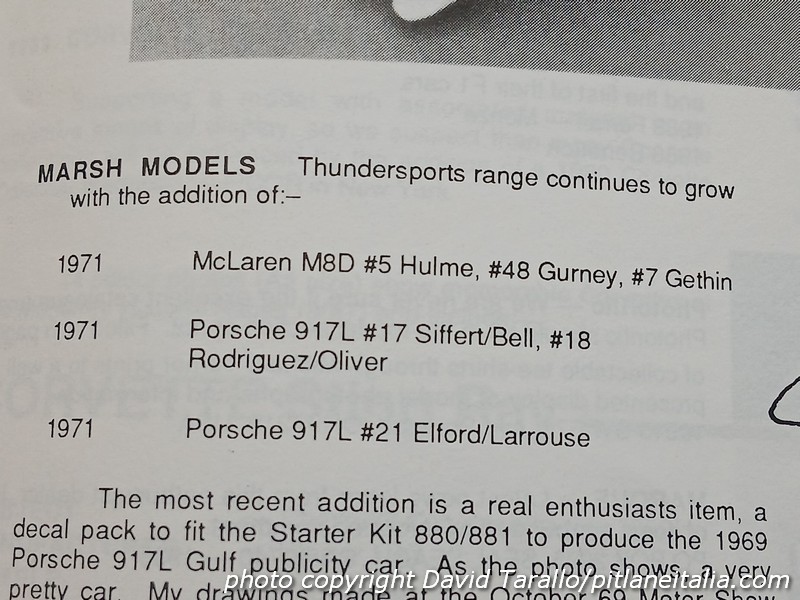
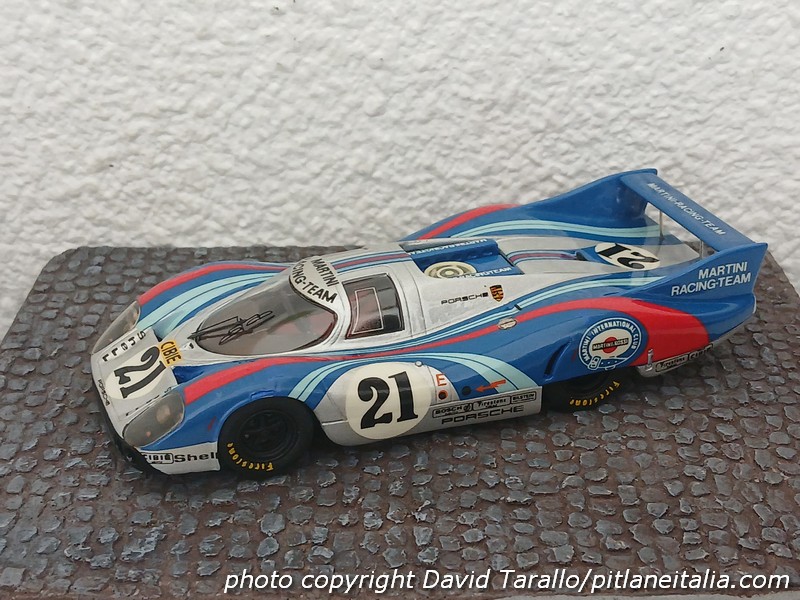
Nel numero di gennaio 1989, Pit Road dà la notizia dell’uscita, insieme alla McLaren M8D, delle tre versioni della Porsche 917LH Le Mans 1971 di Marsh Models
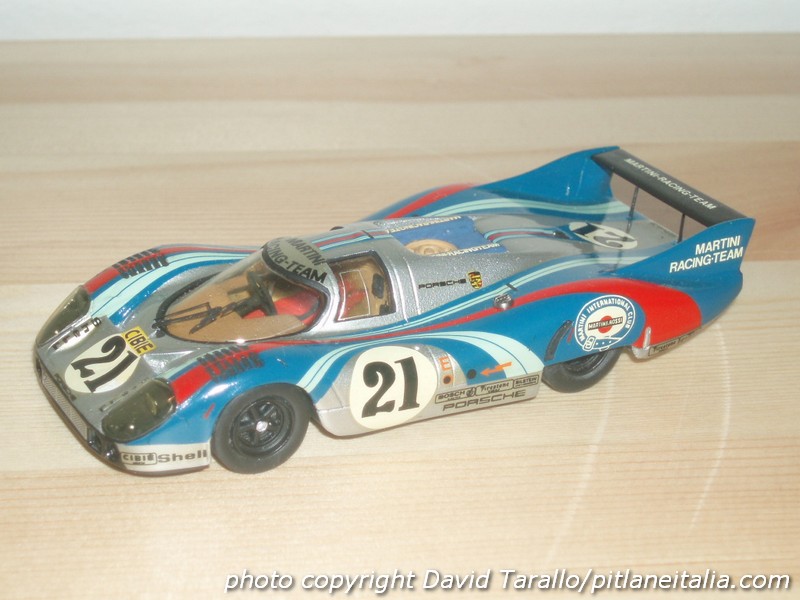
Torniamo ai Marsh. I primi factory built in Italia li aveva Tron e costavano 100.000 lire. Nel 1987 non era certo una cifra spropositata, vista anche la qualità dei montaggi, puliti, dettagliati, tipicamente britannici. I Marsh ebbero un buon successo e John Simons tirò fuori alcuni tra i soggetti più importanti della storia dell’endurance anni ’60-’70, dalle Chaparral alle Ford, dalle Porsche alle Ferrari. Alla fine del 1988 presentò la Porsche 917LH di Le Mans 1971, nelle versioni Martini e Gulf, un modello commercializzato come d’abitudine sia in kit sia già montato.
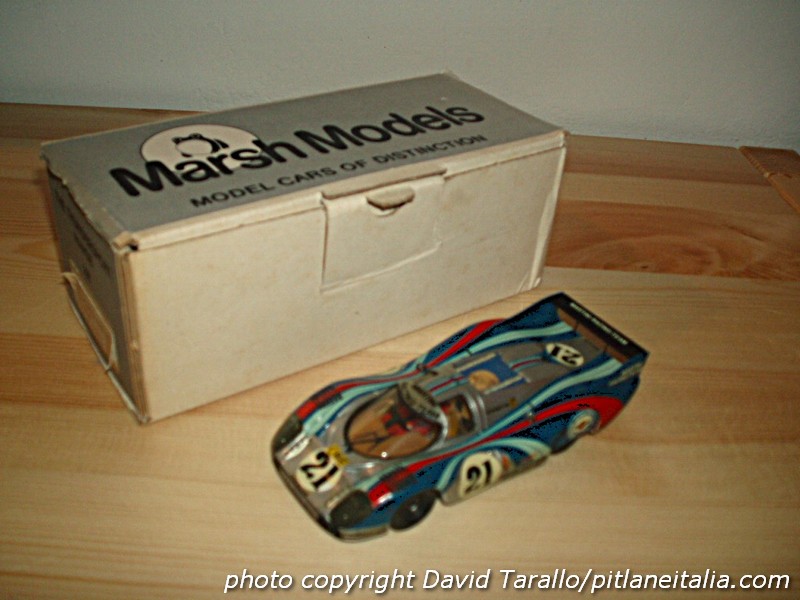
Da liceale squattrinato, il Natale costituiva puntualmente l’occasione per arricchire una collezione alimentata soprattutto dagli invii di Paolo Tron, che dalla Liguria aveva aperto il negozio milanese di Via Boeri. Nel dicembre del 1988 ordinai quindi un paio di modelli: la logica era quella che normalmente seguivo in queste occasioni, un “pezzo forte” (in genere uno speciale montato) e un altro… di appoggio, quasi sempre un diecast. Insieme a una BMW 325i E30 Touring rossa di Gama – che arrivò senza volante! – ordinai la Porsche 917LH Martini Le Mans 1971 della Marsh (MM11), che doveva essere uno dei primissimi esemplari, se non addirittura un pre-serie.
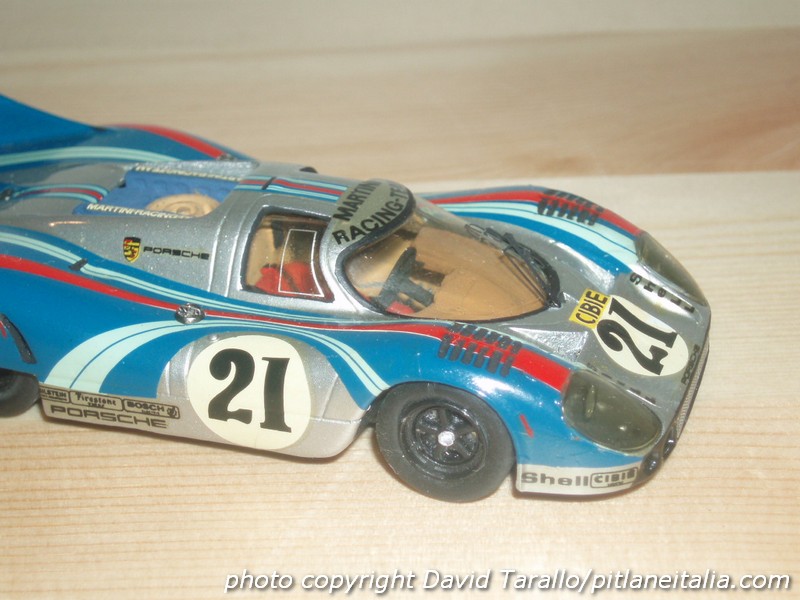
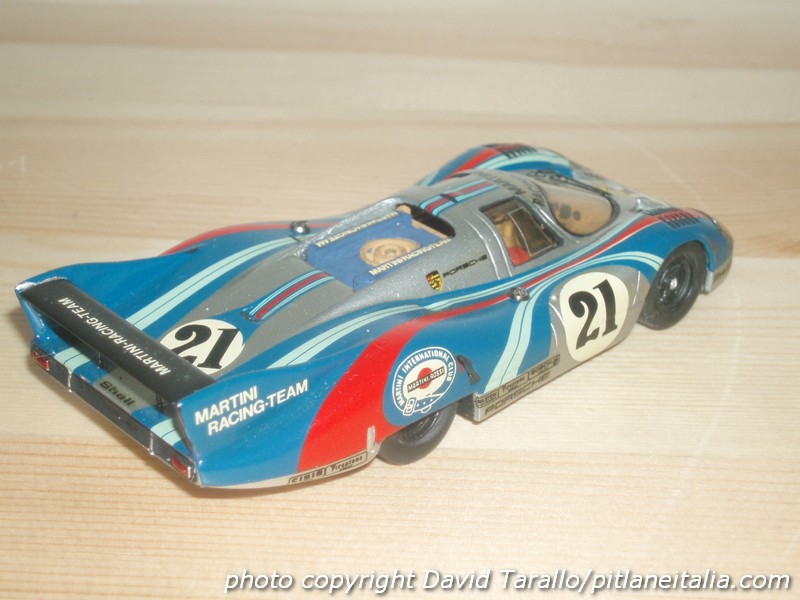
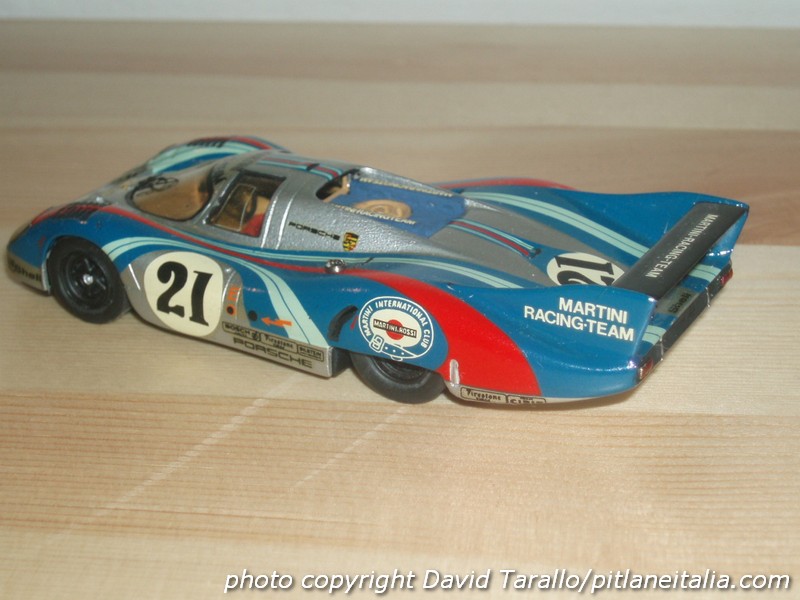
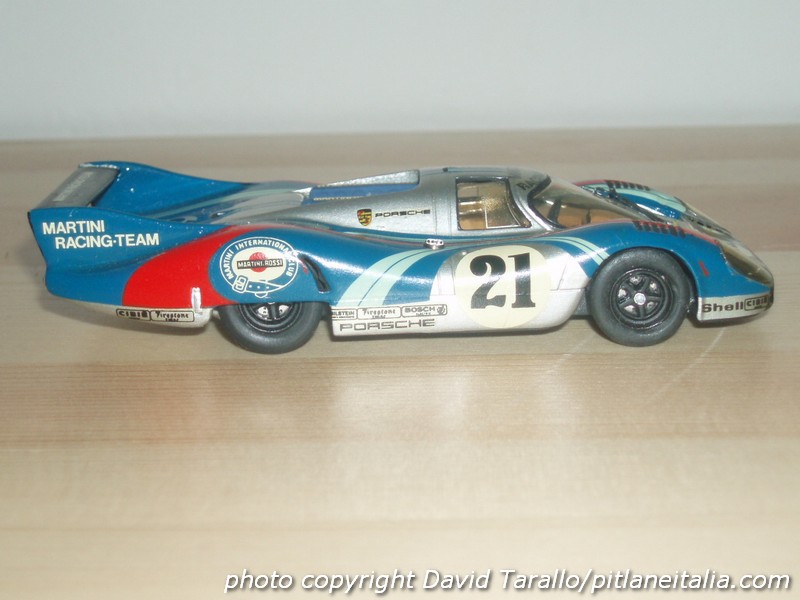
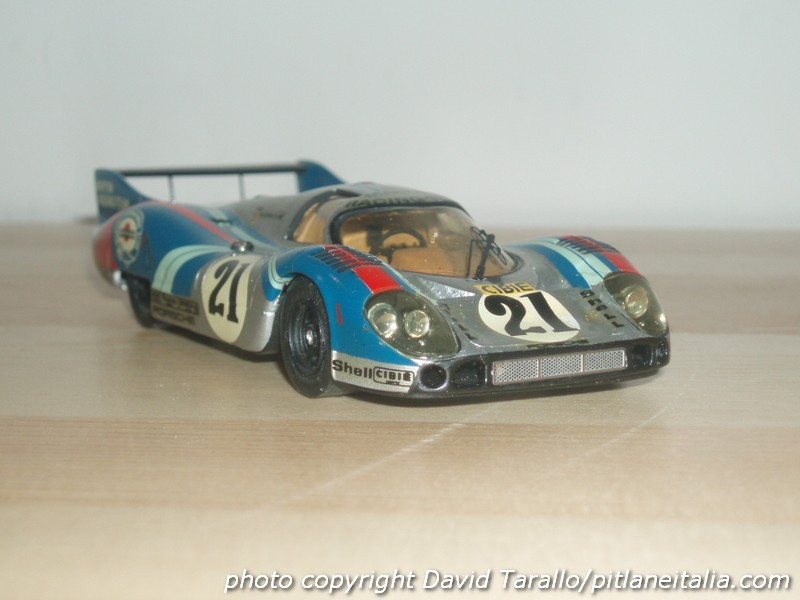
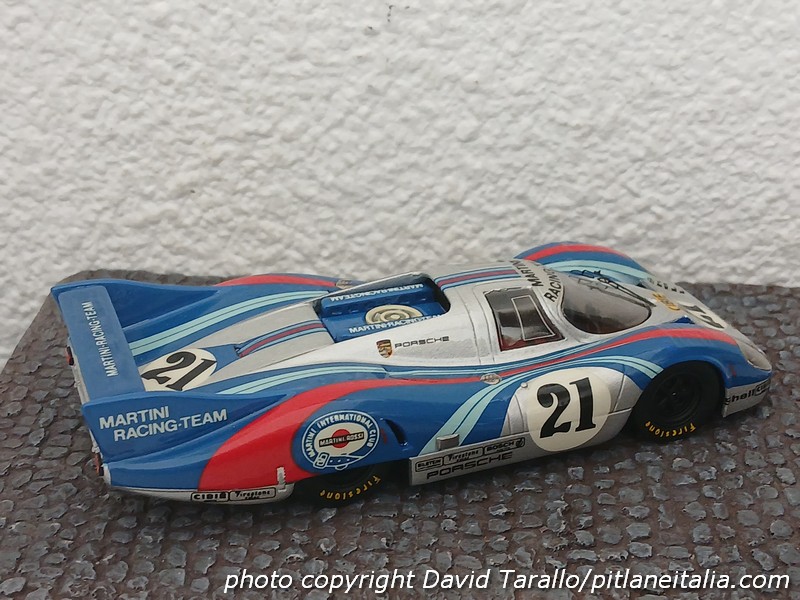
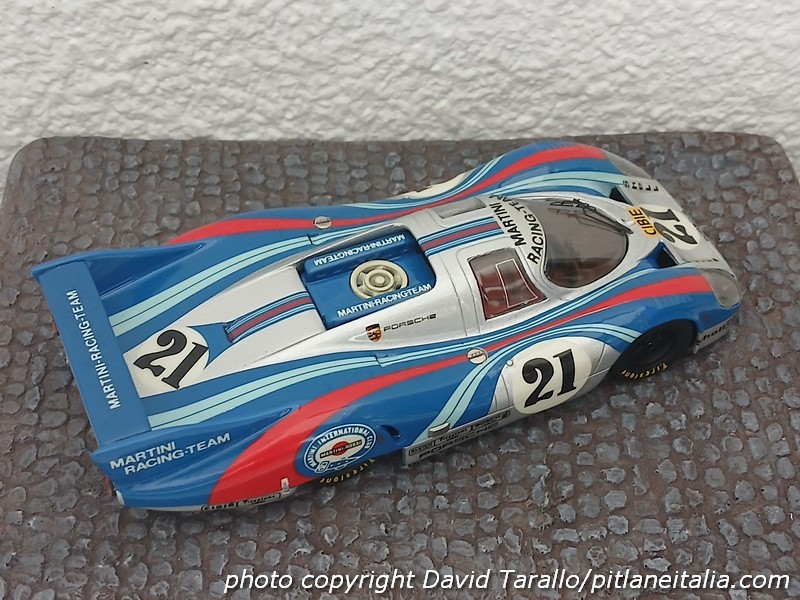
Questo esemplare factory built – di cui non ho mai fotografato il fondino col numero progressivo, ammesso che ce ne fosse uno – restò in collezione dal 1988 al 2007. Notare la griglia anteriore non dipinta, l’ala posteriore nera (giusta) e l’assenza delle decals Firestone sulle gomme. Il cruscotto si presenta nel marroncino che vorrebbe riprodurre la tonalità della vettura esposta al Museo Porsche. La scritta Martini Racing Team sull’ala posteriore dovrebbe essere ruotata di 180 gradi; il posizionamento è però giusto, vicino al bordo posteriore. La scatola era già quella più grande, che aveva sostituito le primissime, completamente bianche e più piatte
La 917 di Marsh non mi deluse e in un’epoca in cui i confronti con altri modelli simili o con documentazione d’epoca erano complicati (anzi, spesso impossibili) non notai la stranezza di un cruscotto dipinto in marroncino chiaro, con un bizzarro effetto scamosciato. La cosa mi saltò all’occhio solo molti anni più tardi, nel 2007, quando fotografai il modello per metterlo in vendita.
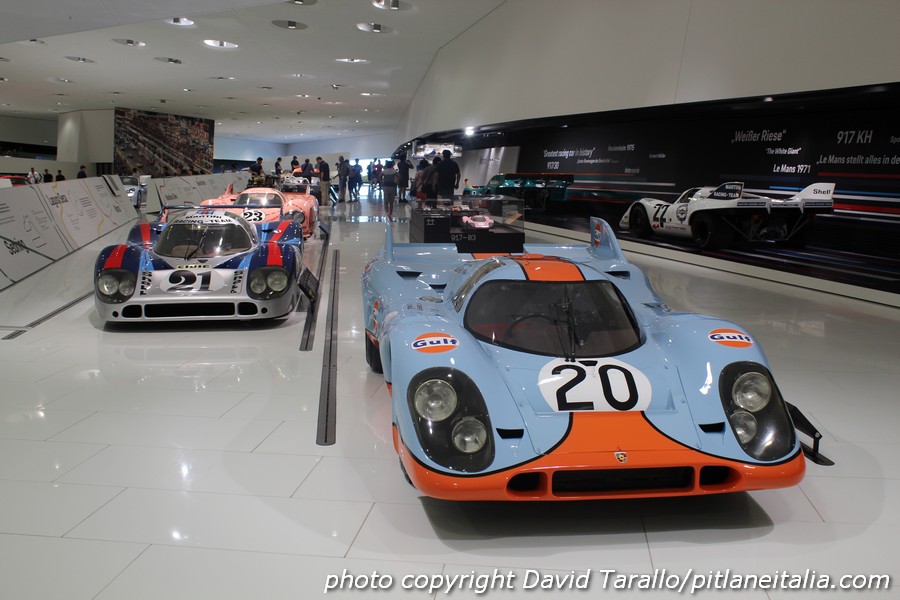
Museo Porsche, giugno 2019: alcune degli esemplari più rappresentativi in occasione del cinquantesimo anniversario della 917. Il cruscotto della n.21, che nella foto sembra tendere al grigiastro per un effetto di luci, è color camoscio
Oggi l’arcano si spiega facilmente: Simons dovette ispirarsi direttamente alla vettura esposta al Museo Porsche di Stoccarda, dove da decenni essa appare con cruscotto di quel colore particolare. La fascinazione di aver “scoperto” qualcosa di inedito o quasi dovette far breccia nell’istinto ricercatore di Simons, che decise quindi che il cruscotto della 917L avrebbe dovuto essere beige e non nero. In realtà in gara, nel 1971, il cruscotto era nero come quello di ogni altra 917 e il motivo del successivo cambio di colore resta almeno per me un mistero. Di factory built della 917LH Martini ne furono montati oltre duecento. Se le serie iniziali erano prive di basetta, verso il 1990 arrivarono i supporti in plexiglas, di gusto più o meno sobrio, che non tutti apprezzarono (e poi, dai, il modello inglese duro e puro aveva da arrivare – dopo settimane – rigorosamente rotto, infilato a forza in una scatolina sempre troppo piccola e soffocato da una massa di inutile gommapiuma, sennò che gusto c’era?).
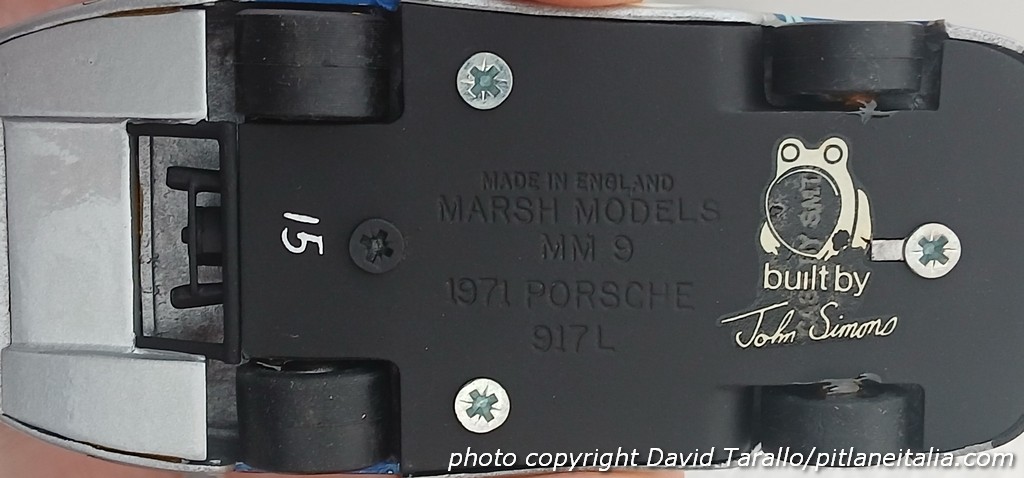
L’esemplare attualmente in collezione è comunque uno dei primi (numero 15 dipinto in bianco sul fondino). La scritta Martini Racing Team sull’ala posteriore, oltre ad essere rivolta nel senso sbagliato, è troppo centrale
L’esemplare che ha rimpiazzato quel modello acquistato nel dicembre 1988 è leggermente diverso, prova che – come spesso accade – la produzione di quei factory built è stata caratterizzata da aggiustamenti e ripensamenti. Dallo scamosciato ignorante, per il cruscotto si passò – chissà poi perché? – a una specie di marrone scuro tendente al rossiccio. Altre differenze riguardarono il trattamento della griglia anteriore (da alluminio a nera), la verniciatura in blu dell’ala posteriore – che nella realtà era nera – e l’aggiunta delle scritte Firestone sulle gomme. A proposito dell’ala posteriore, il ripensamento ha portò ad uno sbaglio: dapprima, correttamente Simons la riprodusse in nero poi, probabilmente fuorviato dalla vettura del Museo Porsche, decise di farla blu, posizionando oltretutto la scritta Martini Racing Team in modo erroneo: essa dovrebbe infatti essere ruotata di 180° e più vicina al bordo posteriore.
Per la 917L di Marsh vale il discorso fatto a proposito di altri speciali d’epoca: essi rivestono un interesse documentario e vanno goduti e apprezzati proprio per la loro collocazione storica. Inutile quindi cercare di aggiornarli o correggerne gli errori, ne verrebbero fuori degli ibridi senza né capo né coda. E a latere, si può dire che questi modelli sono oggi forse molto più godibili rispetto a quelli della produzione attuale, dato che l’eventuale imprecisione è parte integrante del modello e passa quindi in secondo piano. Tutt’altra cosa è andare a parare su un kit commissionato da uno dei guru in circolazione, aspettare mesi, pagarlo svariate centinaia di euro per poi scoprirlo carico di imprecisioni e incoerenze, non solo storiche ma anche di assemblaggio.
1991 became a very important year for the Conquest range. First, four models were released that year: the 1957 Buick Roadmaster 75 4-door Hardtop, the 1954 Pontiac Star Chief Convertible, the 1963 Ford Country Squire, and the 1960 Chevrolet Impala Convertible Top Up.
Secondly, accompanied by the enthusiastic collector of Citroën DS models, Marten Boersma, and his girlfriend Eveline, Henk visited the ModeleX show. There they met many people who were well known at the time, as well as several trade customers of Fa. Daimler House. Among the other visitors and participants, Henk met Doug McHard, founder and proprietor of Somerville. Doug used to include leaflets in the boxes of his fine models. These leaflets were a valuable addition because they allowed customers to learn about the current production programme and future releases, encouraging them to buy new models. Marten Boersma persuaded Henk to add a leaflet to his own models as well. Because the Conquest and Madison ranges were growing rather quickly, the leaflet was soon replaced by a catalogue. These small catalogues were updated almost every year. The last one was the 7th edition from 1999, containing 52 pages and measuring 14 × 7 centimetres. As a result, many models were produced repeatedly depending on demand.
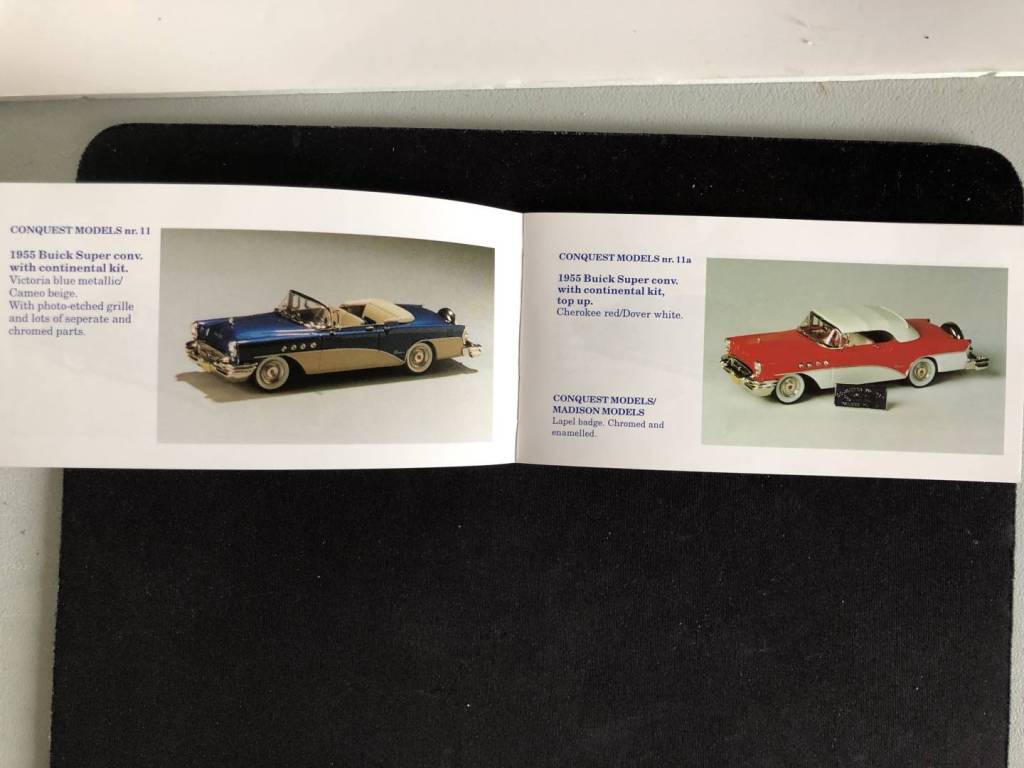
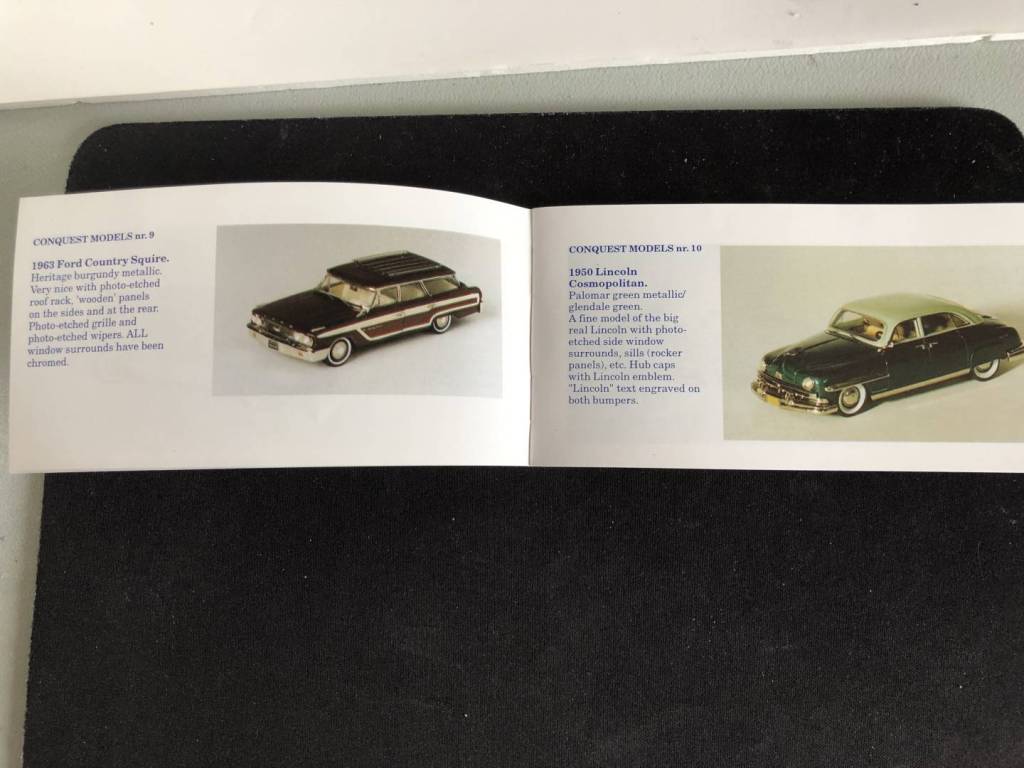
Conquest Models – Madison Models catalogue: the cover and four pages of the 4th edition (photos by Ken Spear)
Model Auto Review magazine regularly published advertisements for Daimler House, and Henk informed readers about his current and future plans. He also donated several models for prize competitions. By the way, another British magazine, Model Collector, did not write very often about Conquest Madison Models, despite having special white metal review columns.
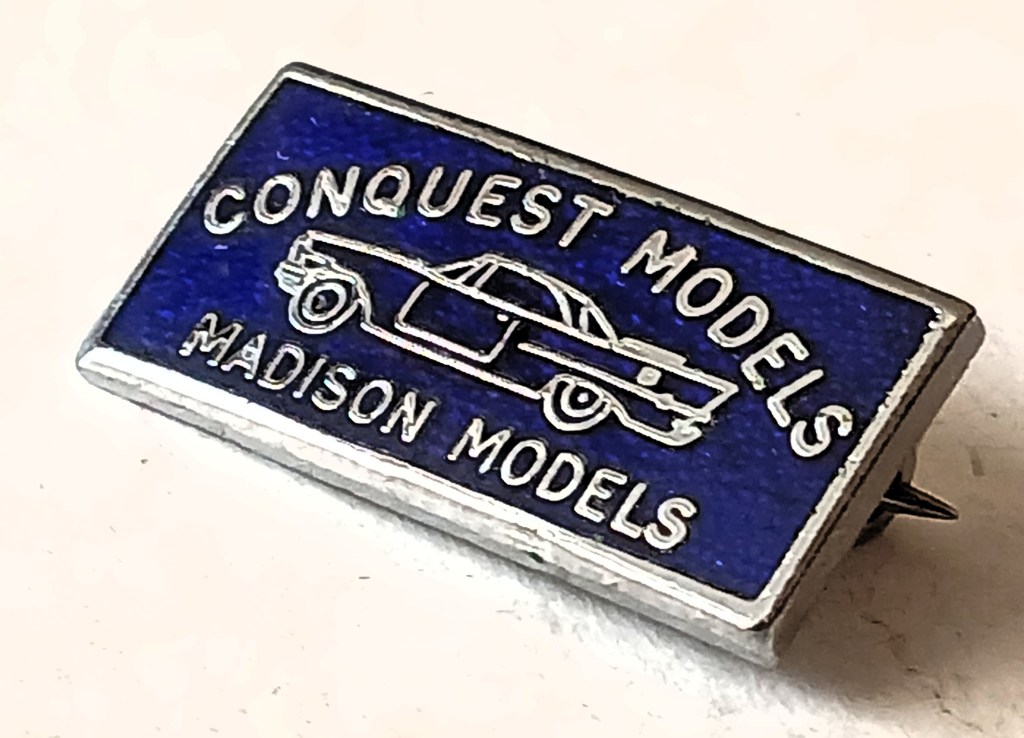
Comquest Models – Madison Models badge (photo by Henk van Asten)
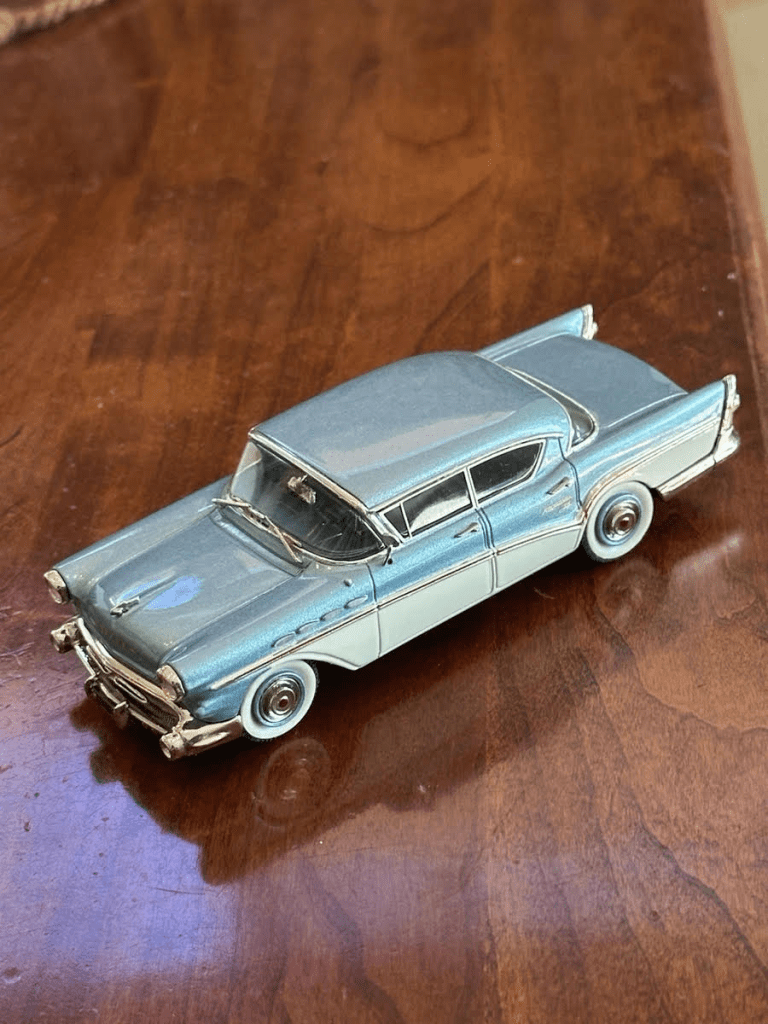
As for the models of 1991, the additions to the range began with Nr.7, the 1957 Buick Roadmaster 4-door Hardtop. This was the most powerful and luxurious version of the 1957 Buick, which by then had been fitted with an almost completely new body. The body became longer than that of the previous generation and received such features as panoramic front and rear screens and elongated fins. The curved Sweepspear side moulding was enhanced with a red line and three ribs on the rear wings. The front bumper featured massive air turbines, which looked very spectacular.
Nr.7 (eBay)
Series 75 was introduced in the middle of 1957. Its main differences from the basic Series 70 were a more luxurious interior, electric operation of the side windows and seats as standard equipment, and a one-piece rear screen instead of one divided into three sections.
Other features remained the same as on the Series 70 models: a 6-litre V8 300 h.p. engine, a 2-speed Twin-Turbine Dynaflow automatic gearbox, and ball-joint front suspension. Customers bought 14,654 Series 75 cars in 1957, which were available in three body styles: Convertible, Hardtop Coupé, and Hardtop Sedan. The latter was modelled by Conquest Models.
This absolutely magnificent model featured a 3-piece instrument panel, a 3-piece front bench seat, 3-piece inner door trim, and, of course, a red line between the side chrome strips. Initially, it was available in two colours: Dover White and Garnet Red Metallic, but a year later Carlsbad Black and the two-tone Biscay Blue Metallic/Dover White were added.
Nr.8 (photo by J. Ceejay Nakamoto
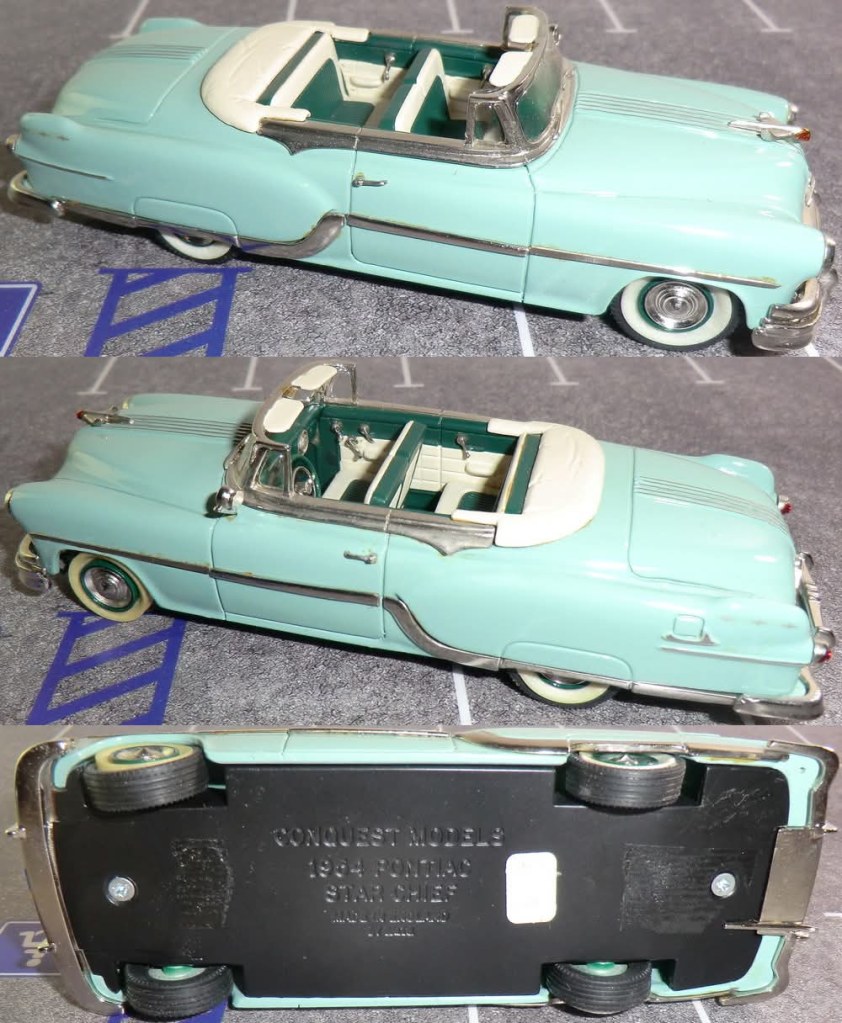
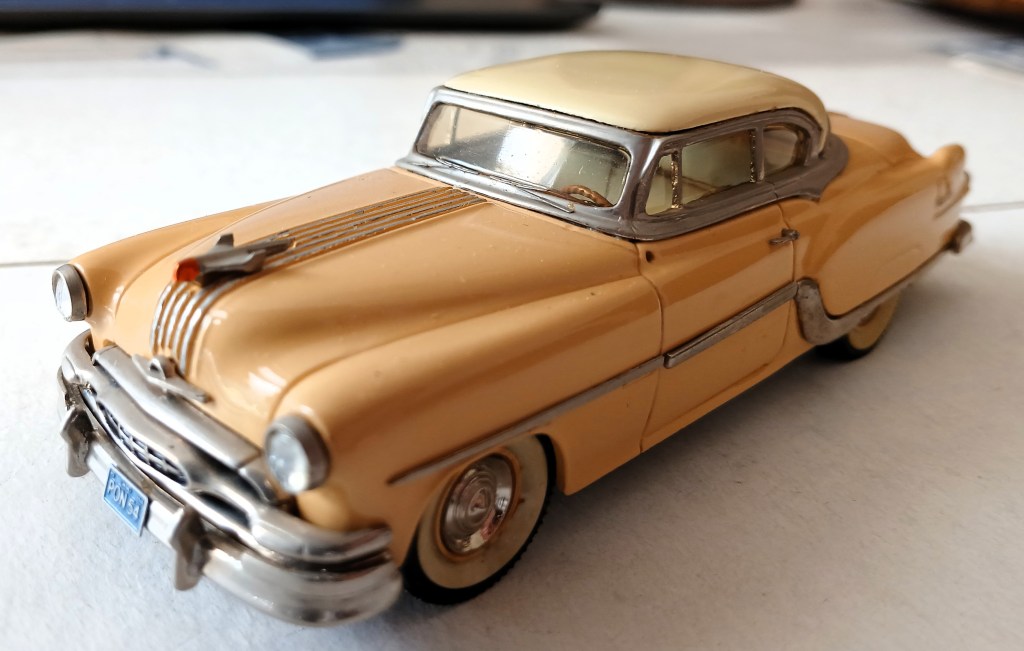
Nr.8, the 1954 Pontiac Star Chief Convertible, represented the most prestigious model of the Pontiac division, based on the Chieftain model. Strictly speaking, this was a long-wheelbase version of the Chieftain built on the same platform. Customers could distinguish the Star Chief from the Chieftain only by its longer wheelbase and the three stars on the fins, but inside it was much better equipped. The car offered such options as electric operation of the windows and seats, power steering, power brakes, and air conditioning, which was offered on Pontiacs for the first time. Two trim variants were available: DeLuxe and Custom.
There was only one engine available for these models: a 4.5-litre inline eight-cylinder producing 122 h.p., along with two types of gearboxes: a 3-speed manual and a 4-speed Hydramatic. With the latter, engine power increased to 127 h.p. In fact, this engine was already obsolete, but GM had decided to introduce the V8 first for Buick and later for Pontiac.
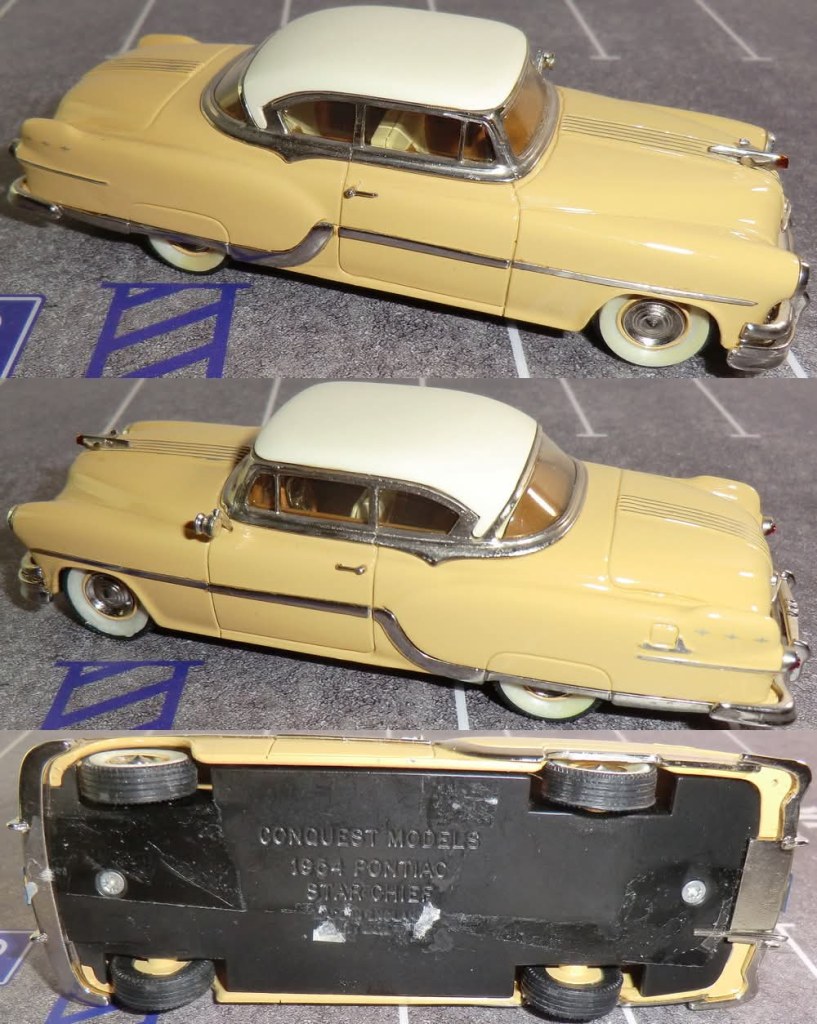
Henk decided to produce the Star Chief Convertible first, and the models were painted in Shannon Green and Arlington Maroon. Three years later he would add Nr.17, the Star Chief Custom Catalina 2-door Hardtop, to the Conquest range. For this model, Maize Yellow/Winter White and Coral Red/Winter White were chosen.
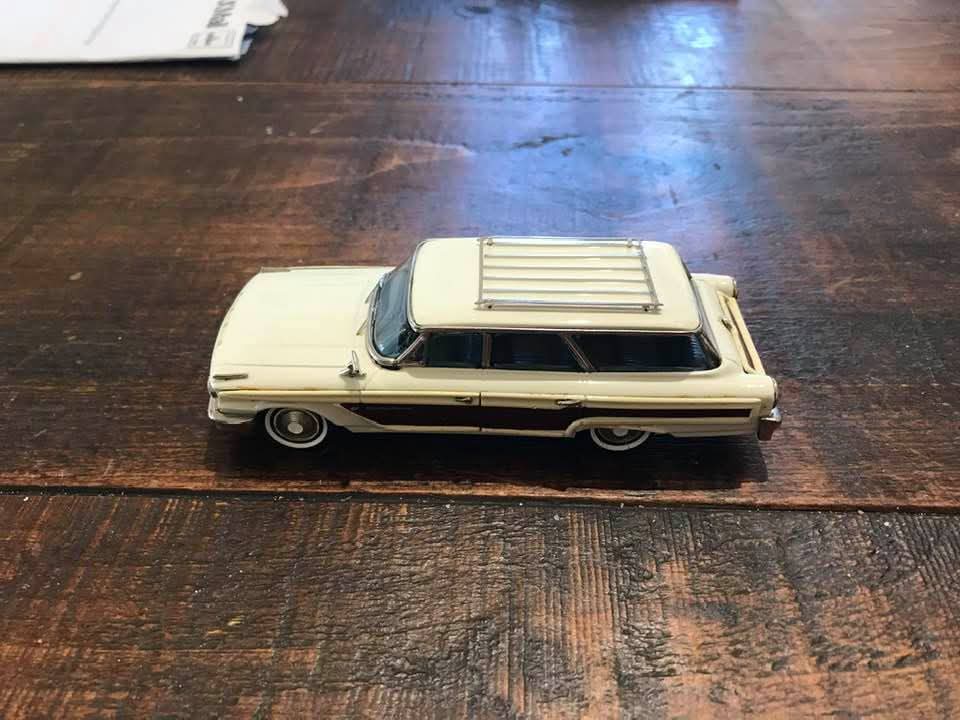
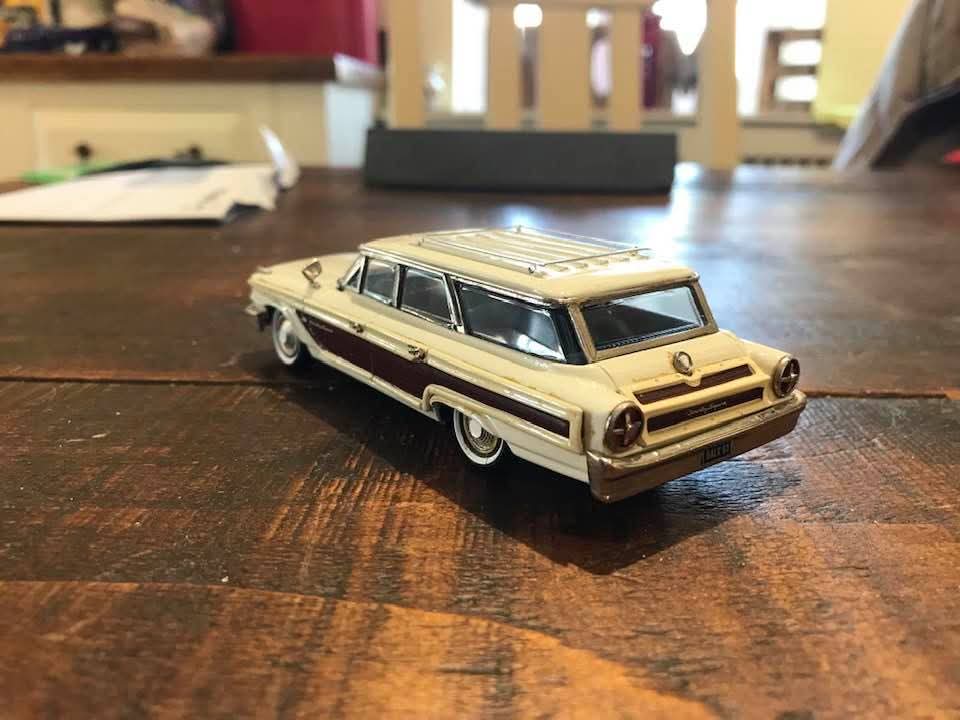
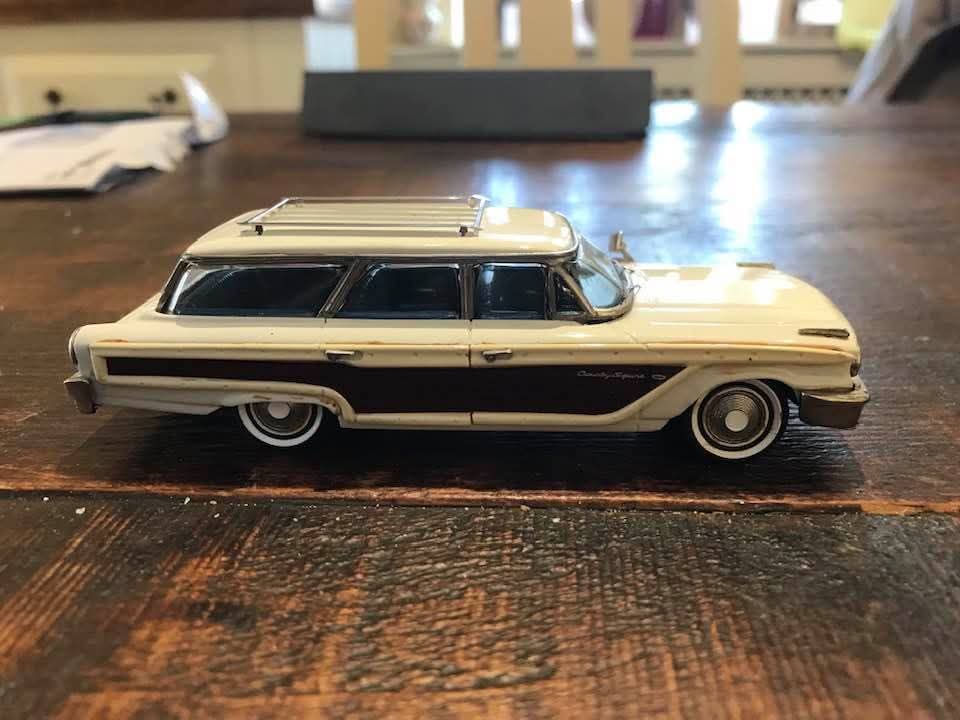
In the previous part, Nr.9, the 1963 Ford Country Squire woody Station Wagon, was briefly mentioned. This model continued the line of the 1963 Galaxie previously modelled by Conquest Models. In fact, by the 1960s the golden age of the woodies had already ended, but in any case cars equipped with imitation wood panelling still looked very attractive. The choice of the estate version was very wise because most manufacturers had never paid attention to this body style. This model also featured a photo-etched roof rack, making it highly realistic. It was painted in Corinthian White or Heritage Burgundy.
Nr.9 (photos by Matty Stone)
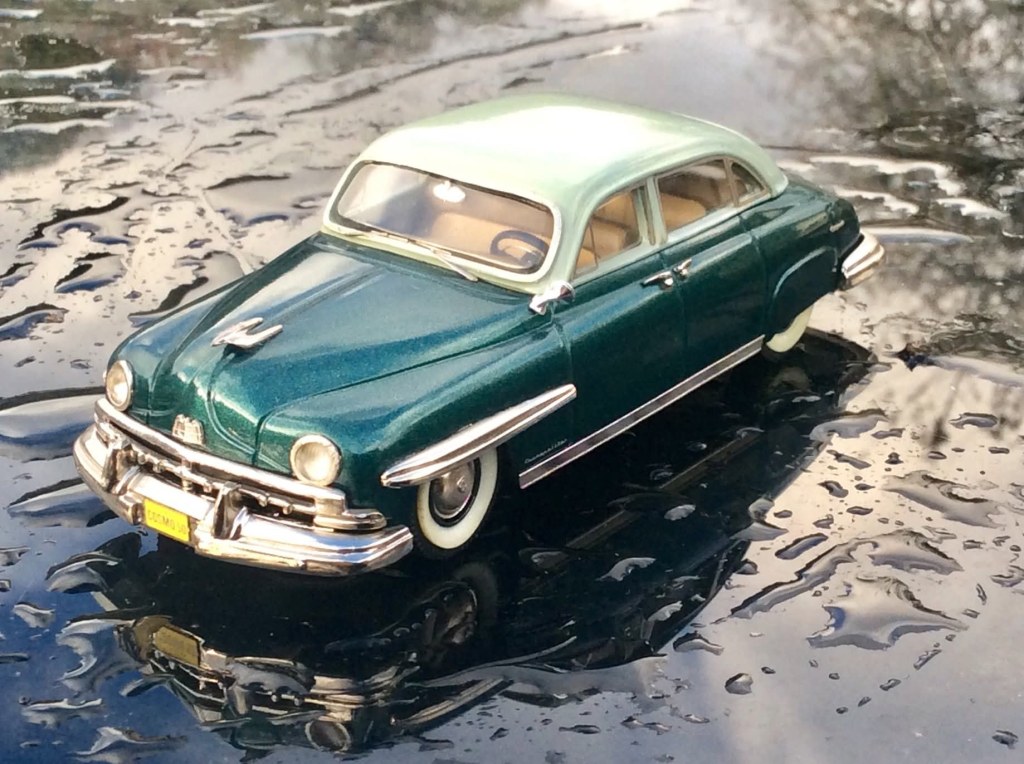
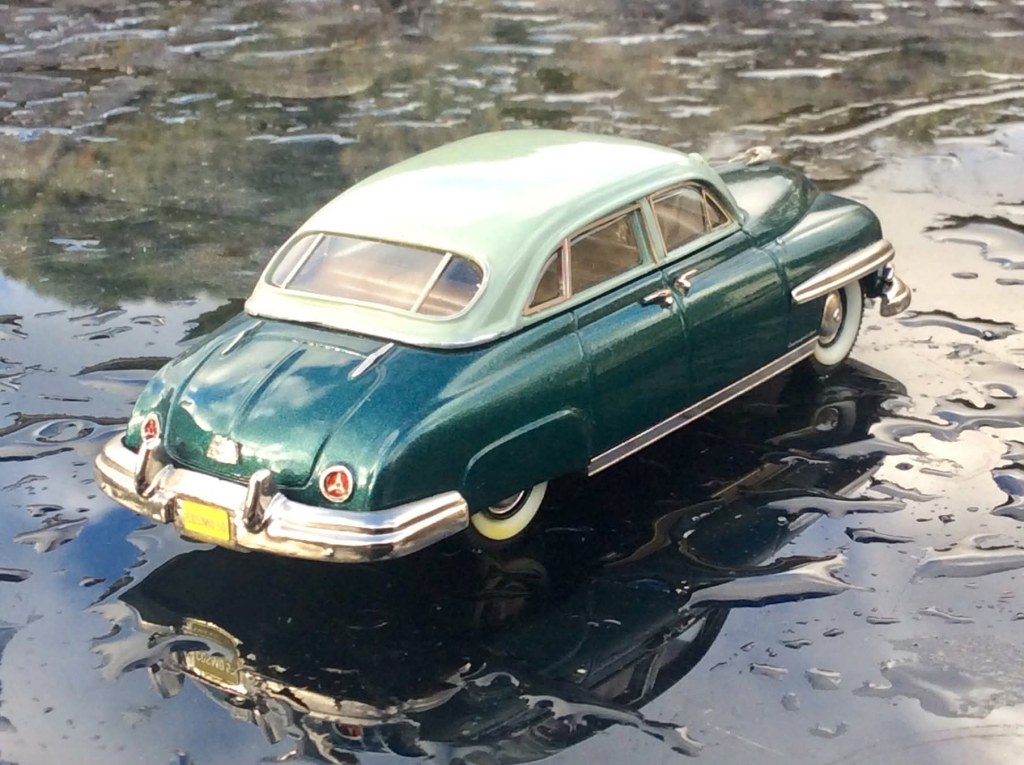
Nr.10, the 1950 Lincoln Cosmopolitan, opened the 1992 model year for the Conquest range. This was an excellent choice for modelling. The Cosmopolitan represented the first new post-war chapter in the history of Lincoln and replaced the obsolete Continental. Released in 1948 for the 1949 model year, it shared a platform with the new Mercury Eight but featured a longer wheelbase. Designed by Eugene Gregorie in pontoon style, it looked remarkable for the late 1940s. The Cosmopolitan became Gregorie’s last project before he left the Ford Motor Company.
Nr.10 (photos by Paul Friend)
The new luxury Lincoln was equipped with a 5.5-litre Flathead V8 producing 152 h.p., replacing the old V12. Most cars had a 3-speed manual gearbox, but a GM Hydramatic automatic transmission was available by special order. The chassis was designed by Earl MacPherson, who created a new independent front suspension for this model.
The exterior and interior featured many chrome elements. The Cosmopolitan range was released in four body variants: 4-door Sport Sedan, Town Sedan (fastback), 2-door Club Coupé, and Convertible.
At the same time, the Lincoln division also produced a standard model in the same style which did not have its own model name. The cheaper models had a divided windscreen, whereas the Cosmopolitan featured a one-piece design.
In 1950 the radiator grille, front bumpers, and dashboard were changed, and the fastback body style was discontinued. That year customers purchased 10,692 cars (8,332 sedans, 1,827 coupés, and 536 convertibles).
In 1951 the design was updated once again, and the following year the model was discontinued.
By the way, the Cosmopolitan became the official car of U.S. President Harry Truman, who ordered several specially prepared cars for the White House.
For his Conquest range, Henk chose the 1950 Sport Sedan. This was the most widespread body style in the Cosmopolitan line-up. The models were painted in very attractive two-tone colour combinations: Palomar Green Metallic/Glendale Green and Nassau Beige Metallic/Carlsbad Tan.
For a long time, the 1950 Lincoln Cosmopolitan by Conquest Models had no alternative until Brooklin released the 1949 Convertible version in 2007, which is now a fine addition, though not a replacement, for collectors. Nowadays resin companies from China produce many models of American cars, but they have not rushed to create a wide range of Cosmopolitans.
Nr.11 (photo by Albert Kopans)
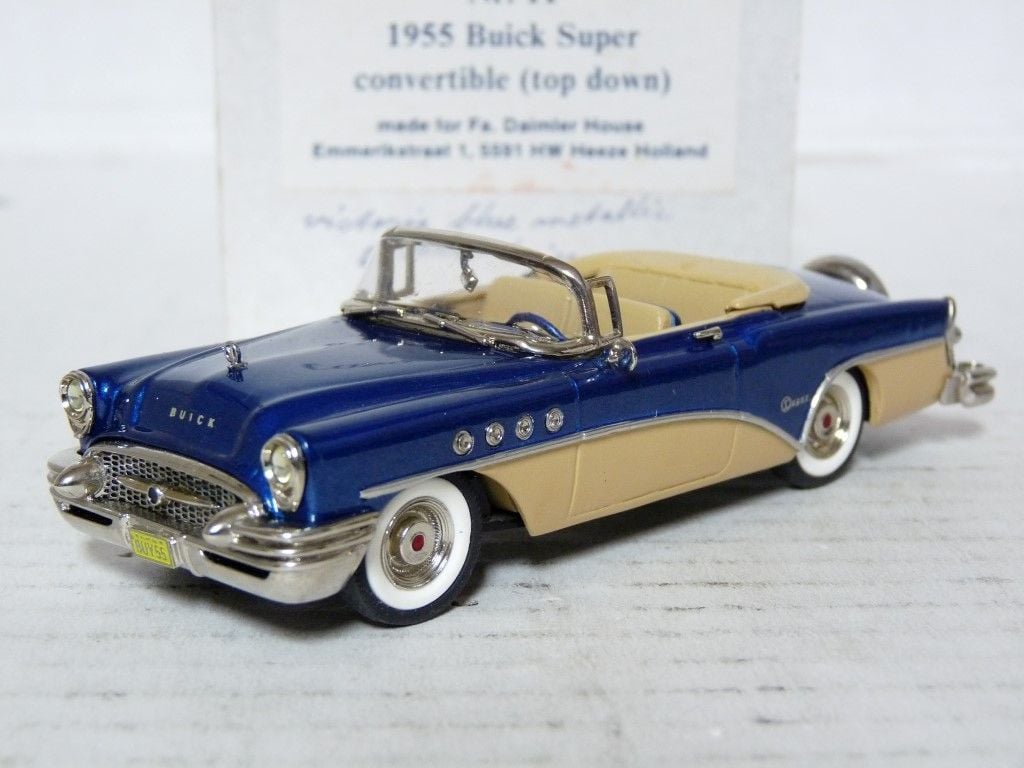
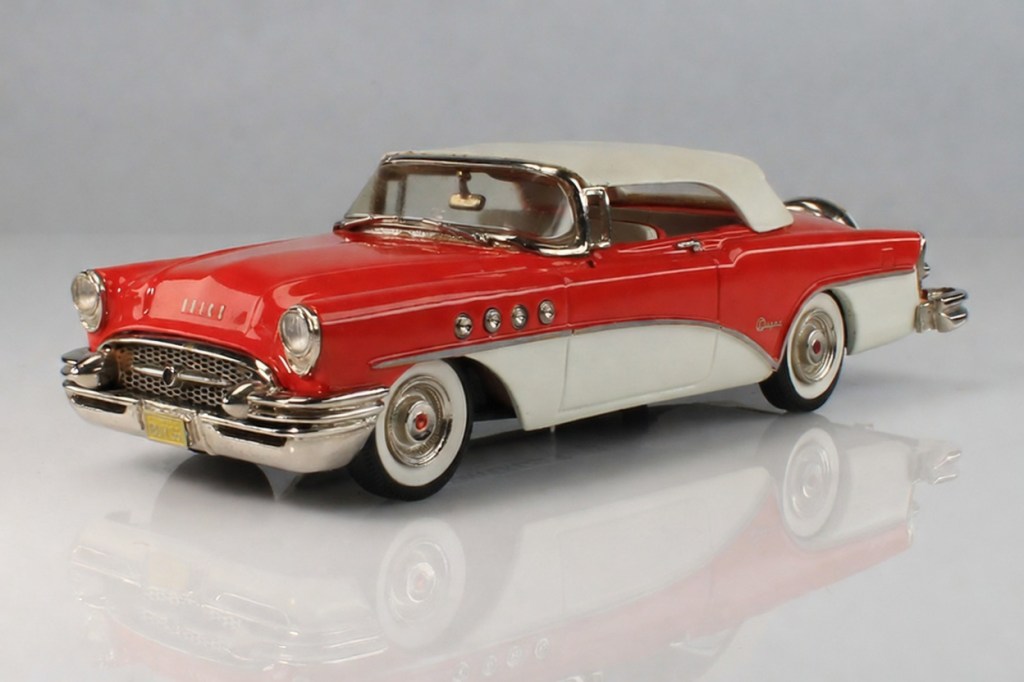
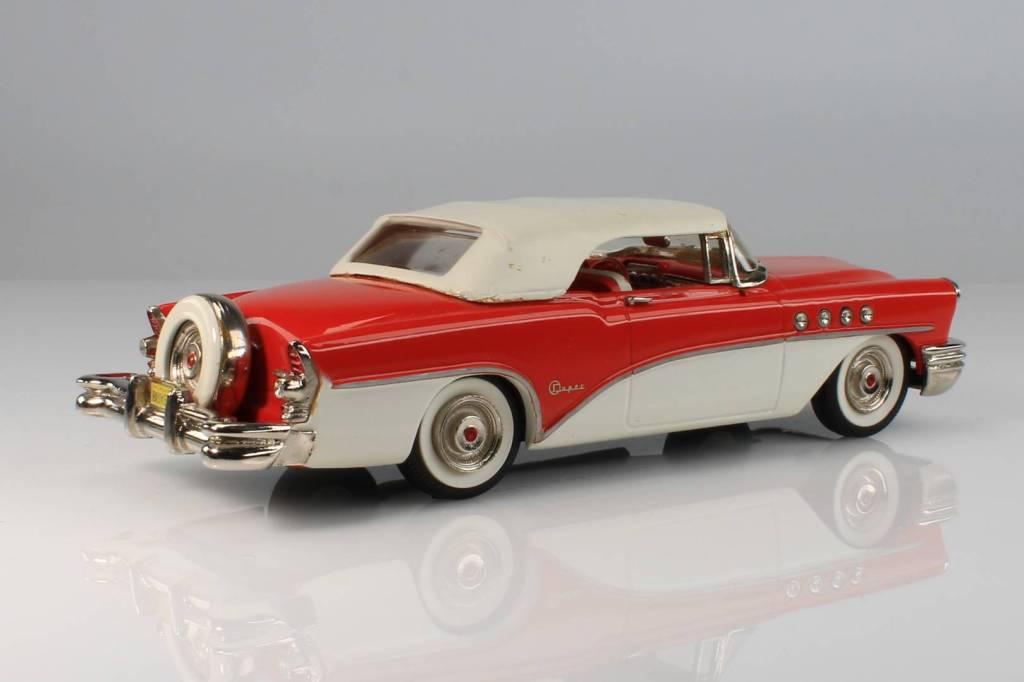
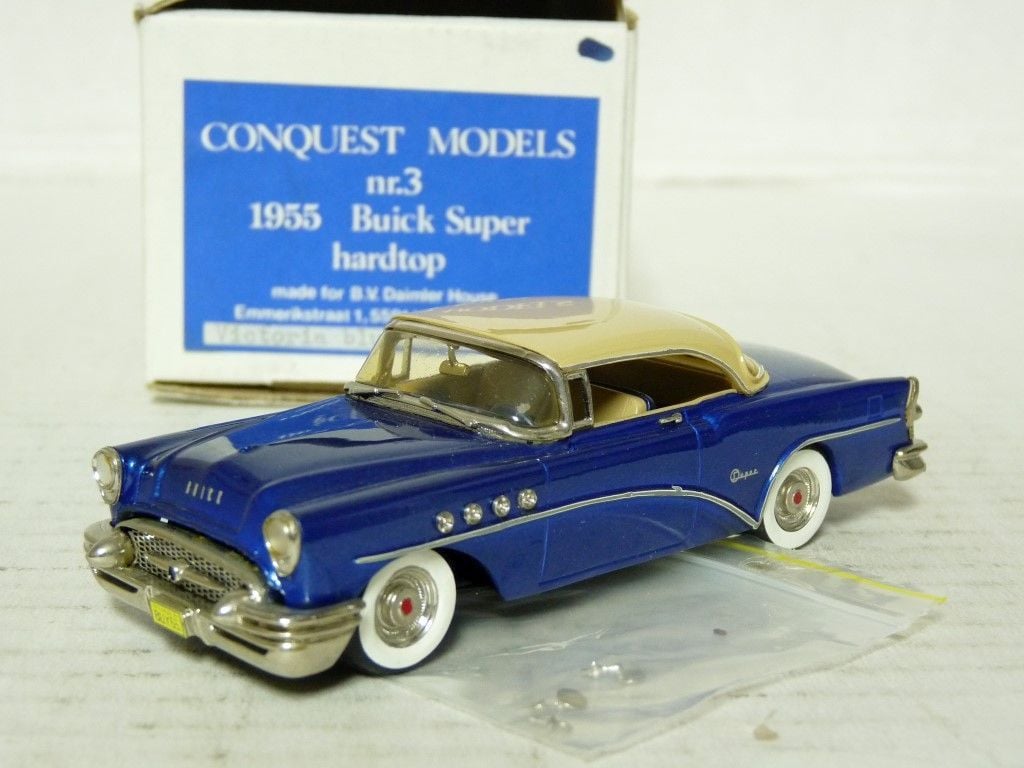
Nr.11 and 11a, the 1955 Buick Super Convertible Top Up and Top Down, were added to the range of 1955 Buick body styles previously begun with Nr.3, the Super Riviera 2-door Hardtop. Initially, Nr.11 was available in Cascade Blue/Temple Grey and Gulf Turquoise/Cameo Beige. A year later Victoria Blue Metallic/Camaro Beige was added. For Nr.11a, Cherokee Red/Dover White was chosen.
Nr.11a (photos by Dave Gilbert)
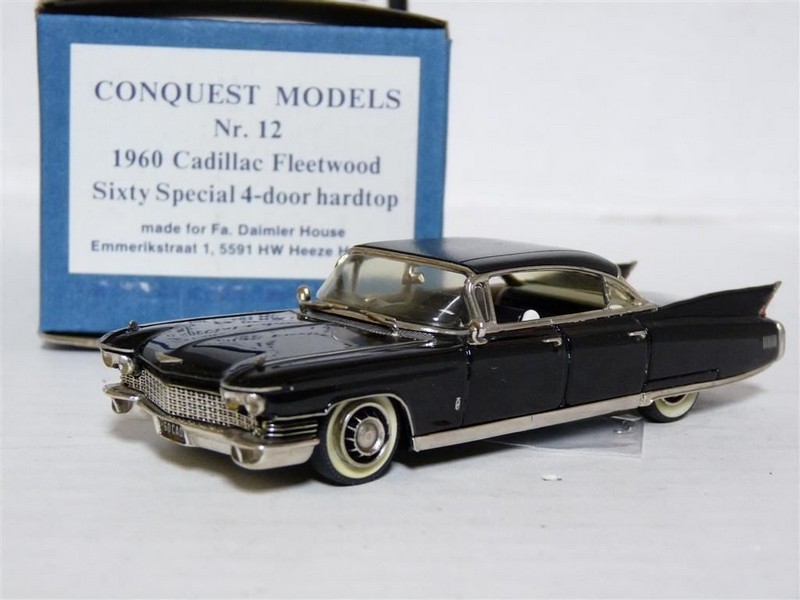
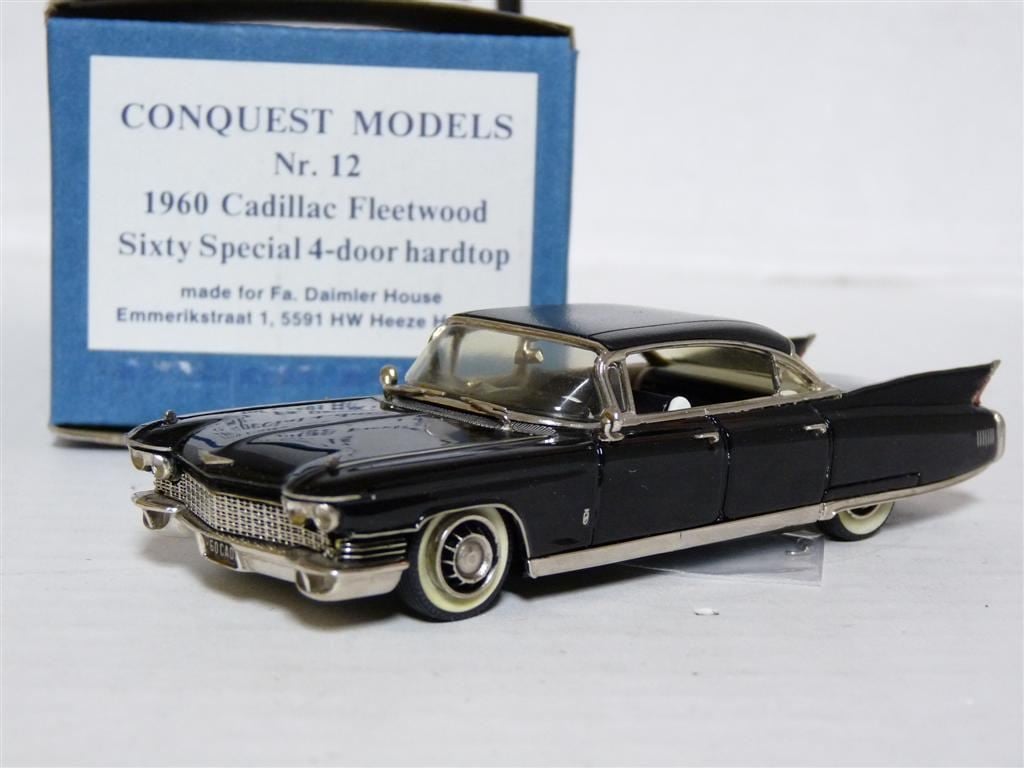
Nr.12, the 1960 Cadillac Fleetwood Sixty Special 4-door Hardtop, represented one of the most stylish and luxurious cars of the 1960s. Since 1938, the Sixty Special name had been used for the long-wheelbase and luxury versions within the Cadillac family. In 1959 the seventh generation of this model was introduced. It featured an absolutely spectacular design with large rear fins and numerous chrome details on both the front and rear sections of the body. The car was equipped with a 6.4-litre V8 producing 325 h.p. and a 4-speed automatic Hydramatic transmission. Innovative air suspension utilizing freon-filled shock absorbers was optional on the Sixty Special series.
Nr.12 (photo by Albert Kopans)
For 1960, the changes included shorter tail fins, cleaner side trim design, and a rear grille similar to that of the Eldorado. The 1959 and 1960 Fleetwood range consisted of the Series 60 Sedan and 4-door Hardtop, as well as the Series 75 Limousine. Henk chose to release a model of the 1960 4-door Hardtop version. It was available in Ebony (Black) and Arroyo Turquoise Metallic.
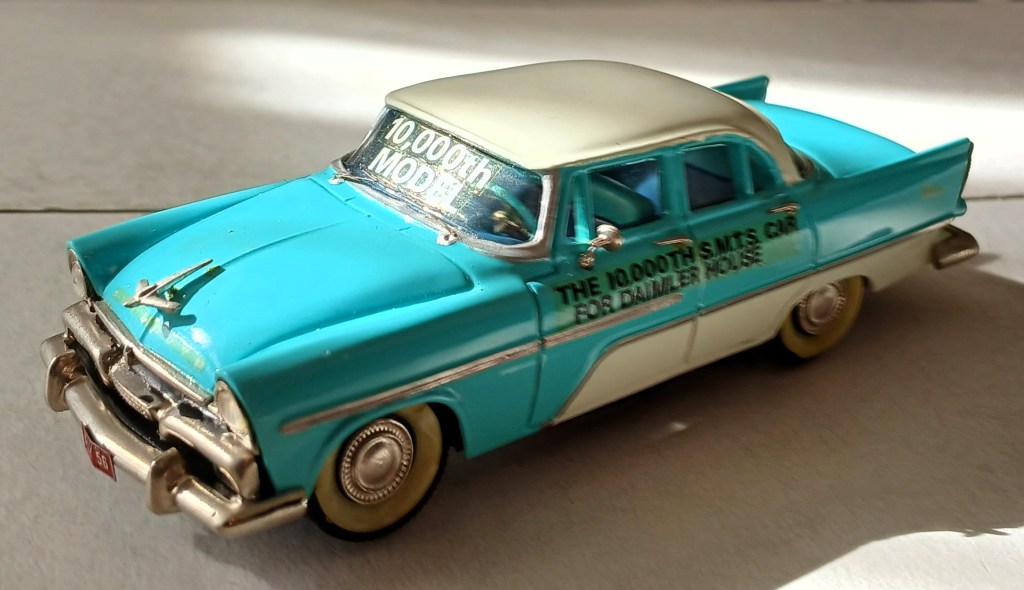
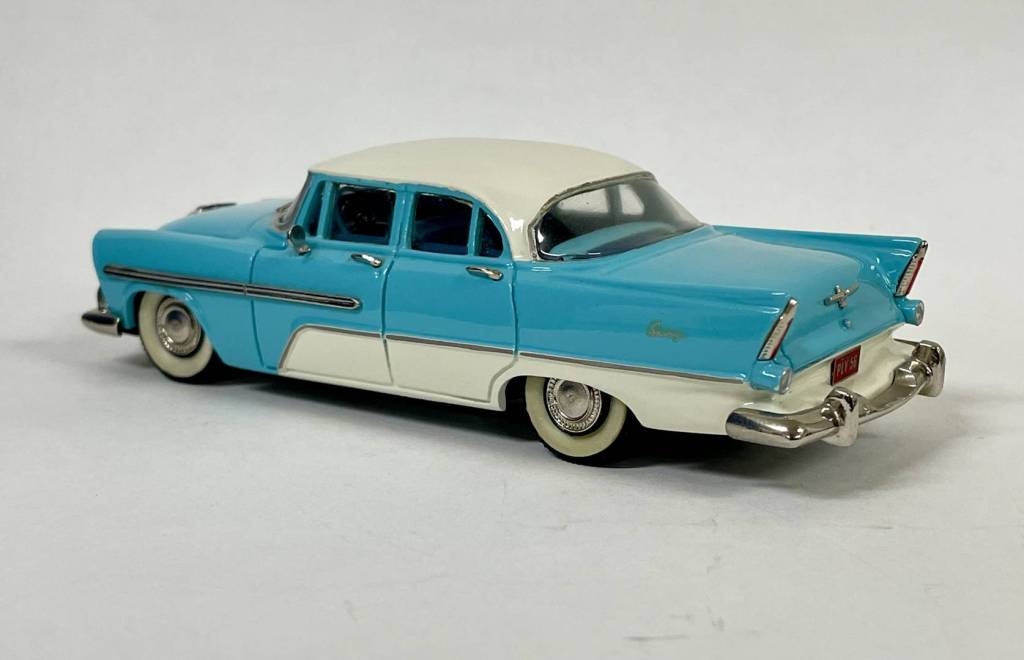
Nr.13, the 1956 Plymouth Savoy 4-door Sedan, represented one of the most inexpensive cars of its time. Its main customers were average families, and despite its reasonable price this car had a very attractive style, like most American vehicles of that period. In 1955 the second generation of the Savoy, designed by Virgil Exner, was introduced. In the Plymouth range, the car was positioned between the Plaza and the Belvedere, both of which were also named in honour of prestigious hotels.
Nr.13, 10.000th model made for Daimler House by SMTS (photo by Henk van Asten)
Initially, only two body styles were introduced in the Savoy range: the 2-door Club Sedan and the 4-door Sedan. The following year, the 2-door Sport Coupé Hardtop was added. The power of the basic 3.8-litre 6-cylinder engine was increased from 117 to 131 h.p., while the optional Hi-Fi V8 engines increased from 157 and 167 h.p. to 187 and 200 h.p. By the way, the Savoy was exported to Europe, and these versions received economical 95 h.p. 6-cylinder engines and more powerful V8 engines producing 165 h.p.
The Conquest model was painted in two-tone colour combinations: Turquoise Blue/Eggshell White and Briar Rose/Eggshell White. The 1956 Savoy became the last miniature released in 1992.
For 1993, new releases for the Conquest range consisted of the 1948 Pontiac Torpedo Eight De Luxe Convertible Top Down and Top Up, the 1956 Buick Special Convertible, and the 1957 Ford Thunderbird Hardtop.
13 and 14a (photos by Dave Larsen)
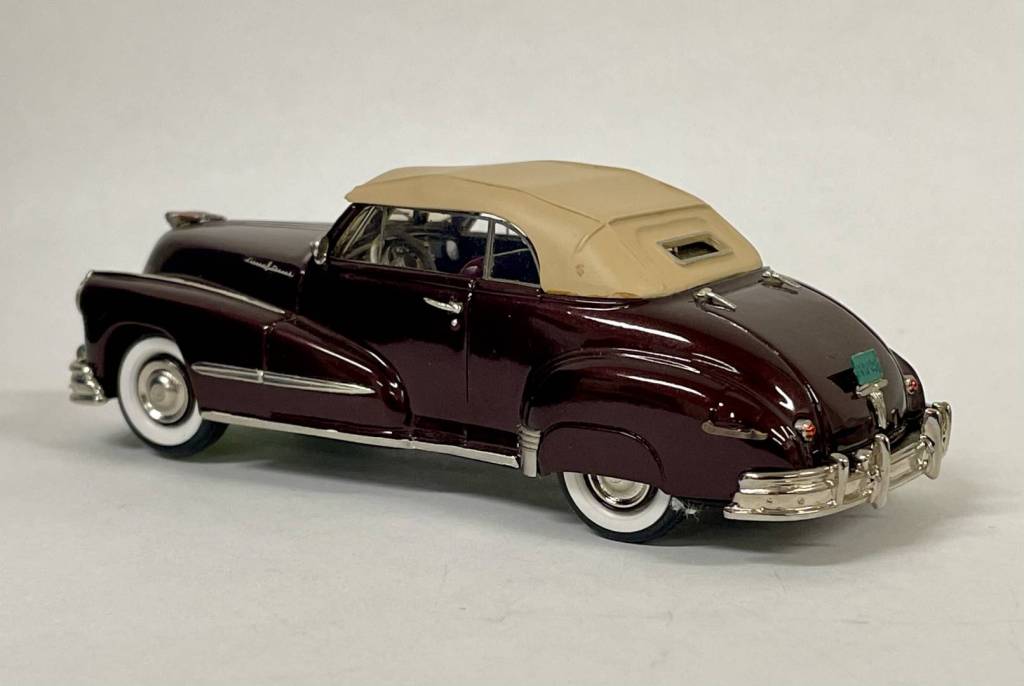
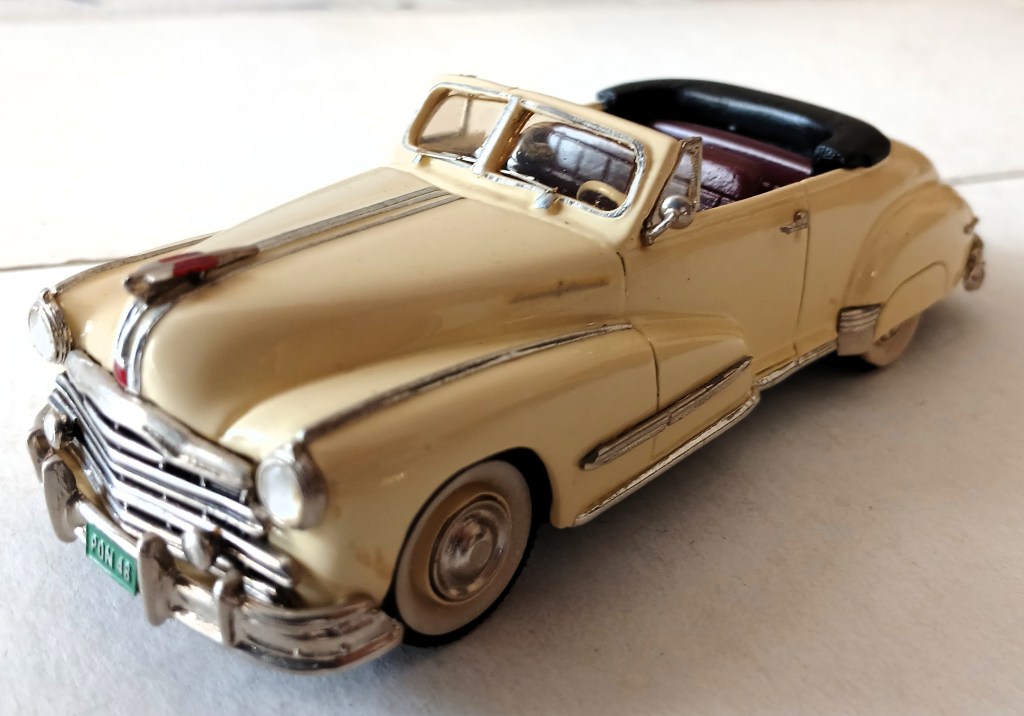
With Nr.14, the 1948 Pontiac Torpedo Eight De Luxe, Henk appealed to collectors of models from the early post-war years. After World War II ended, most manufacturers in the USA resumed production of pre-war cars. Thus, the 1948 Pontiac was in fact based on the 1942 model because production of civilian vehicles had stopped after the attack on Pearl Harbor.
Nr.14 (photo by Henk van Asten)
1948 became the final year for the old Pontiacs before they were replaced by the next generation. Initially there were two versions: the Torpedo, based on a short-wheelbase chassis, and the Streamliner, based on a long-wheelbase chassis. The Torpedo was available as a Business Coupé, Sport Coupé, 2-door Sedan Coupé, 4-door Sedan, and Convertible. Streamliner body styles included Coupé, Sedan, and woody estate. The models were equipped with either a 3.9-litre 6-cylinder 90 h.p. engine or a 4.1-litre engine producing 103 h.p. The 1948 version differed very little from the 1947 one: the radiator grille design was altered and the Hydramatic transmission became optional.
Conquest modelled the luxurious Convertible version equipped with the 8-cylinder engine. In fact, in 1948 only this variant was available. Its main exterior features were the side mouldings on the front wings. The Top Down version was painted in Genesee Green Metallic and France Ivory, while the Top Up version came in Blue Lake Blue Metallic and Parma Wine Metallic.
Three years later Henk continued the 1948 Pontiac range by producing the Streamliner woody estate.
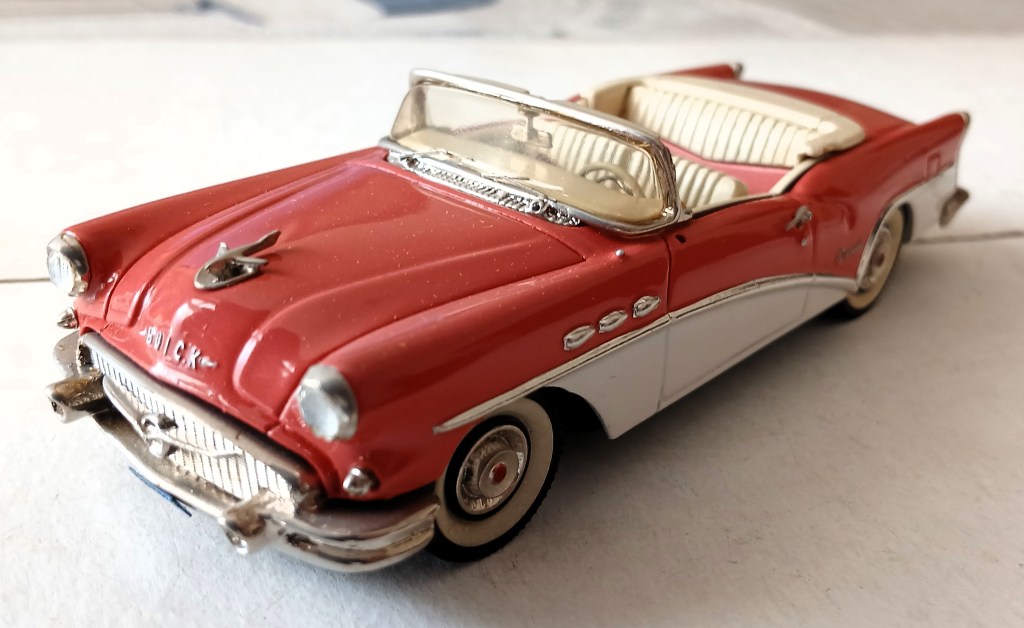
Nr.15, the 1956 Buick Special Convertible, was added to the selection of mid-1950s Buicks in the Conquest range. This model filled a gap between the 1955 and 1957 miniatures previously reproduced by the company. The car had several minor exterior differences from the 1955 version, and the model was painted in Foam Green/Dover White and Tahiti Coral/Dover White.
Nr.15 (photo by Henk van Asten)
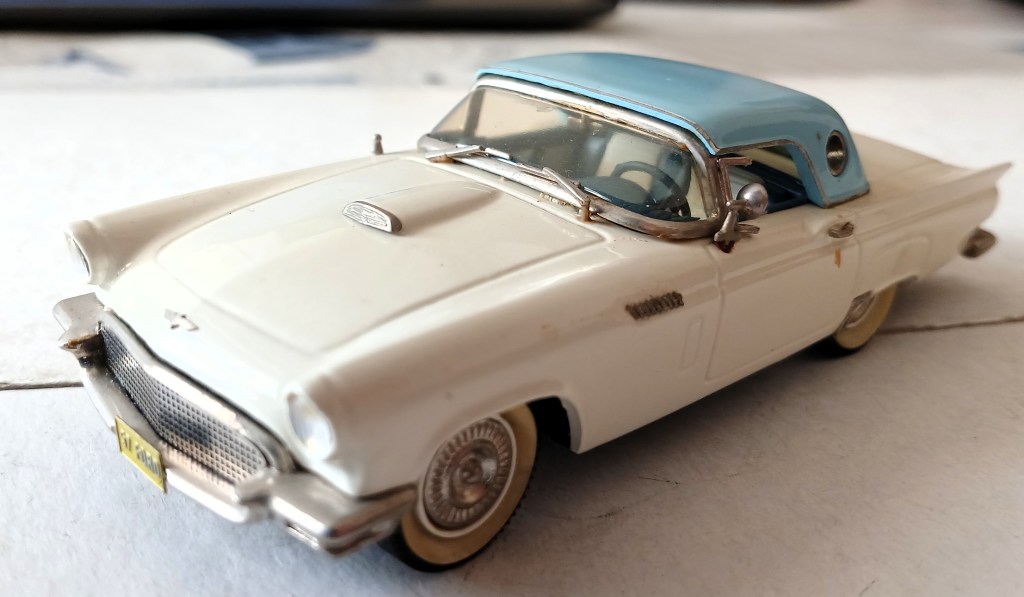
Nr.16, the 1957 Ford Thunderbird Hardtop, completed a very busy year for the Conquest range in 1993. Strictly speaking, the first-generation Thunderbird was already a rather common subject among die-cast and hand-built manufacturers, but most of them focused on the 1955 and 1956 versions. For example, both had been produced by Brooklin Models.
Nr.16 (photo by Henk van Asten)
The company from Bath also produced 1957 Convertibles, but not the Hardtop. Thus Daimler House filled this gap and offered collectors a very sophisticated miniature. The history of the Thunderbird is very well known, so there is no need to describe it in detail in this review. The 1957 model became the last of the first generation. It received new front and rear bumpers, an enlarged boot section with an added Continental kit, and a new dashboard featuring a round speedometer. The power of the V8 engines was also increased, with the most powerful version achieving 270 h.p. In 1957, 21,380 customers bought 2-seat Hardtops and Convertibles before they were replaced by the 4-seat personal luxury cars of the second generation. Henk selected two colour combinations for the Hardtops: Flame Red/Colonial White and Colonial White/Starmist Blue. The models proved so successful that, after many customer requests, Nr.28 Roadster was added to the range in 1997. It was painted in Tuxedo Black and Silver Mocha Metallic.
Nr.17 (photo by Henk van Asten)
Apart from Nr.17, the 1954 Pontiac Star Chief Custom Catalina, and the 1955 Oldsmobile 98 Holiday, the 1960 Plymouth Fury 4-door Hardtop was released in 1994. Production of Nr.18 was delayed until 1995.
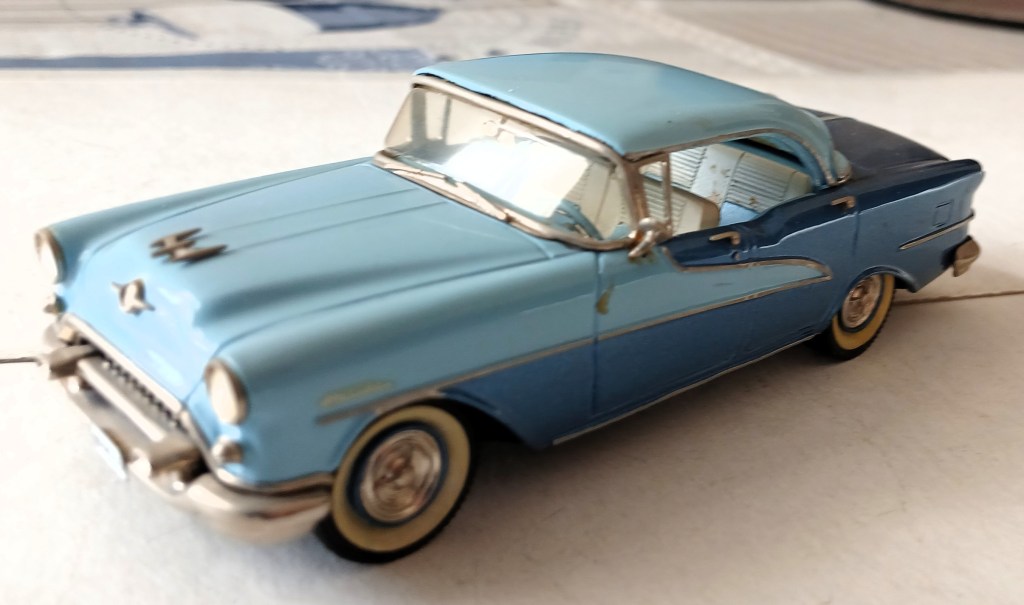
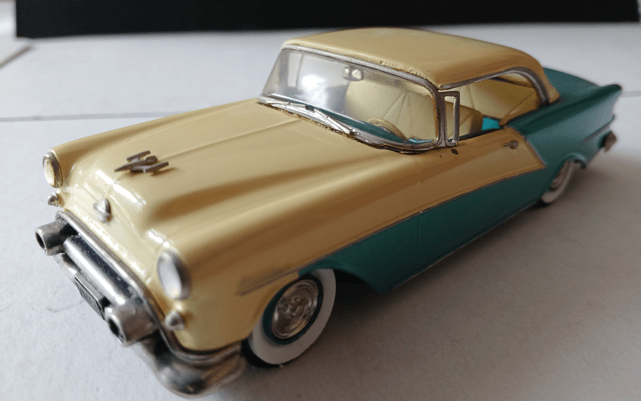
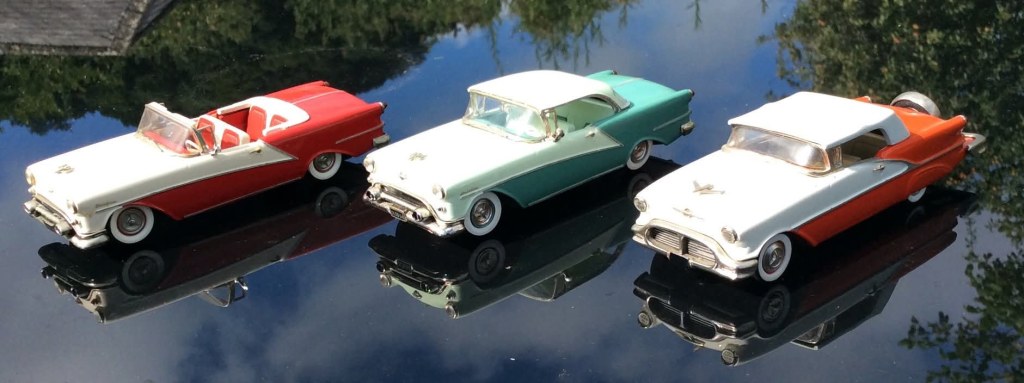
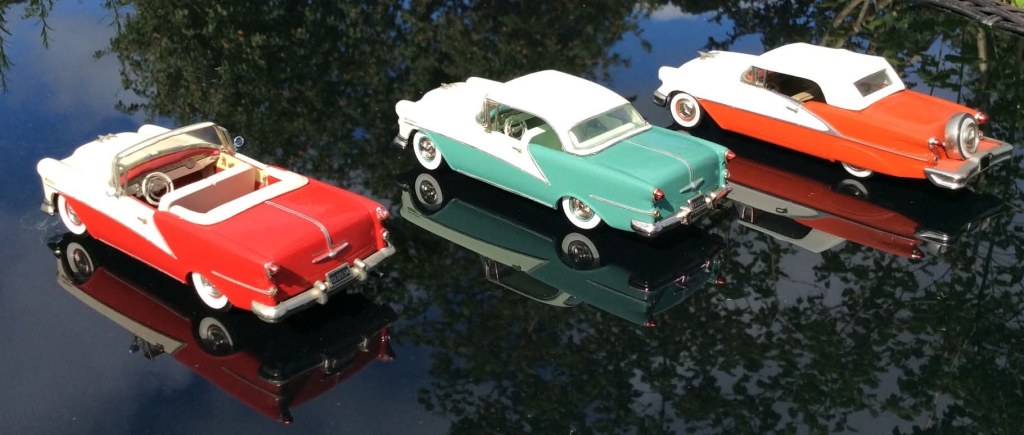
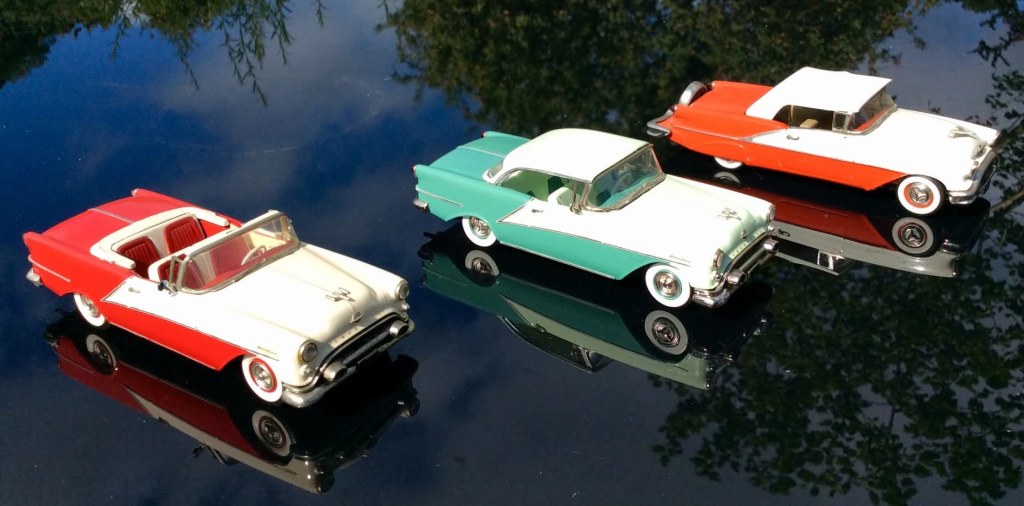
Nr.19, the 1955 Oldsmobile 98 Holiday 4-door Hardtop, was added to the range of mid-1950s Oldsmobiles by Conquest. To avoid duplicating other versions, Henk decided to reproduce the 1955 variant in addition to the 1954 one. This version featured a different radiator grille and several revised trim elements. The colours were Twilight Blue/Panama Blue Metallic, Mint Green/Glen Green Metallic, and an exclusive limited edition in Burlingame Red/Polar White.
Nr.17 (photo by J. Ceejay Nakamoto)
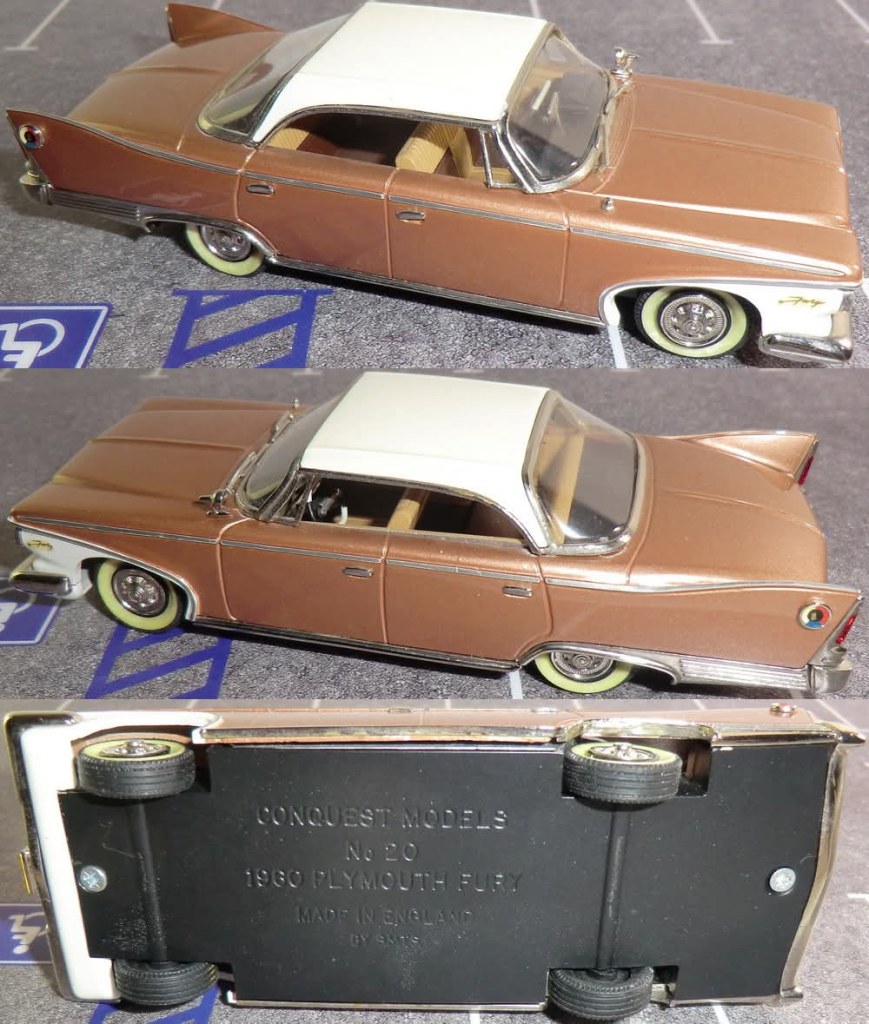
Nr.20, the 1960 Plymouth Fury 4-door Hardtop, represented one of the most stylish and unusual cars in the Plymouth range. The first generation, released in 1959, replaced the Belvedere at the top of the line-up. A year later the second generation was introduced. Its main design features were the large tail fins, which disappeared in 1961.
This became the first Chrysler Corporation model with a unibody construction. Other innovations included Chrysler’s ram induction system and a new economical 3.7-litre 6-cylinder engine producing 145 h.p. A selection of V8 engines producing between 230 and 330 h.p. was also available.
Nr.19 (photo by Henk van Asten)
Nr.20 (photo by J. Ceejay Nakamoto)
The Fury range consisted of four body styles: 2-door Hardtop, 4-door Hardtop, Sedan, and Convertible. In 1960, customers bought 55,487 Furys. Daimler House chose the 4-door Hardtop, one of the most expensive models in the range. The brass master for Nr.20 was made by Alistair Duncan, who was also known for his short-lived A & S Modelmakers range, in which he produced a selection of 1958 Thunderbirds. For the Plymouth, two colour combinations were chosen: Caramel Metallic/Oyster White and Chrome Green Metallic/Oyster White.
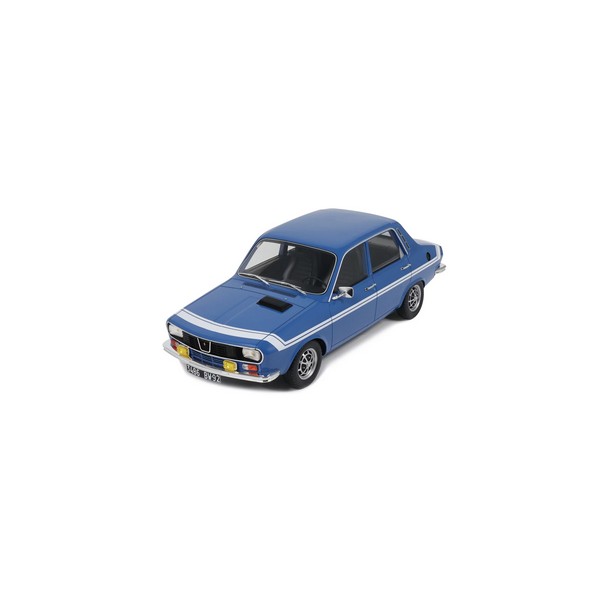
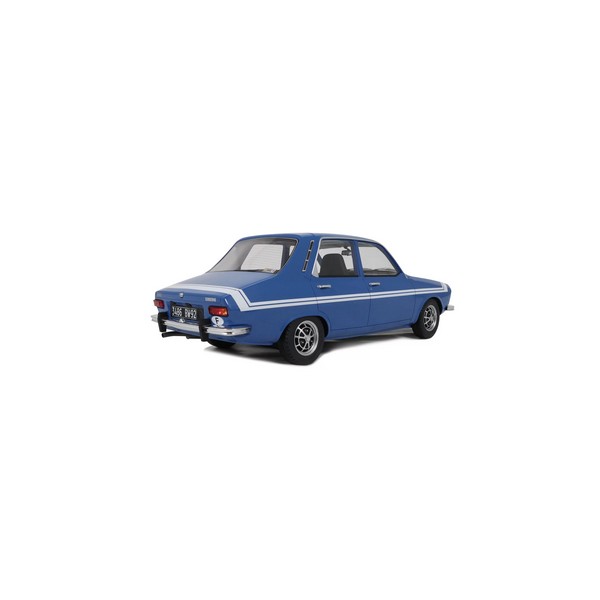
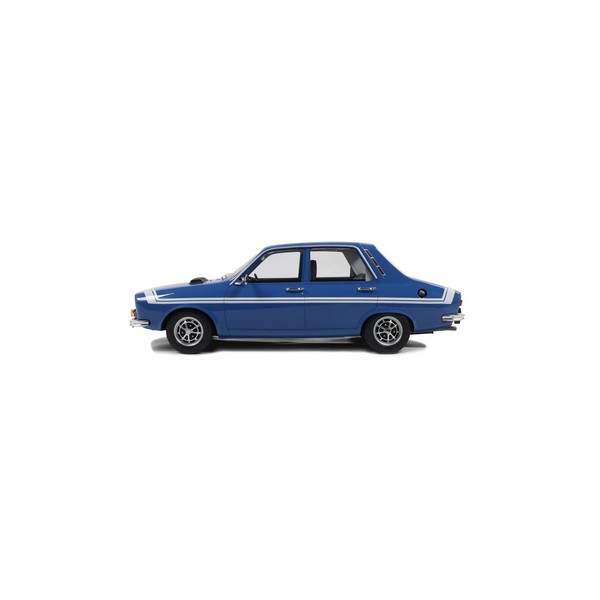
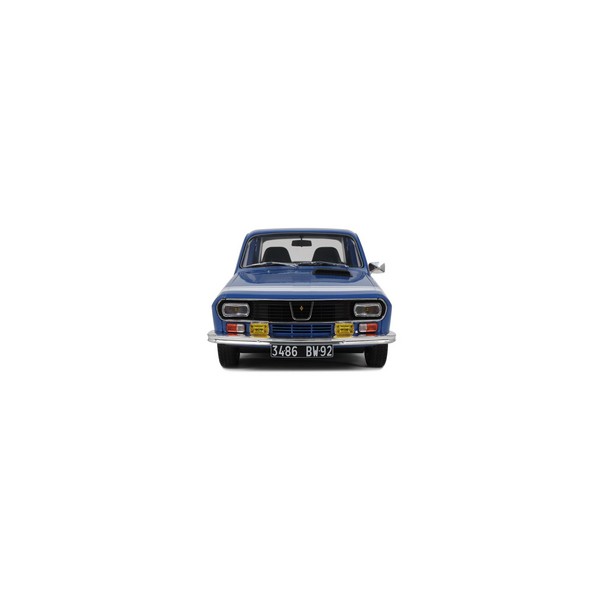
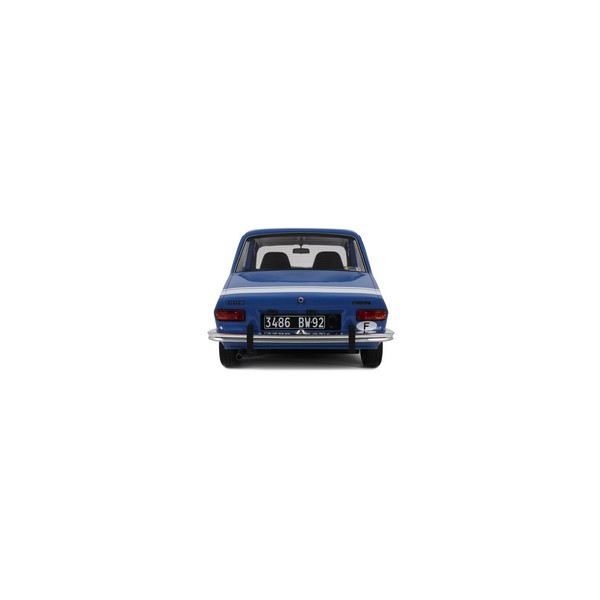
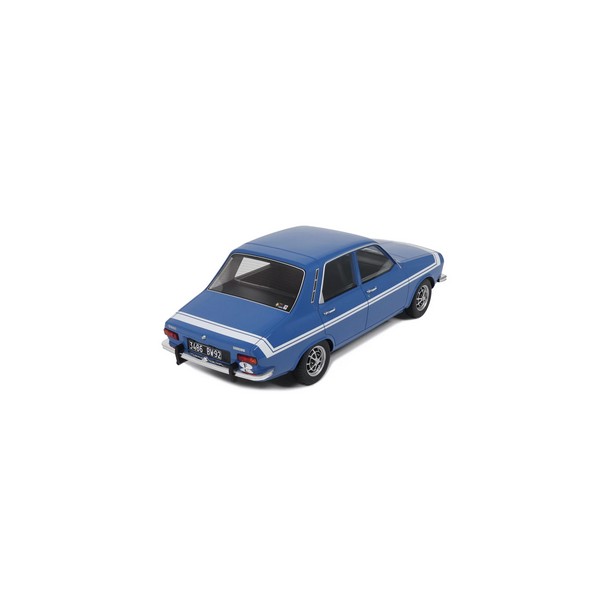
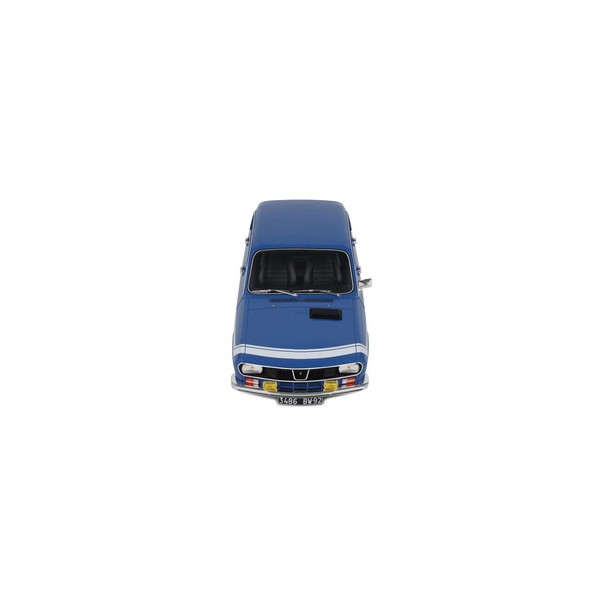
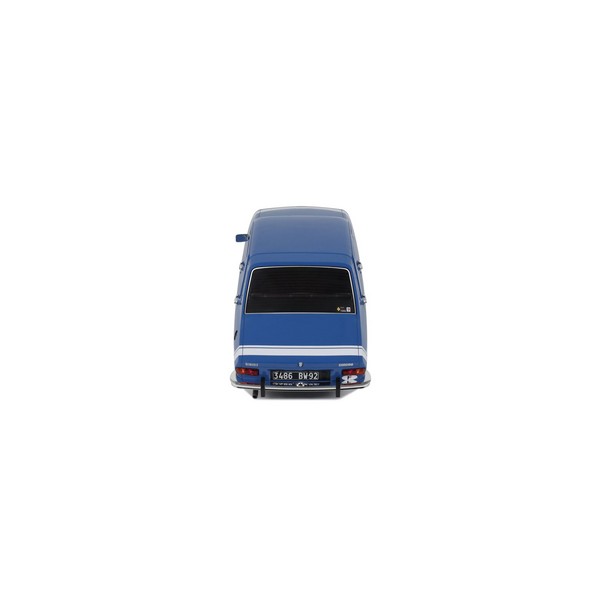
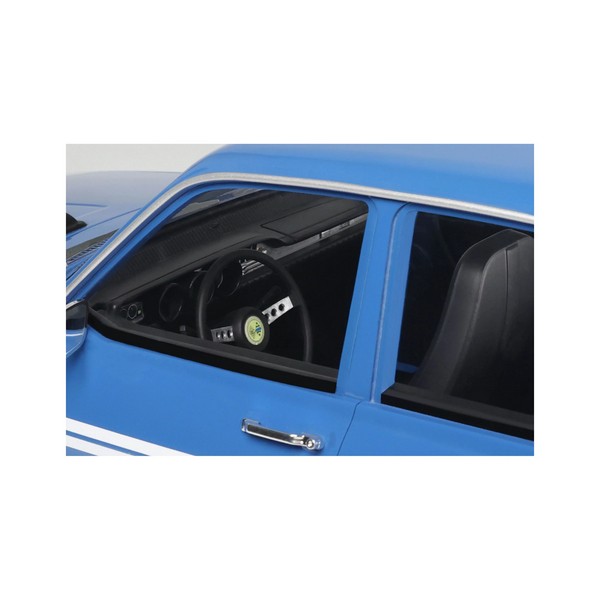
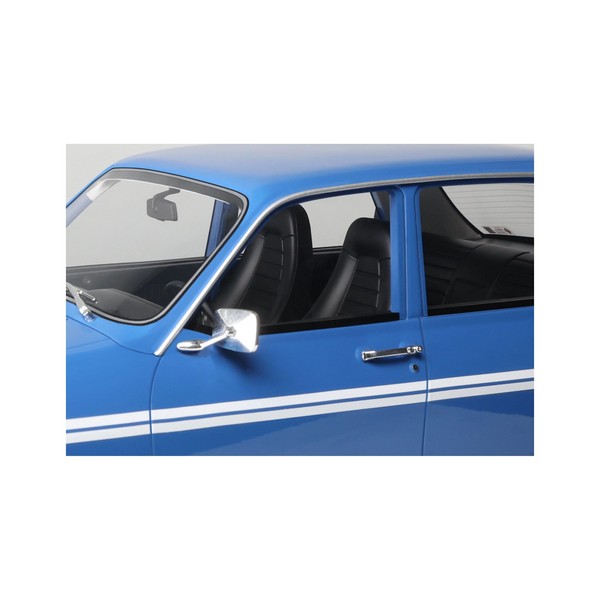
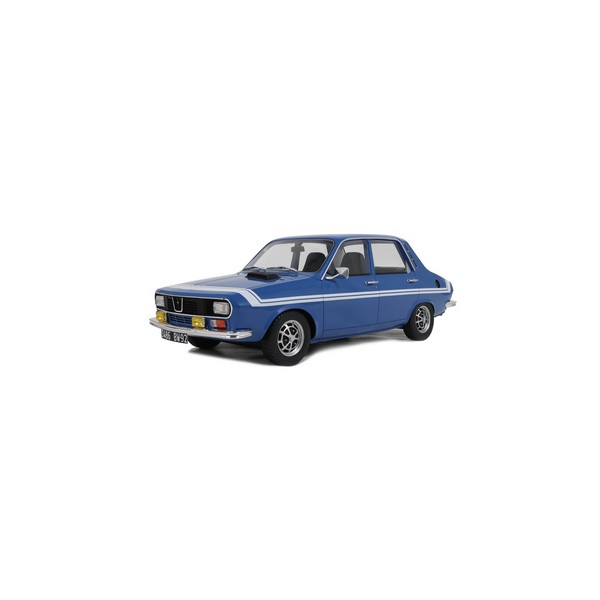
Inizieranno il 3 giugno le spedizioni dell’ultima novità 1:12 di OttOmobile (Club, vendita speciale), la Renault R12 Gordini (1972) nel classico Blu 418 con le bande laterali bianche. Prezzo: € 129,90.
Il modello, numero di catalogo G101, è prodotto in serie limitata di 1500 esemplari numerati, forse abbastanza per evitare certe speculazioni che tutti conoscono fin troppo bene. Per chi questi modelli non solo volesse averli a tutti costi ma avesse pure la voglia di esporli, OttOmobile ha previsto una vetrina specifica, disponibile sul sito ufficiale a € 49,90.
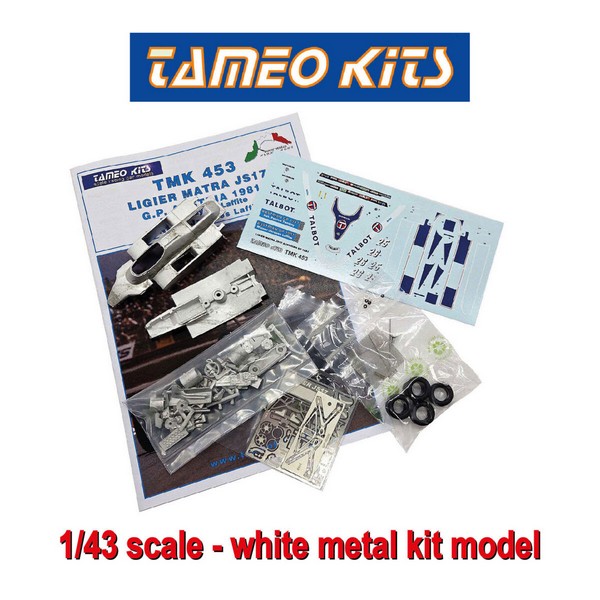
E’ disponibile il kit 1:43 Tameo (TMK453) della Ligier Matra JS17 F.1 che si aggiudicò il Gran Premio d’Austria 1981 con Jacques Laffite. La JS17 fu una monoposto molto competitiva e conquistò due vittorie nella stagione 1981, appunto Austria e Canada. Il modello permette di riprodurre anche la versione di Patrick Tambay. Si tratta di un kit dettagliato ma semplice e quindi adatto, secondo il produttore, ad ogni tipologia di modellista. Fusione in metallo, fotoincisioni, minuterie metalliche e pneumatici in gomma sono la dotazione standard unitamente a due fogli di decals serigrafate.
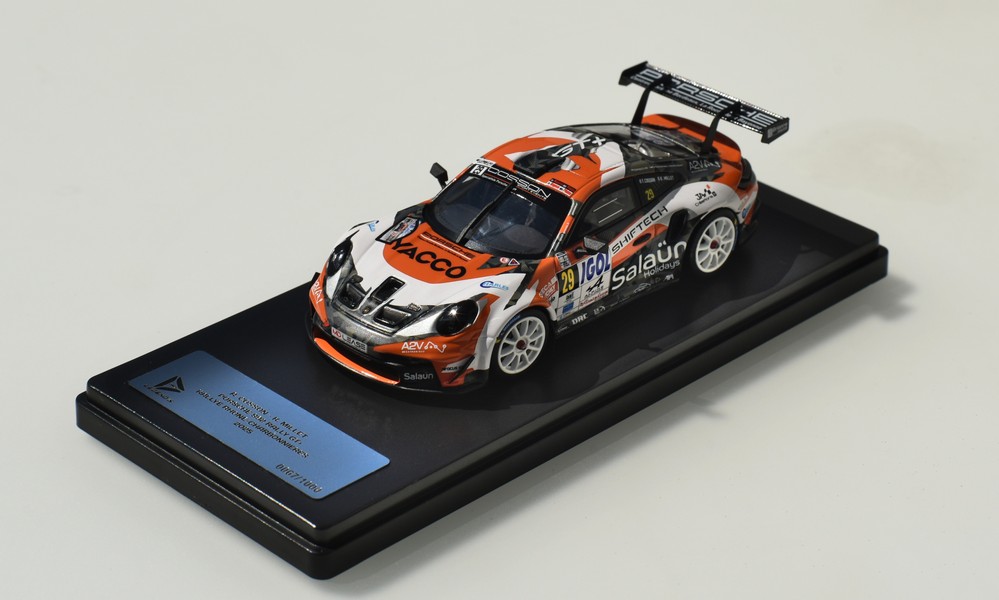
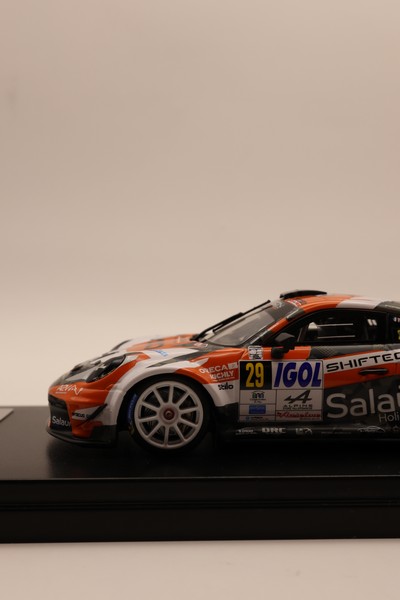
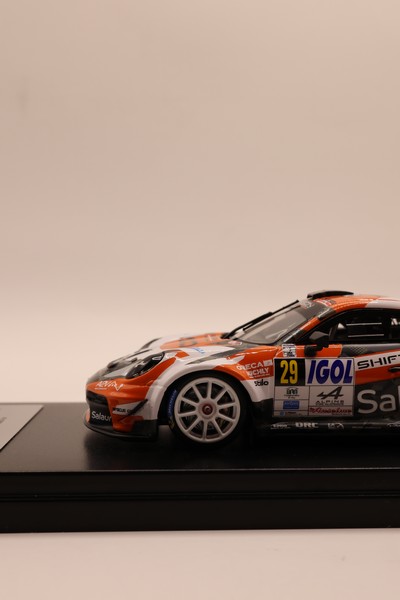
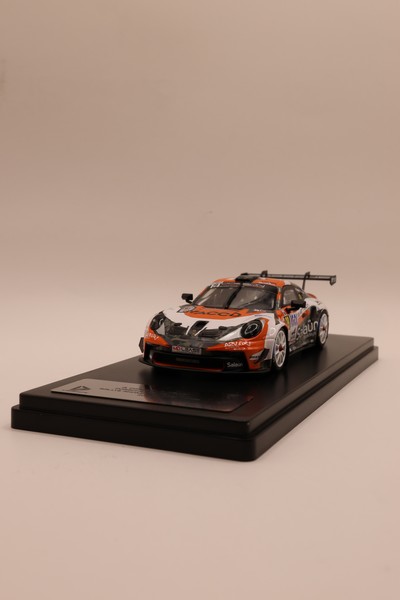
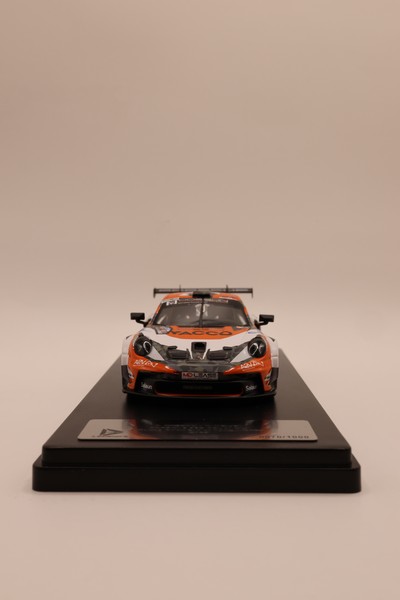
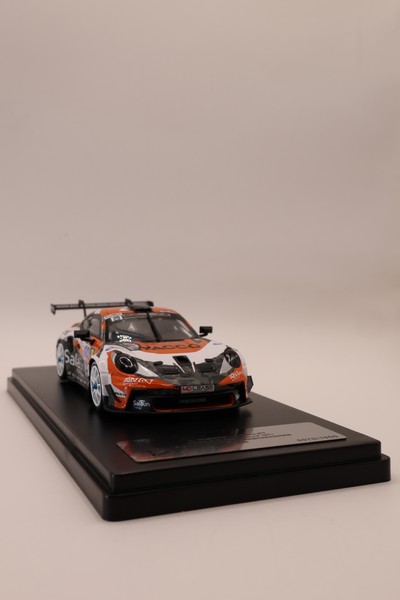
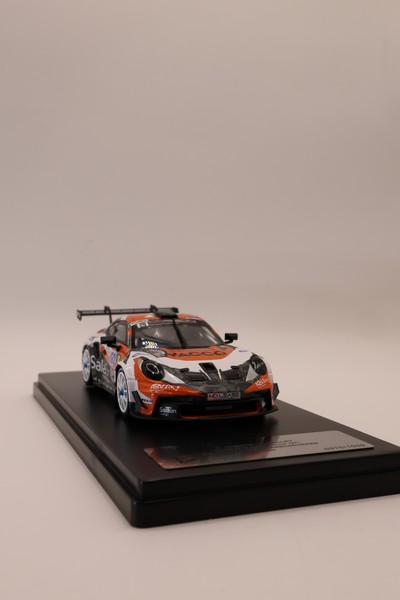
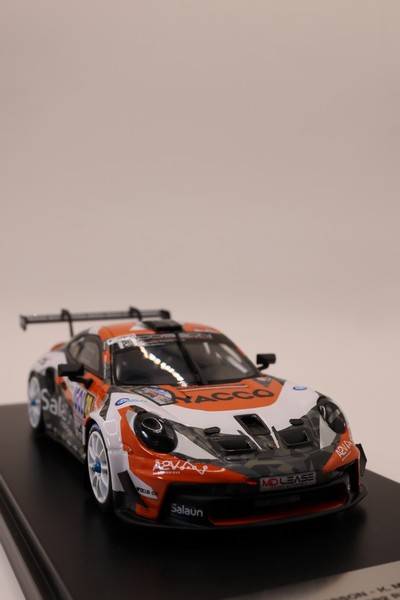
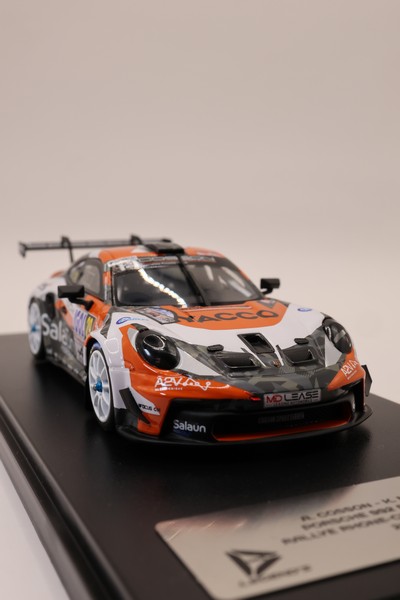
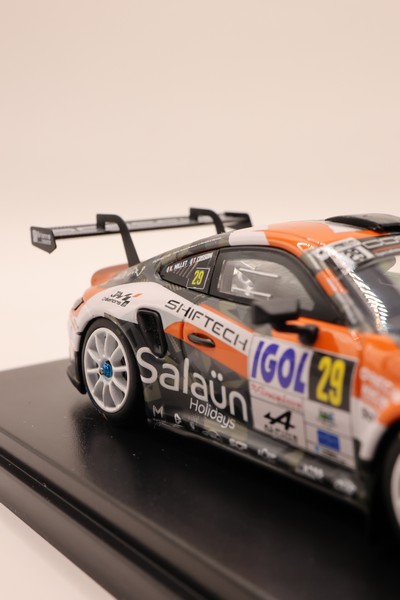
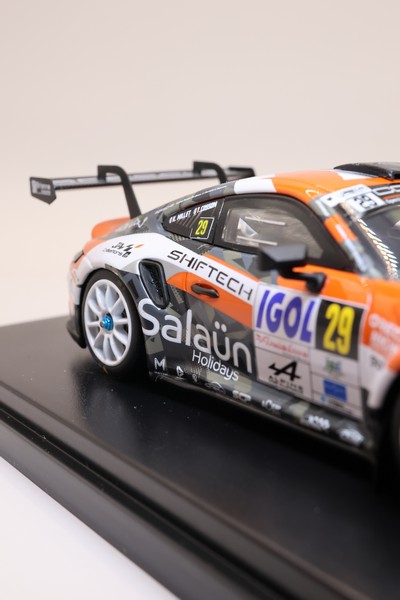
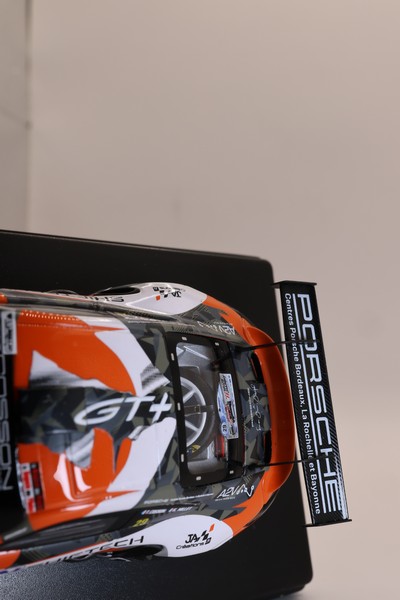
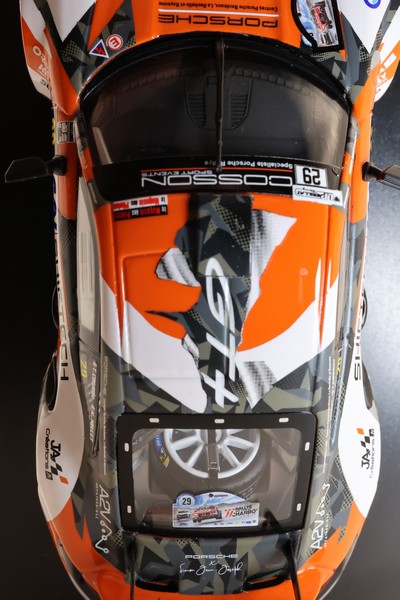
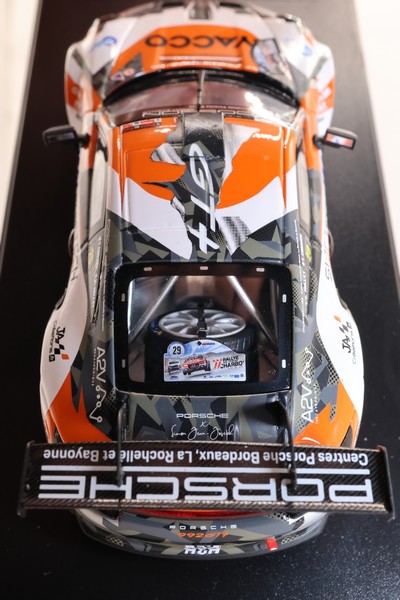
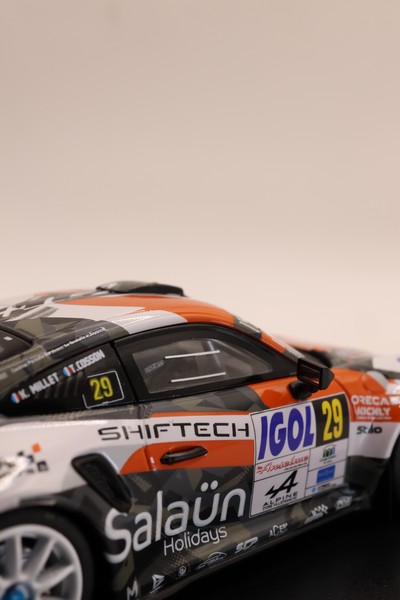
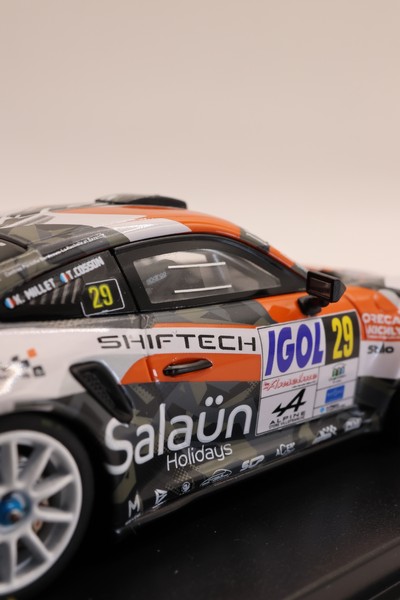
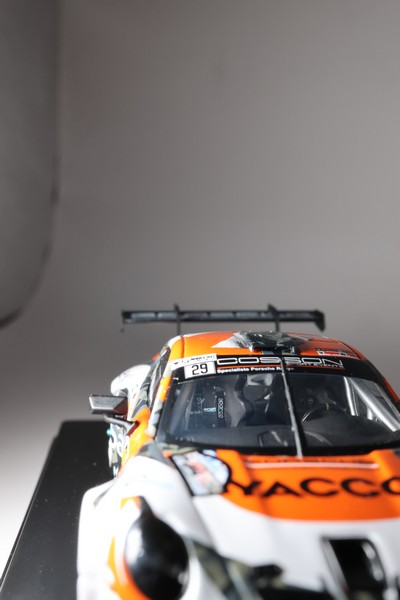
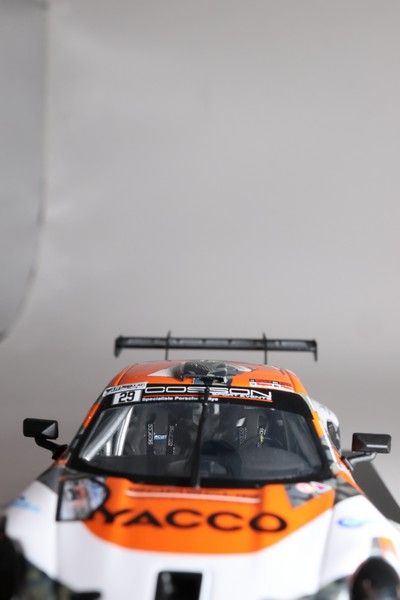
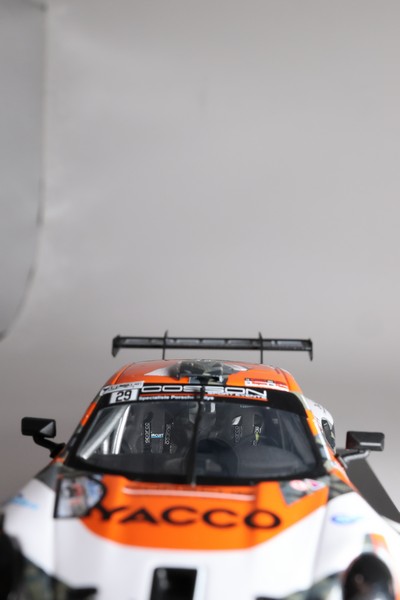
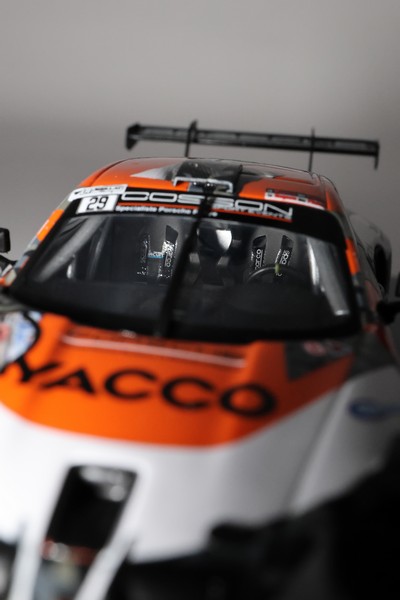
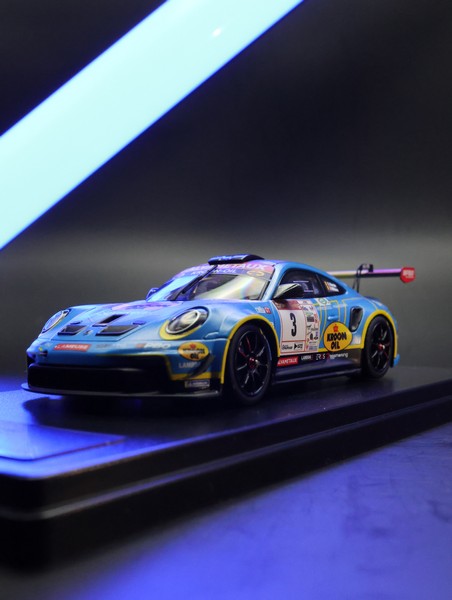
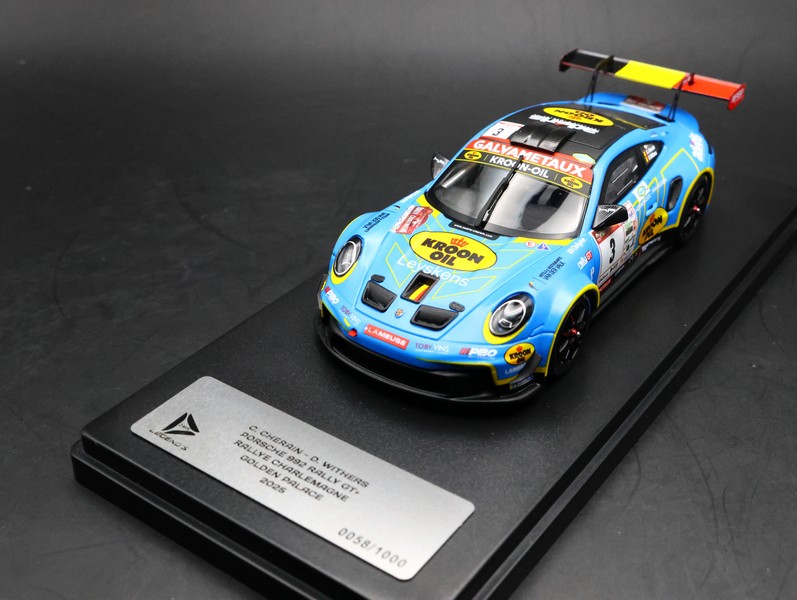
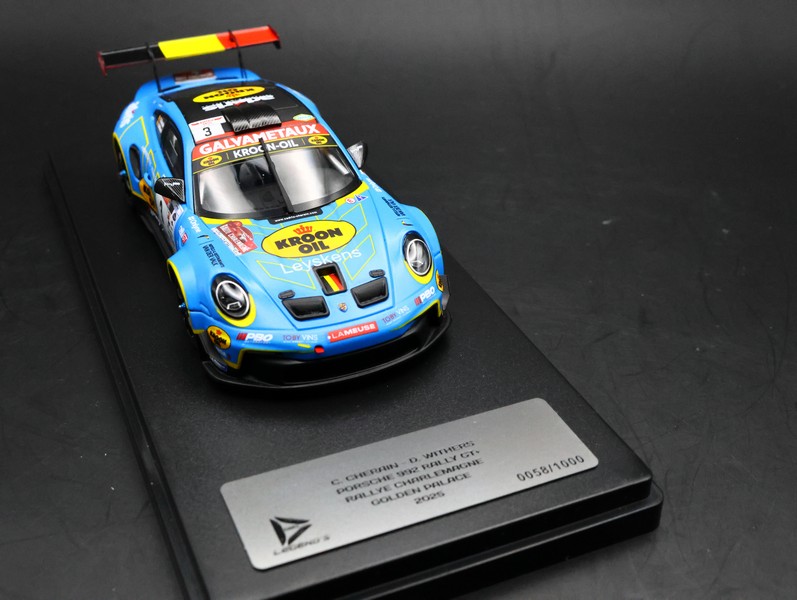
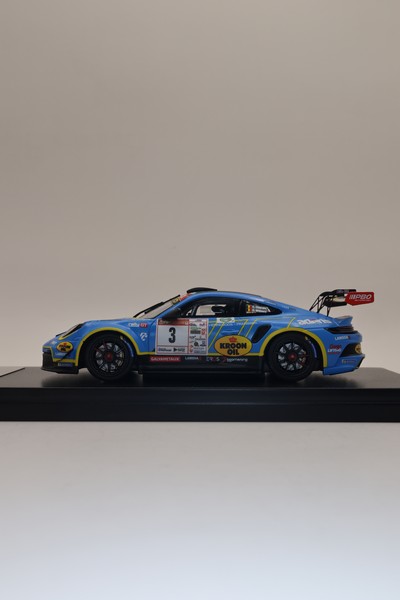
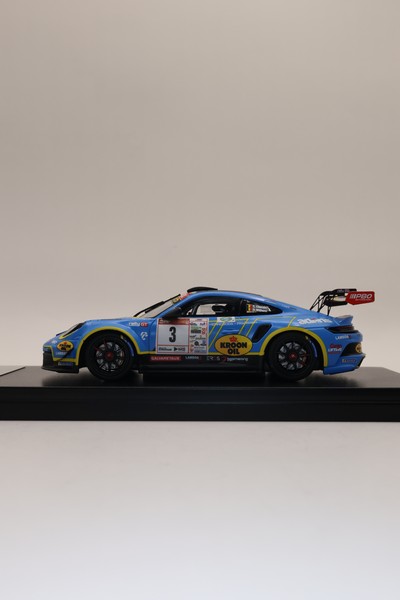
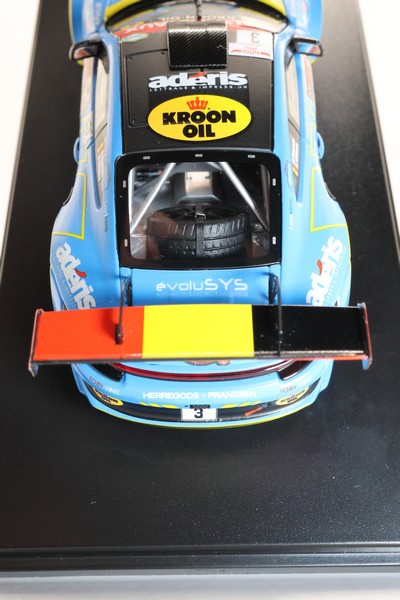
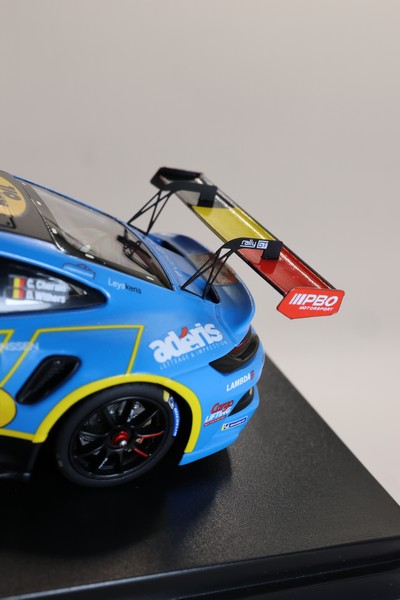
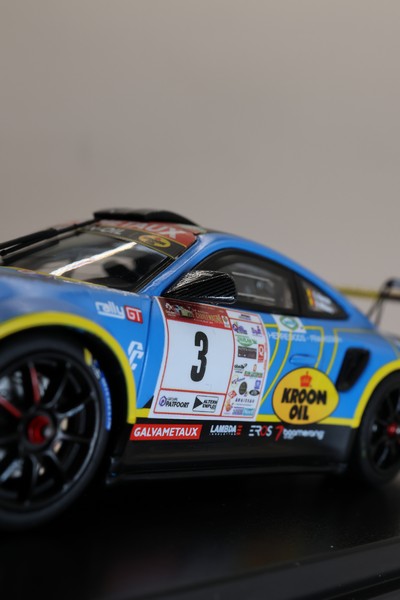
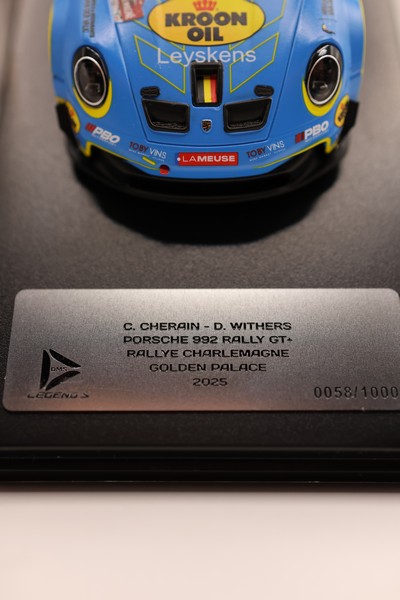
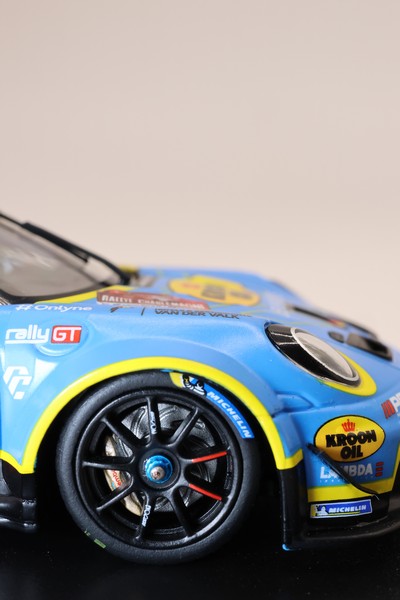
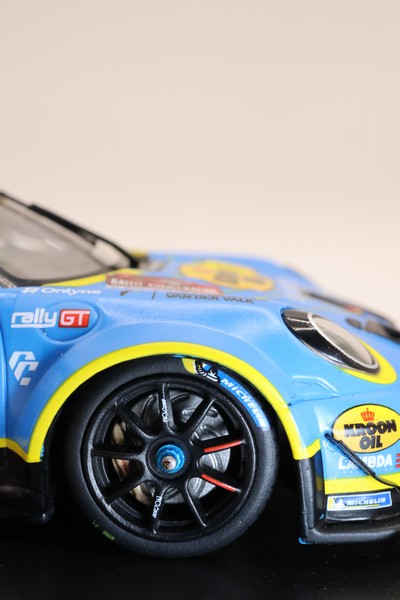
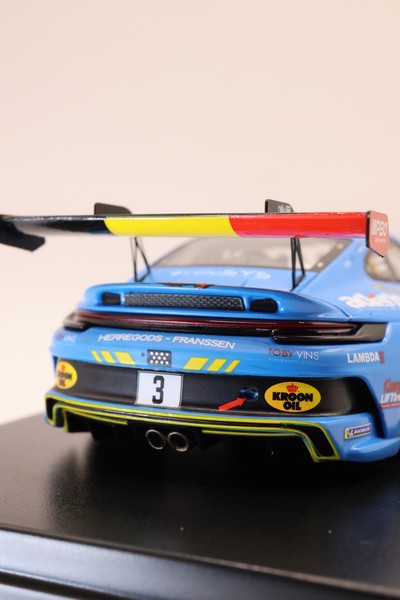
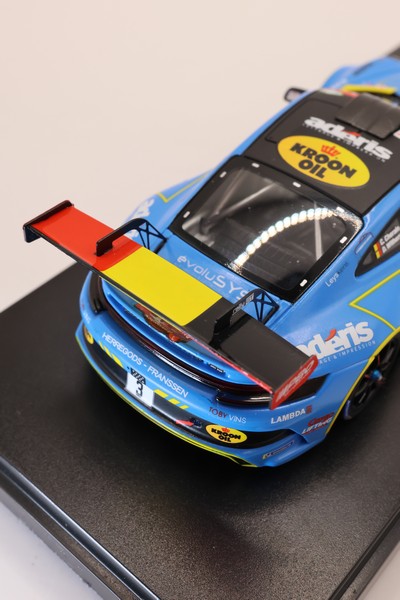
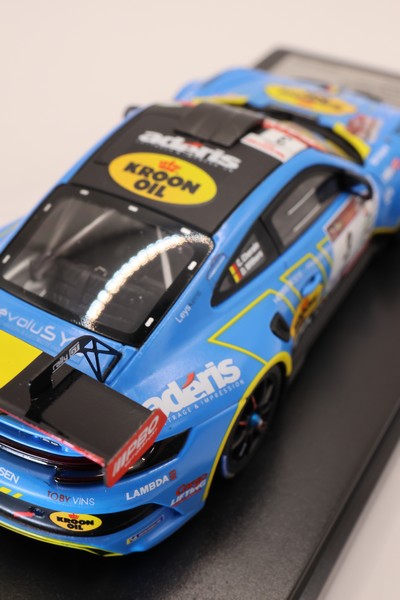
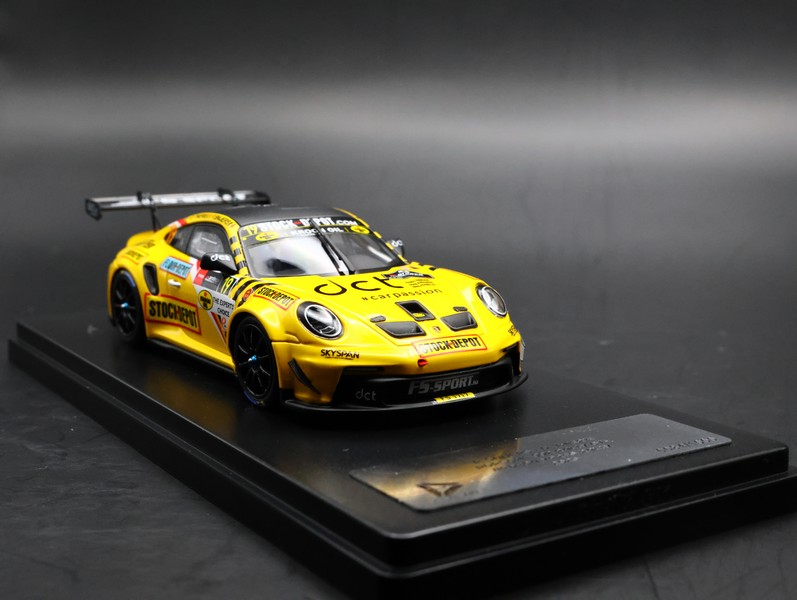
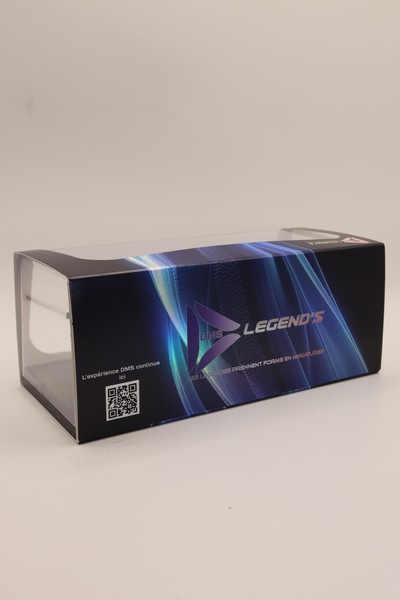
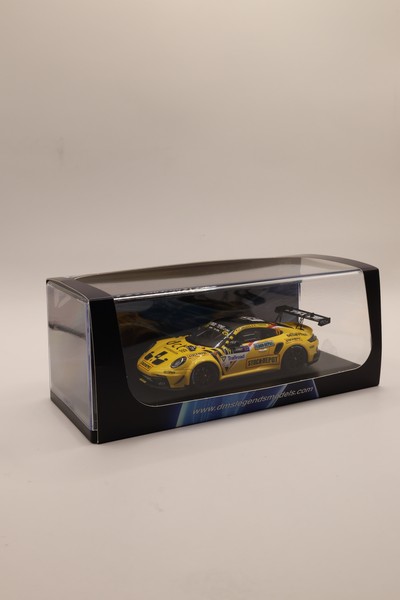
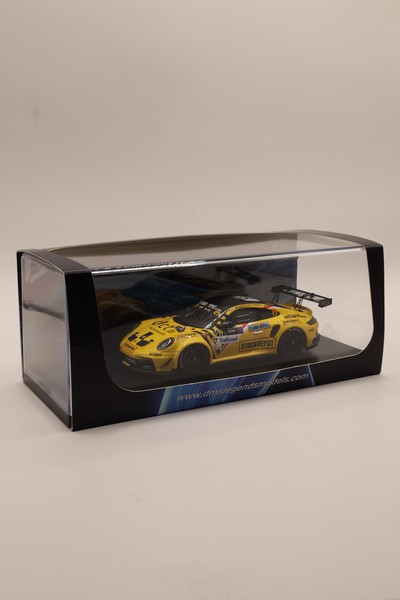
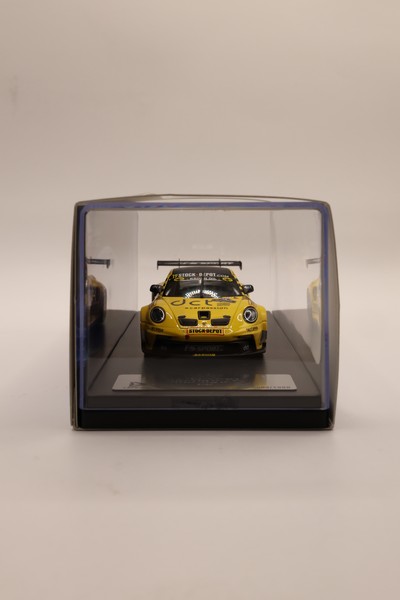
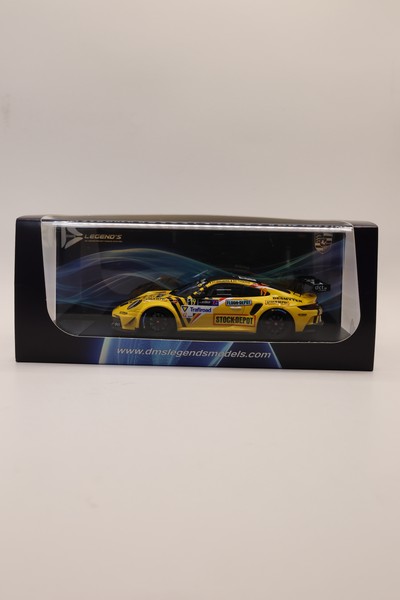
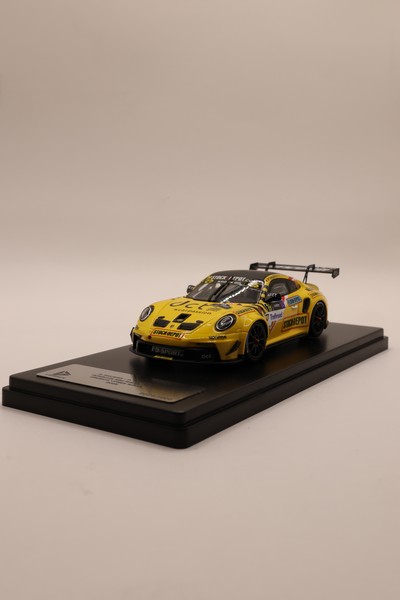
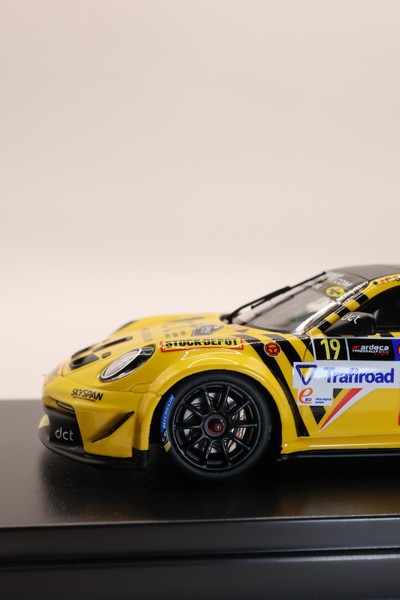
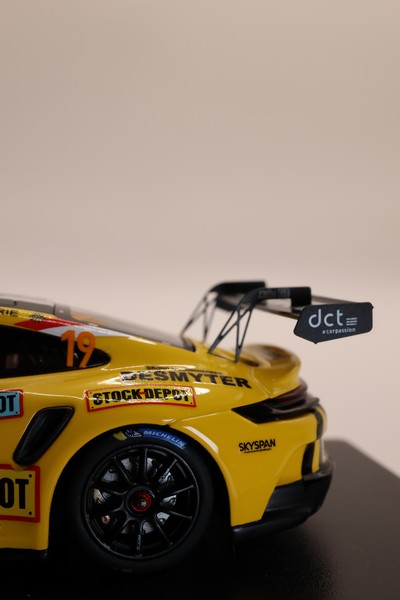
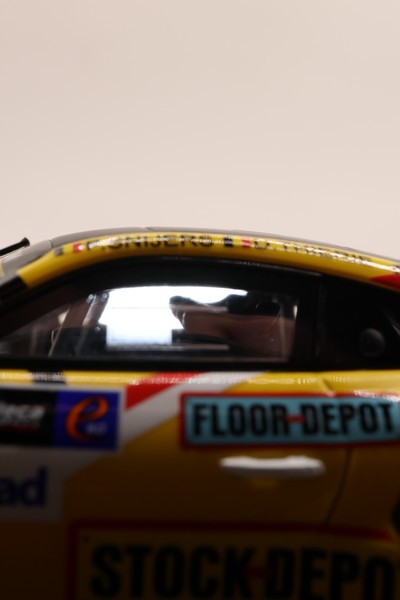
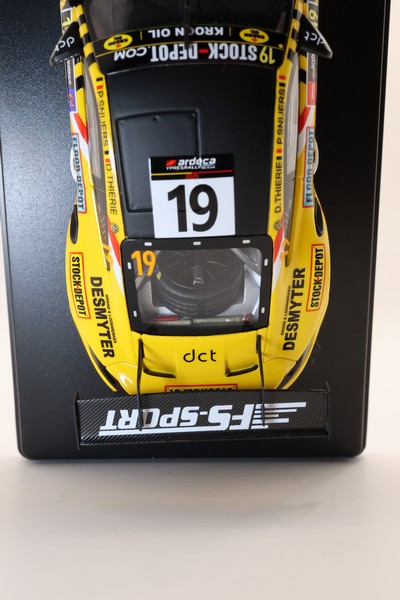
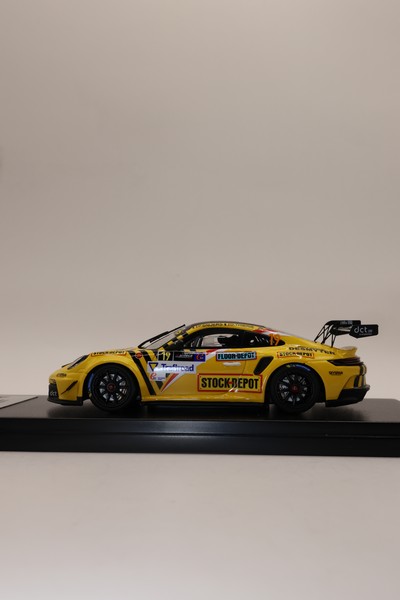
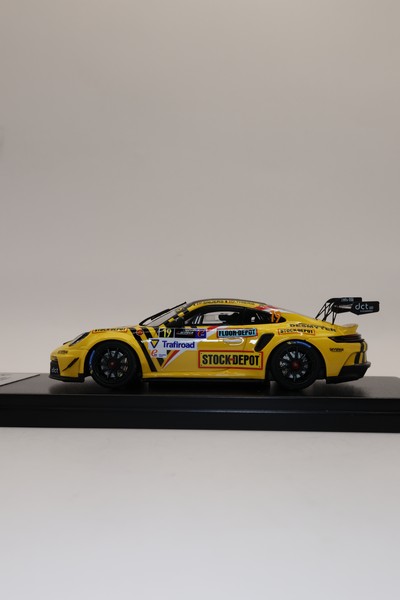
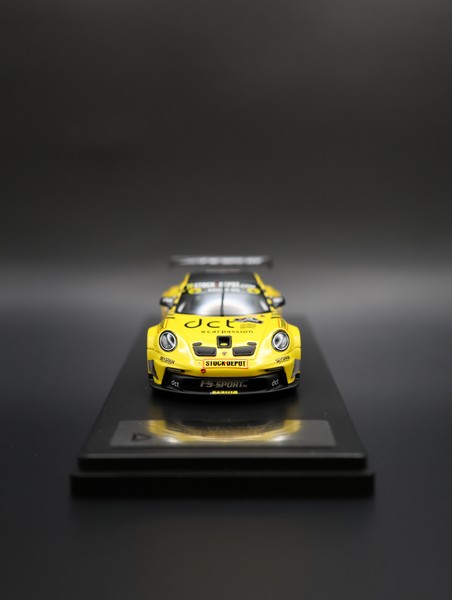
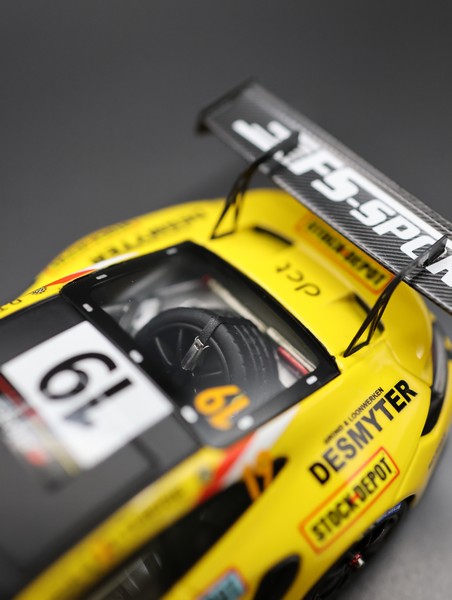
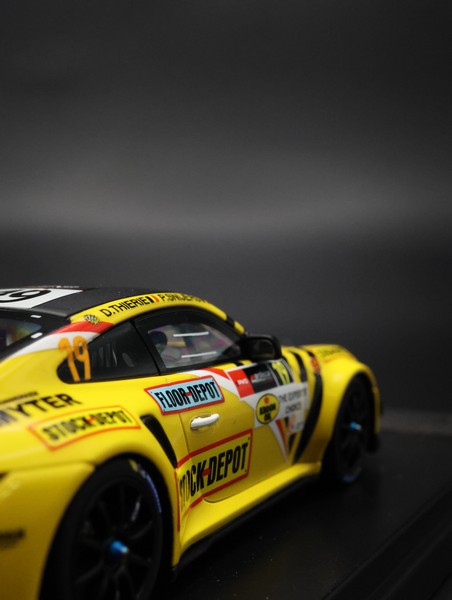
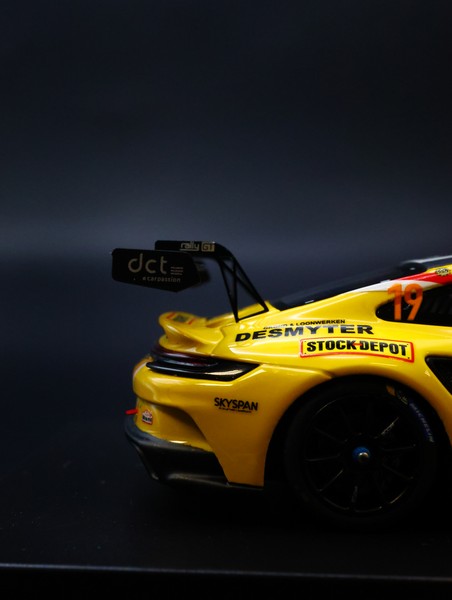
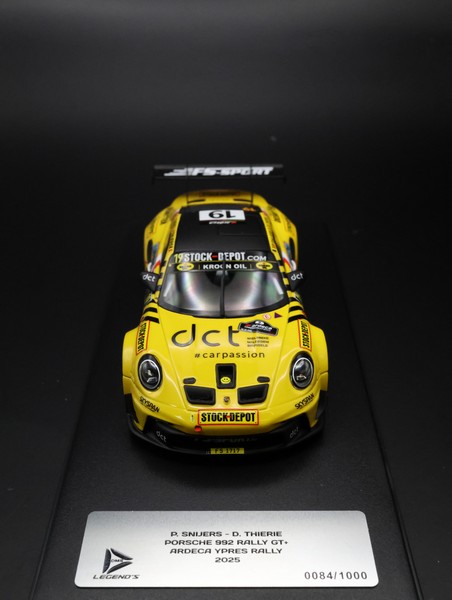
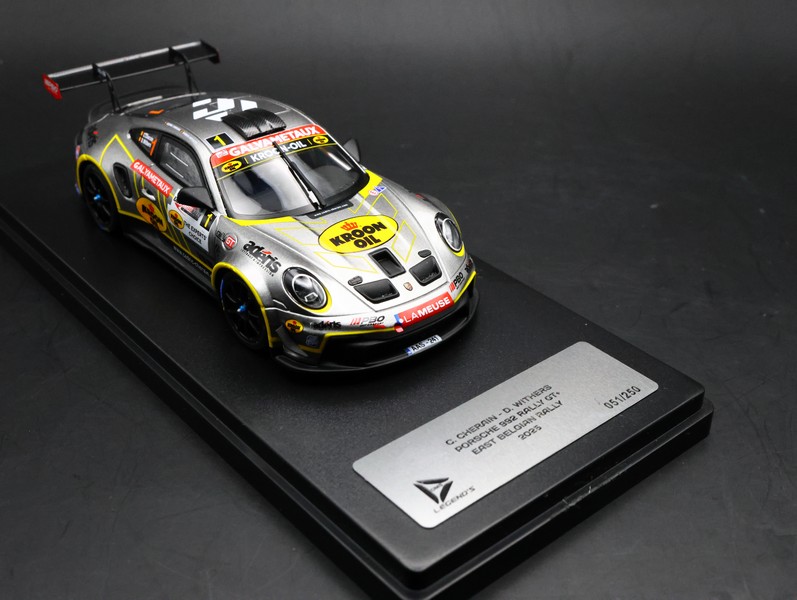
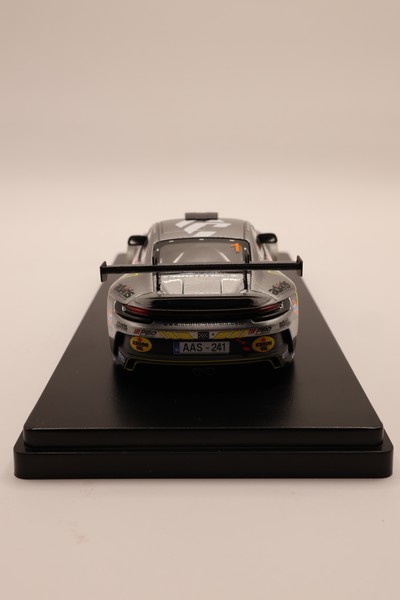
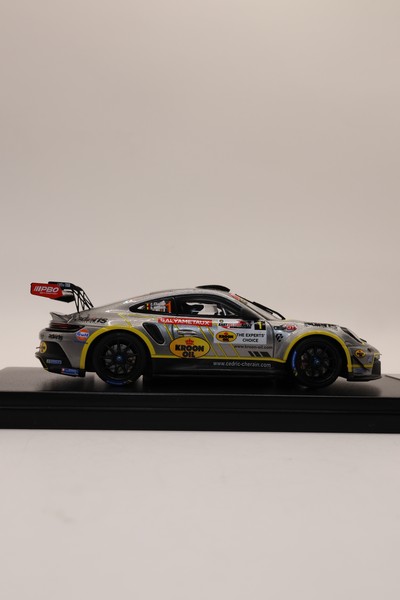
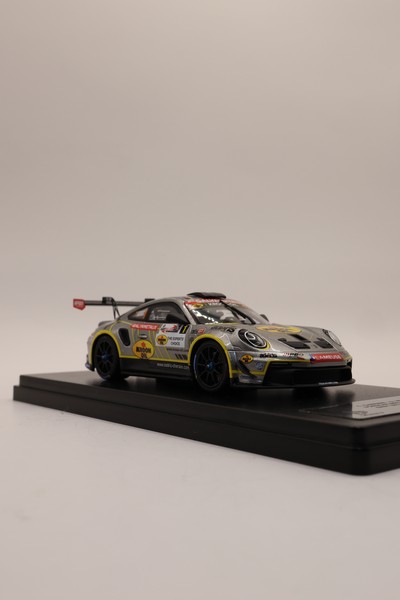
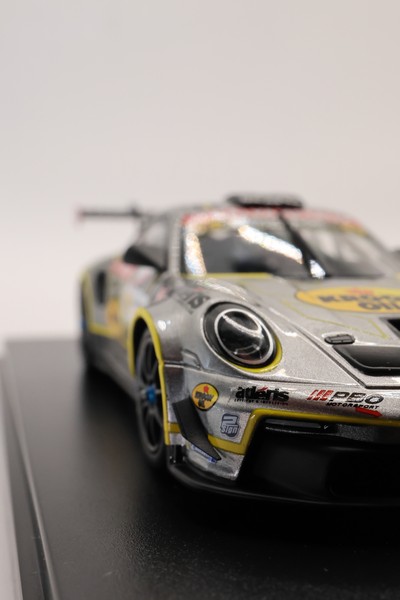
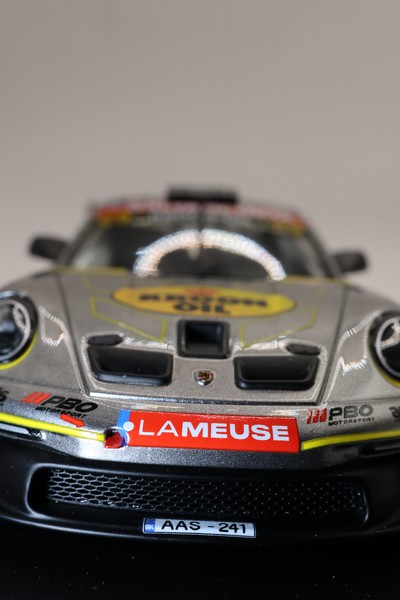
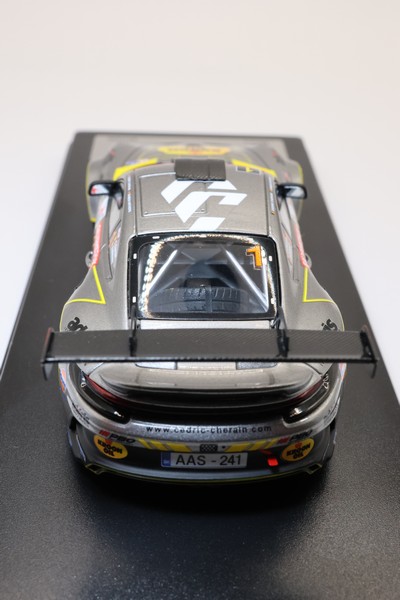
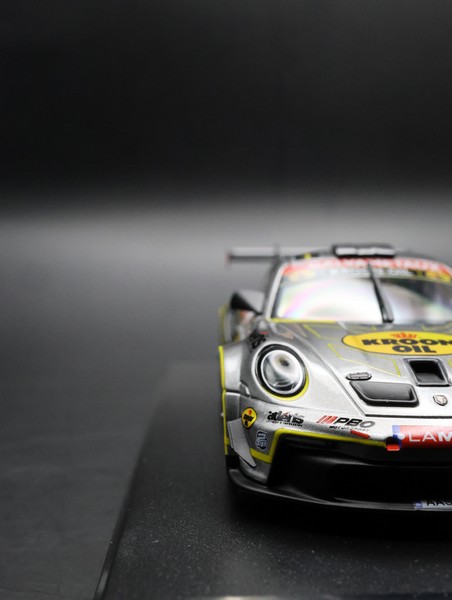
Anche nel piccolo grande mondo del modellismo il progresso avanza inarrestabile; a questo pensavo pochi giorni fa quando su Facebook – del tutto casualmente – mi sono imbattuto in una pubblicità di DMS Legend’s, un nuovo marchio francese che produce modelli di auto da rally dei giorni nostri. Dopo essermi diretto sul sito (graficamente moderno e piacevole), subito la mia attenzione è stata catturata dai primi automodelli commercializzati dalla ditta di Longjumeau, un grazioso paese situato nell’Île-de-France. Io sono praticamente da sempre un fan del marchio Porsche e questi modelli riproducono proprio alcune 911 GT+ che hanno corso in questi anni in gare europee, prevalentemente francesi com’è scontato che sia.
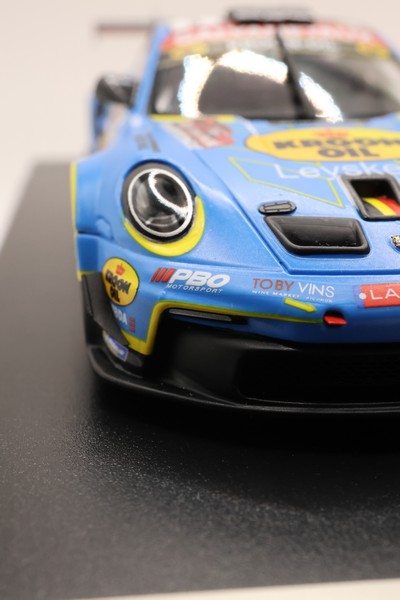
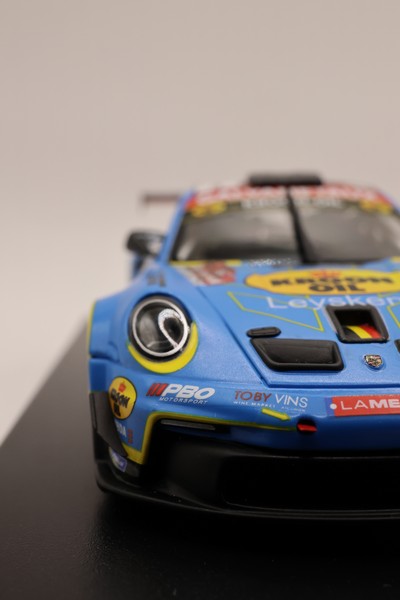
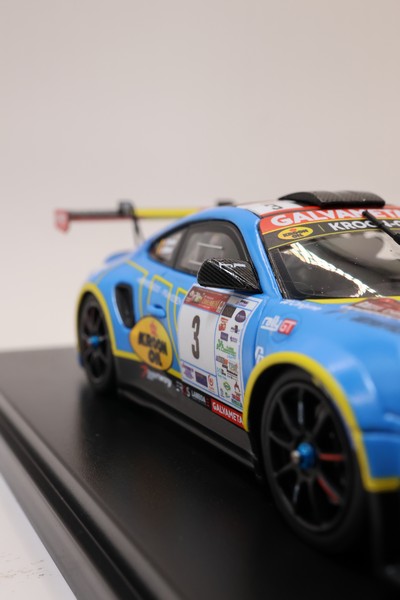
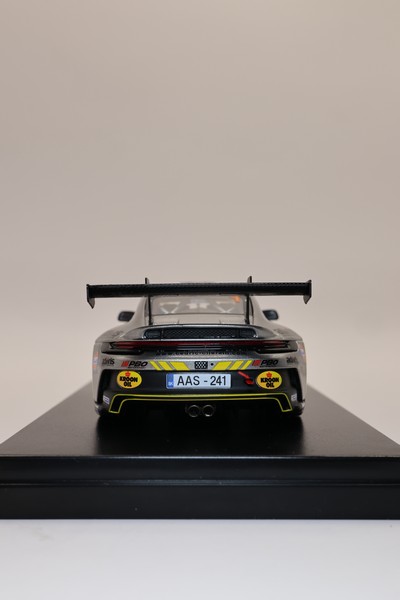
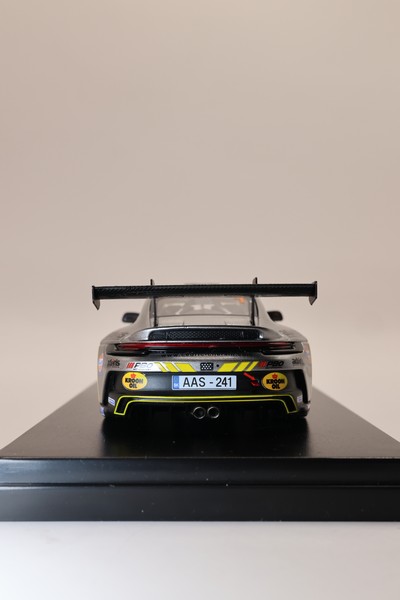
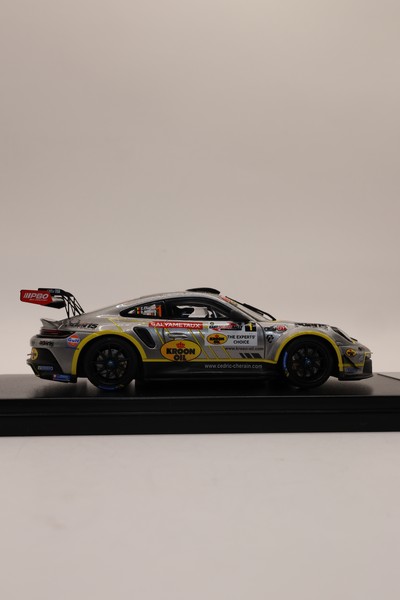
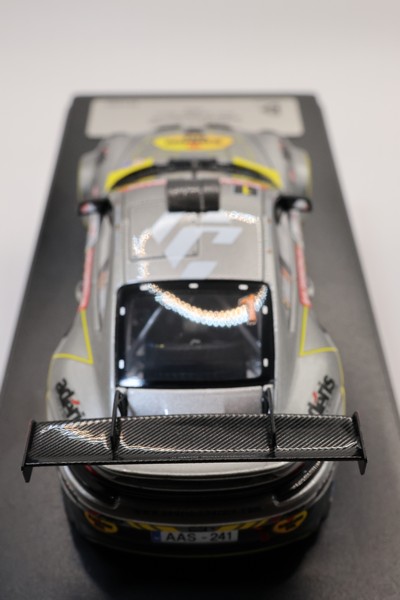
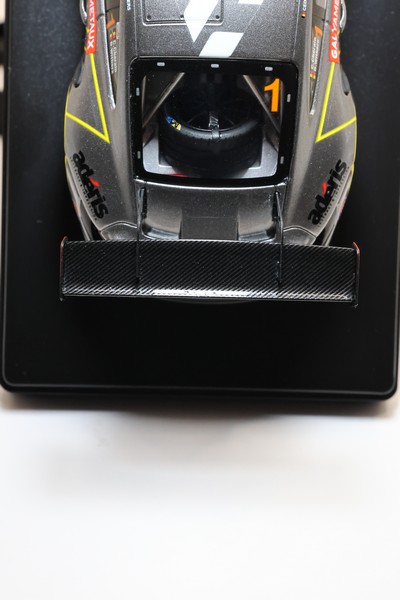
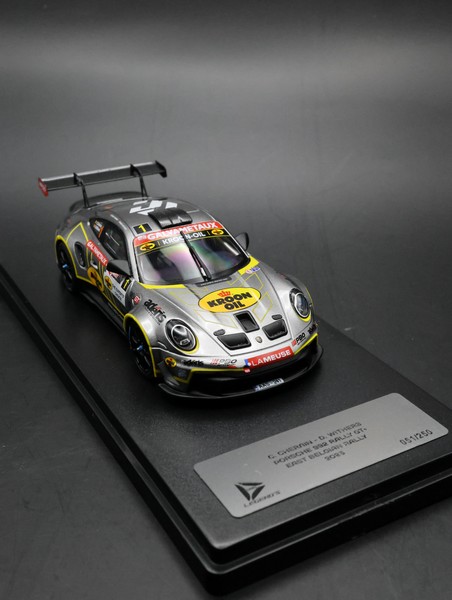
Detto fatto; non ci ho messo molto per ordinare il primo modellino, contrassegnato dal numero di catalogo DMS-0002 (vedi gallery sotto).
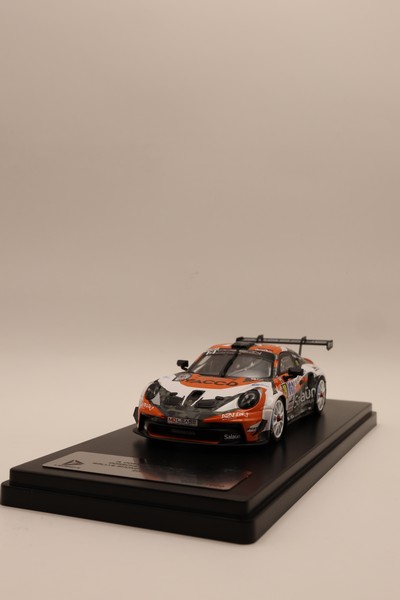
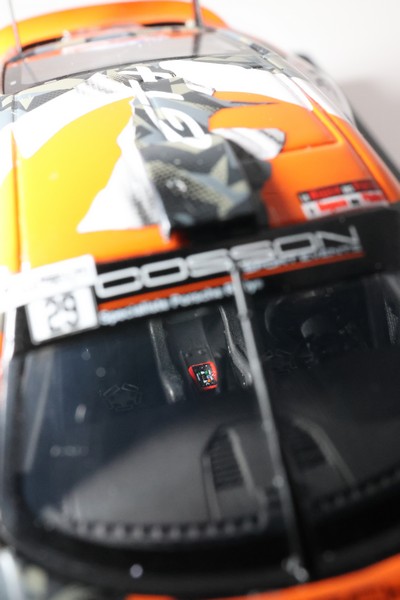
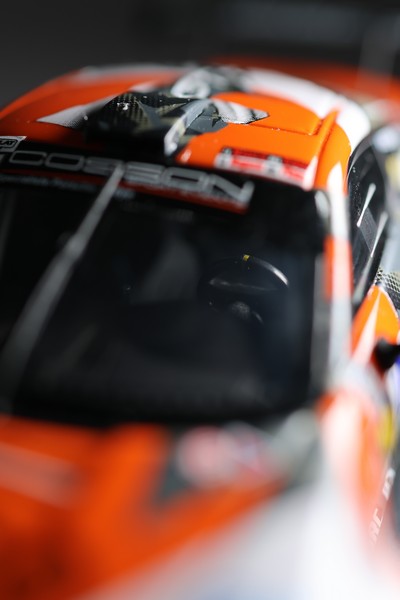
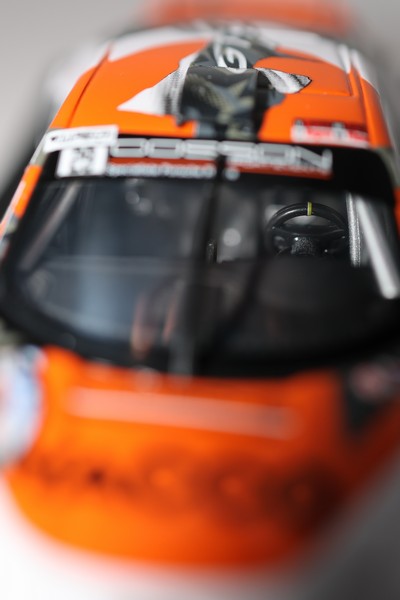
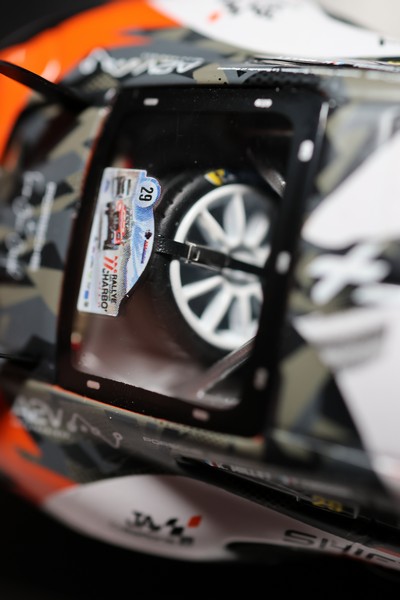
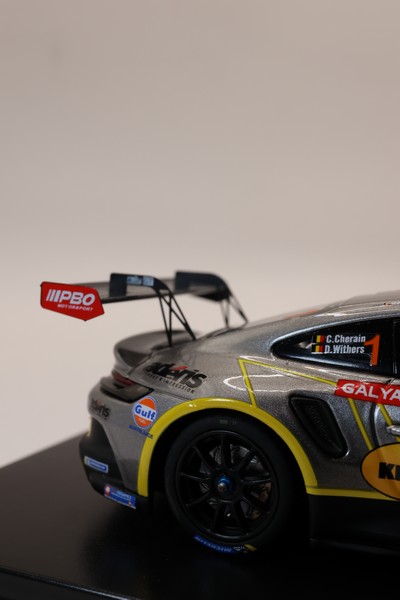
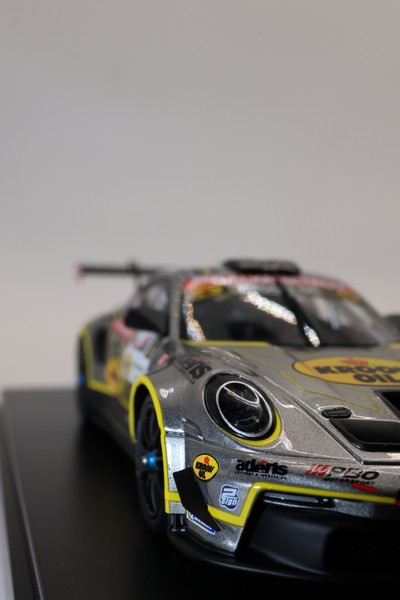
Osservandolo sul sito mi è sembrato veramente ben fatto ma la conferma definitiva avrei potuto averla solo quando mi sarebbe stato recapitato. La vettura riprodotta è la Porsche 911 GT+ che ha corso il Rallye National Charlemagne “Golden Palace” dell’anno passato, guidata dall’equipaggio belga formato da Cedric Cherain e dal navigatore Damien Withers, secondi assoluti. Il modello è in metallo, come del resto tutta la produzione di DMS Legend’s, e la decorazione è realizzata dallo stesso titolare del marchio, Florent Daumas. L’auto è veramente bella, nella sua livrea azzurra con fregi gialli dello sponsor principale “Kroon Oil” e riproduce perfettamente la vettura reale anche nei più piccoli dettagli; degno di nota anche l’abitacolo, al quale non sempre i produttori dedicano le dovute attenzioni. Anche la ruota di scorta fa bella mostra di sé, ben visibile attraverso il lunotto, ed aumenta non poco il realismo complessivo. In pochissimi giorni mi è stata consegnata dal corriere e tutte le impressioni positive hanno avuto conferma: non c’è nulla fuori posto e si ha la sensazione di trovarsi quasi di fronte ad un modello in scala… 1/1! Dico di più: spero che mi perdonerete il paragone forse irriverente ma mi sono tornate in mente le mai abbastanza rimpiante produzioni di HPI Racing… scusate se è poco!
Abbiamo chiesto a Florent di tratteggiare brevemente il ritratto della ditta ed ecco cosa ci ha raccontato:
“L’histoire de DMS Legend’s Models: de l’asphalte à la miniature.
L’ADN: la passion du réel DMS Legend’s Models n’est pas née dans des bureaux de design froids, mais au bord des spéciales de rallye, au milieu du bruit des moteurs et de l’odeur de gomme brûlée. Notre philosophie est simple: pour créer une miniature d’exception, il faut avoir vibré devant la vraie voiture. Le véritable acte de naissance de notre marque en tant que fabricant s’est écrit en direct, lors du mythique Rallye Mont-Blanc Morzine 2025. Cet événement a été notre “Épisode 1”. Être présents sur cette épreuve légendaire du Championnat de France, au cœur des Alpes, nous a permis de confronter notre vision aux exigences des pilotes, des teams et des puristes. C’est là que la dynamique DMS Legend’s s’est lancée, avec la volonté de retranscrire la fureur et la beauté des monstres du tarmac – comme la Porsche 911 GT+ – en modèles réduits ultra-fidèles. Plus qu’une simple entreprise, c’est un projet mené par des actionnaires passionnés de miniatures de rallye et soutenu par une expertise inégalée. Un de ses fondateurs bénéficie d’une solide expérience, ayant déjà œuvré dans ce milieu avec DMS PROD, assurant ainsi une connaissance approfondie du marché et des exigences des collectionneurs. Notre équipe fondatrice et consultative comprend également d’anciens pilotes et copilotes qui ont eux-mêmes forgé la légende sur les pistes, garantissant que chaque produit est imprégné d’authenticité et de l’esprit de compétition.
Haute qualité et exclusivité Notre mission est de transposer cette passion en objets de collection d’exception. DMS Legend’s se spécialise dans la création de miniatures de très haute qualité, allant bien au-delà des standards habituels. Chaque modèle est conçu avec une attention obsessionnelle aux détails, aux finitions, et à la fidélité historique. Afin de préserver leur valeur et leur caractère unique, toutes nos créations sont produites en série très limitée. Posséder une miniature DMS Legend’s, c’est détenir une pièce d’histoire exclusive, réservée aux collectionneurs les plus exigeants.
Au cœur de la légende: l’engagement des équipages Ce qui distingue véritablement DMS Legend’s, c’est notre processus de sélection et de validation. Nous croyons que les meilleurs modèles sont ceux qui racontent une histoire vécue. C’est pourquoi nous mettons un point d’honneur à incorporer les équipages (pilotes et copilotes) directement dans le processus de choix des modèles. Leur aval, leur connaissance intime des véhicules et des moments clés garantissent que chaque miniature sélectionnée est une véritable “légende” et un hommage précis à leur carrière”.
Abbiamo poi posto alcune domande alle quali Florent ha risposto di buon grado…
Pitlaneitalia.com: chi sono i proprietari di DMS Legend’s? Florent: Florent Daumas est le proprietaire de l’entreprise en tant que PDG et mr. Frederick Favre est associé en tant de directeur administratif.
Pitlaneitalia.com: da dove nasce la vostra passione per gli automodelli ed i rally? Florent: nous avons fait tous les deux du rallye soit en tant que pilote pour moi et copilote pour Frederick… nous sommes collectionneurs depuis la tendre enfance tous les deux.
Pitlaneitalia.com: qual è la vostra opinione sull’attuale situazione dell’automodellismo in scala 1/43? Florent: malheureusement c’est comme tout en ce moment, c’est un peu la crise, mais je pense que nos produits sous licences constructeurs vont surpasser les standards actuels.
Pitlaneitalia.com: cosa pensate dell’avvenire del nostro settore? Florent: j’y crois sinon je n’aurais pas lancé DMS Legend’s models!
E questo è tutto; l’esordio è stato davvero notevole e siamo certi che per questo marchio il successo continuerà ed anzi aumenterà… siamo solo all’inizio!
Di Fedor Eliseev (con la collaborazione di Marco Nolasco) avete letto alcuni giorni fa sul PLIT la prima parte della storia della Old Cars. Attendendo le puntate successive, vi proponiamo anche altri contributi di Fedor; iniziamo da un marchio molto amato dai collezionisti di modelli in metallo bianco, Conquest. Personalmente ricordo di aver sognato parecchio sulle foto che Modelauto Review pubblicava delle loro edizioni limitate, non sempre facili da reperire in Italia. Ecco intanto la prima parte di una storia originariamente apparsa su MAR Online, sito ormai chiuso, che proprio di Modelauto Review aveva rappresentato la continuazione digitale. [David Tarallo]
For collectors of precision white metal models of American and European cars, the name Conquest/Madison Models became a symbol of the highest quality and meticulous attention to every detail. Produced by SMTS, these miniatures were very expensive, but without any doubt they were worth it. These brands created by Henk van Asten are reasonably well known, but I believe that, in fact, we know much less about them than we do about Brooklin. Gianluigi Cappi did a superb job by publishing his comprehensive collector’s guides, which answer virtually every question connected with the company from Bath. I hope that someday enthusiasts will produce similar guides about SMTS and all its brands, including Western Models, Minimarque, Motor City USA and others.
This series of articles does not pretend to be a complete guide to all Conquest/Madison Models; it is simply an attempt to bring them together in one place and to tell the story of the company and its production. I believe that this research will encourage other enthusiasts to produce more and more books about white metal models.
For easier reading, I decided to divide this research into three parts according to the ranges created by Henk van Asten:
Conquest Models – American cars;
Conquest Models – European cars series;
Madison Models and Light Duty – a range of American cars and commercial vehicles.
For Henk van Asten, his journey into the model world began in 1952 at the age of six, when he received a Mobaco set, a Dutch-made construction toy consisting of wood and cardboard elements that allowed children to build houses. Some time later, Henk was given Meccano sets, and he fell in love with these construction toys made of metal parts. He acquired more and more Meccano and played with them with great enthusiasm. In developing his imagination, Henk built car chassis with working steering systems and many other mechanisms.
Henk’s father owned a tobacco shop in the village of Heeze, near Eindhoven, where he also sold household items and toys, which he purchased from a wholesaler named Jan van Zummeren. Jan had some Dinky Toys in his shop, which greatly impressed Henk and became the objects of his dreams. Henk’s father asked van Zummeren to bring one Dinky Toy for his son, who was overjoyed to receive it, and from that time on Henk received one Dinky every month, as his father purchased goods with that frequency. During that period, which lasted from 1956 to 1958, Henk acquired about 20 models, mostly of British production, though several were French. He played with them very intensively, which is why most of these cars were eventually destroyed, although several examples have survived to this day, naturally not in mint condition. Around the same time, Henk also received Schuco Varianto toys, consisting of cars that could run on a layout powered by a battery. Then, for Saint Nicholas Day in 1959 (6 December), he received his first Märklin train layout.
After graduating from school in 1964, Henk went on to study economics at the Katholieke Hogeschool Tilburg (now Tilburg University). As a student, he stopped playing with his trains and began collecting Dinky Toys very seriously. In 1965, he purchased the first model specifically intended for his collection: Dinky Toys number 198, the Rolls-Royce Phantom V.
Henk van Asten completed his university education in 1971 and became a teacher of economics and bookkeeping at a secondary school. During his free time, he continued collecting diecast models, constantly finding new ways to acquire them.
One day, on his way home, Henk visited an old-fashioned shop in Nederweert which still had some Dinky models from the early 1960s in stock. He bought many of them without hesitation, though he still regrets not acquiring the entire stock. Another place where Henk bought models in the mid-1970s was a shop in Veldhoven.
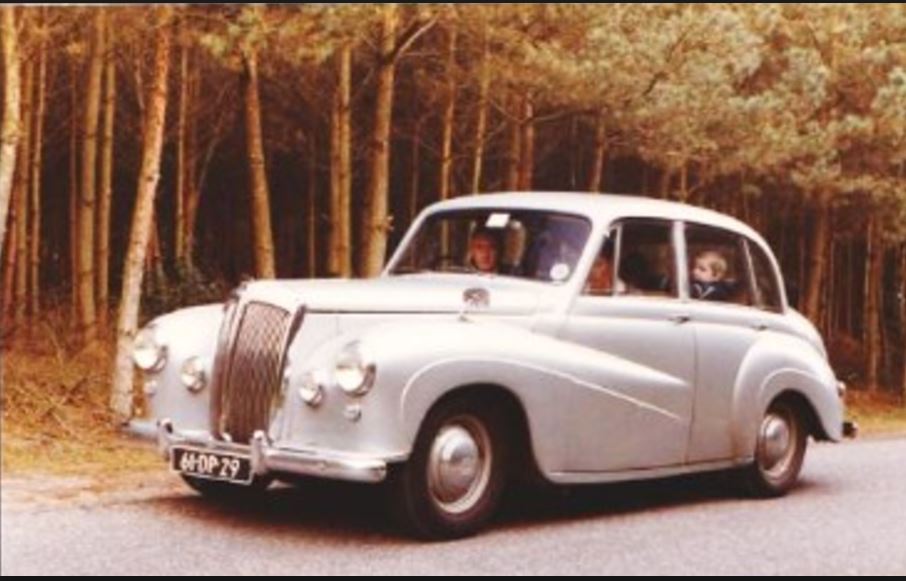
As an avid collector of diecast models, Henk also developed an interest in real classic cars. In 1973, he bought his first classic, a 1949 Rover P3 75 Saloon, which was later traded for a 1950 Bentley Mark VI. Then, in 1974, classic car dealer Arnold van Os offered Henk the opportunity to purchase a 1953 Daimler Conquest in good condition, which had previously been in use in London. This proved to be a very successful choice, one Henk has never regretted, and thanks to this purchase he became a member of both the local classic car club and the Daimler & Lanchester Owners’ Club in the UK.
The 1953 Daimler Conquest of Henk van Asten (photo taken in 1980 during a historic event). A friend of Henk’s at the wheel.
Driven by his passion for the Daimler marque, Henk found an advertisement in one of the English magazines for a 1938 Daimler E20 Charlesworth Saloon for sale. The car was in good condition but was not yet roadworthy. In 1975, during a holiday in England with his nephew, Henk visited Lutterworth, where the car was located. After a year, it had been repaired and made roadworthy. It was then collected by a friend and his girlfriend and driven to the Netherlands, to Henk’s home.
The following year, Henk and his nephew made a trip to a flea market. There was a plethora of diecast models for sale, and they bought a significant quantity. From that time on, Henk spent every holiday in England and purchased many Dinky Toys there. By the beginning of the 1980s, his personal collection had grown to approximately 1,000 models.
Flea markets and swap meets offered huge numbers of Dinky Toys in mint or near-mint condition at that time, and the idea of starting a side business was born. During his holidays, Henk bought models not only for himself but also for resale. The business became successful. He also met many English collectors and dealers. In the late 1970s, Henk met Rod Ward, who had a shop in Huddersfield and later in Leeds. In 1982, Rod established Model Auto Review, which became one of the most authoritative sources of information in the hobby for the next 30 years.
Visiting swap meets, shops, and flea markets, Henk realised that many cars had never been modelled in 1:43 scale. As a collector, he developed a passion for American cars of the 1930s to the 1960s, with their abundant chrome trim and spectacular styling features. In the 1980s, diecast manufacturers were not particularly active in this field, and some of the gaps were being filled by white metal companies such as Brooklin and Western Models. In fact, these two major producers in the white metal sector were unable to cover the full range of American cars produced by the major manufacturers. Moreover, at that time Brooklin models had a relatively simple level of detail. So, in 1985, Henk decided to create a highly sophisticated range that would reproduce chrome trim, mouldings, door handles, and other fine details, while avoiding duplication of models already produced by other white metal manufacturers. Naturally, he already had a list of miniatures he wanted to add to his personal collection.
Without any doubt, the process of creating a new company is a very difficult undertaking. It was necessary to find a good pattern maker and a production factory. After several attempts, one of Britain’s finest pattern makers, Pete Kenna, contacted Henk and offered to create a master for the new range. The chosen subject was a 1957 Chrysler 300C Convertible.
The next stage was selecting a name. Initially, Henk considered calling his range Diamodels, but Rod Ward persuaded him to choose another name. He therefore decided on Conquest Models, in honour of the Daimler Conquest, and Madison Models. The company itself was named Daimler House.
As a production partner, Henk approached SMTS in Hastings. The company, founded by Keith Williams, John Allen and Steve Overy, had been established only relatively recently at that time, but it already possessed all the necessary equipment and skilled staff capable of producing not only their own Racing Line and Classic Line series, but also fulfilling commissions for other companies and retailers.
At first, Henk also decided to create a less expensive range, which was named Madison Models. This was not in honour of President James Madison, but simply because the name sounded appropriate and carried an American association. The first release was the 1957 Chrysler 300C Convertible, marketed under the Madison Models name and introduced in 1987. It was an attractive model, but compared with the Conquest range it featured fewer chrome and photo-etched parts, allowing Daimler House to sell Madison models at approximately 20% less than Conquest. The Chrysler 300C became the first and only model ever offered in kit form as well.
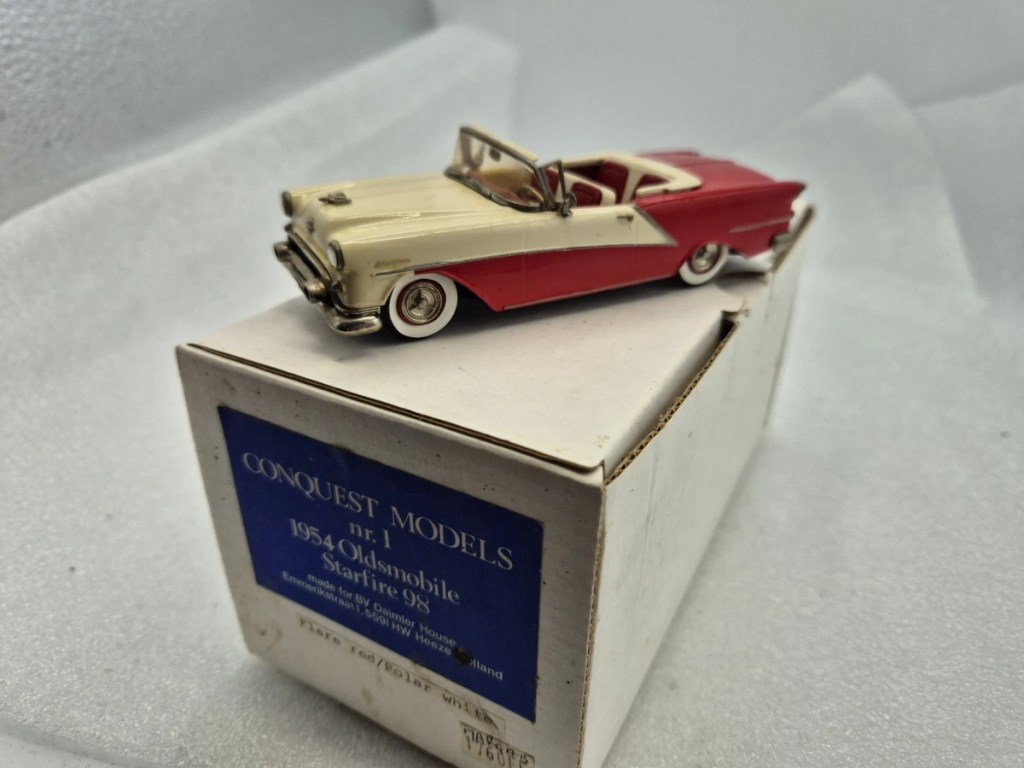
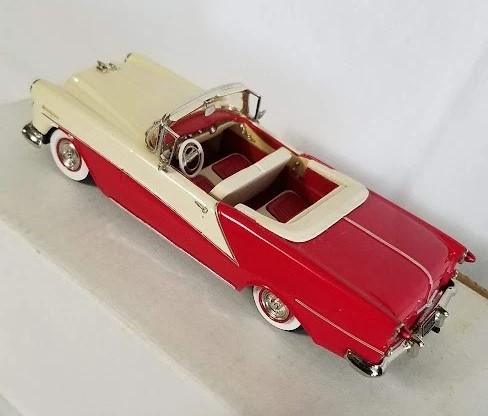
A few months after the release of the 1957 Chrysler, the first model in the Conquest range was introduced: the 1954 Oldsmobile 98 Starfire Convertible.
This miniature takes us back to a time when the Oldsmobile brand held a strong position within the GM empire. Designed by Harley Earl, the car featured innovations such as a panoramic windscreen, small rear fins, and a V-shaped chrome side trim line, all representative of the aerodynamic styling trend of the period. The chassis shared its basic structure with the Oldsmobile 88, but featured a longer wheelbase. The Rocket V8 engine was upgraded, with displacement increased to 5.3 litres and output raised to 185 hp. The four-speed automatic transmission remained unchanged compared with its predecessor.
In 1954, the Oldsmobile 98 was available in three body styles: a four-door sedan, the two-door Holiday Coupe, and the Starfire Convertible. The latter was chosen by Conquest for reproduction.
The Starfire was, in fact, the most expensive model in the range. In 1954, a total of 93,375 Oldsmobile 98s were produced, of which only 6,800 were Starfires.
For the Conquest range, developed by Henk in collaboration with SMTS, he aimed for the highest possible standards of quality. Though made in white metal, these models were far from crude, and their proportions were captured extremely well. This was the result of extensive measurement work, based on books and period advertisements featuring the real cars. It was also thanks to the excellent work of the pattern maker, combined with SMTS’s highly professional standards in casting, painting, and final production.
Each model featured chrome parts, fully detailed dashboards, trim closely replicating the real prototype, separate door handles, clear resin headlights and red tail lights, photo-etched windscreen wipers, number plates, and numerous other small details. The earliest Oldsmobiles were painted in single-tone colours, while later releases were offered in various two-tone combinations.
Nr.1 (source: eBay)
The baseplates were rather plain, but few collectors paid much attention to underside details. Here, customers could find information including the model name, catalogue number, range name, and the manufacturer’s name, SMTS. Additional details such as aerials, rear-view mirrors, mascots, and other delicate components were supplied in a separate small bag and were intended to be fitted by collectors displaying their models in large cabinets.
As for packaging, Daimler House initially used white cardboard boxes, later switching to blue ones. During the early years, there were no leaflets, collector cards, or advertising inserts inside, which makes it difficult today to determine exactly how many units of each model were produced.
At the same time, Henk van Asten’s spectacular models were undeniably expensive. In the early 1990s, for example, the average retail price for a Conquest or Madison model was around £80–90, while Brooklin retailed at approximately £30 and Western Models at around £50.
The brass master for the 1954 Oldsmobile Starfire was created by Ian Playfoot. The first editions were produced in Blue Metallic and Willow Green Metallic. Later editions appeared in Flare Red/Polar White and Capri Blue/Polar White.
Because SMTS was unable to increase production capacity quickly enough, they could not initially provide Henk with sufficient quantities. As a result, one batch of Starfires was shipped to the Netherlands in kit form to be painted and assembled by two model builders employed by one of Henk’s acquaintances. The quality was very good, but their pace was rather slow.
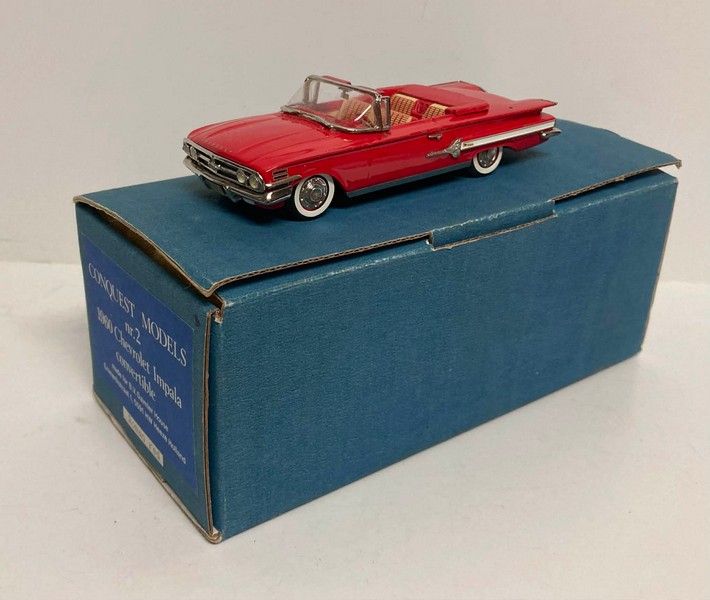
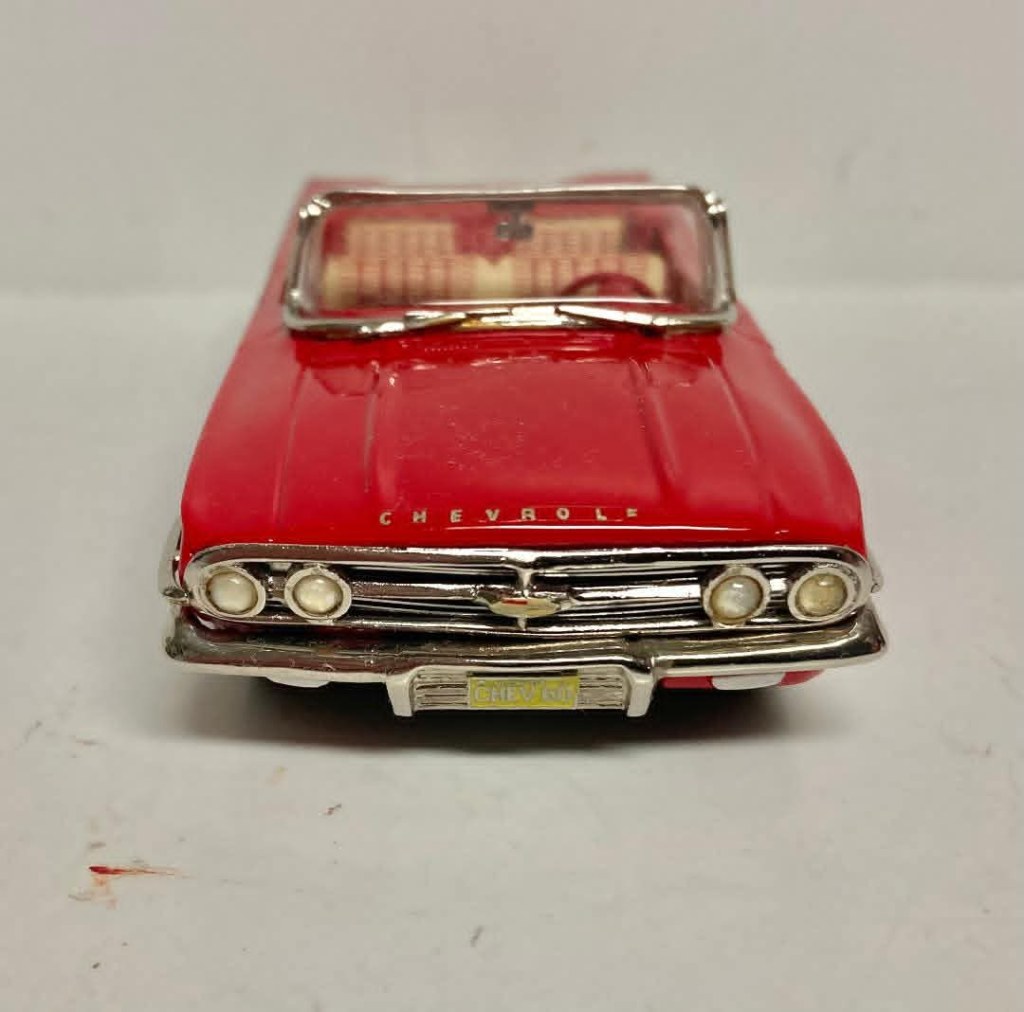
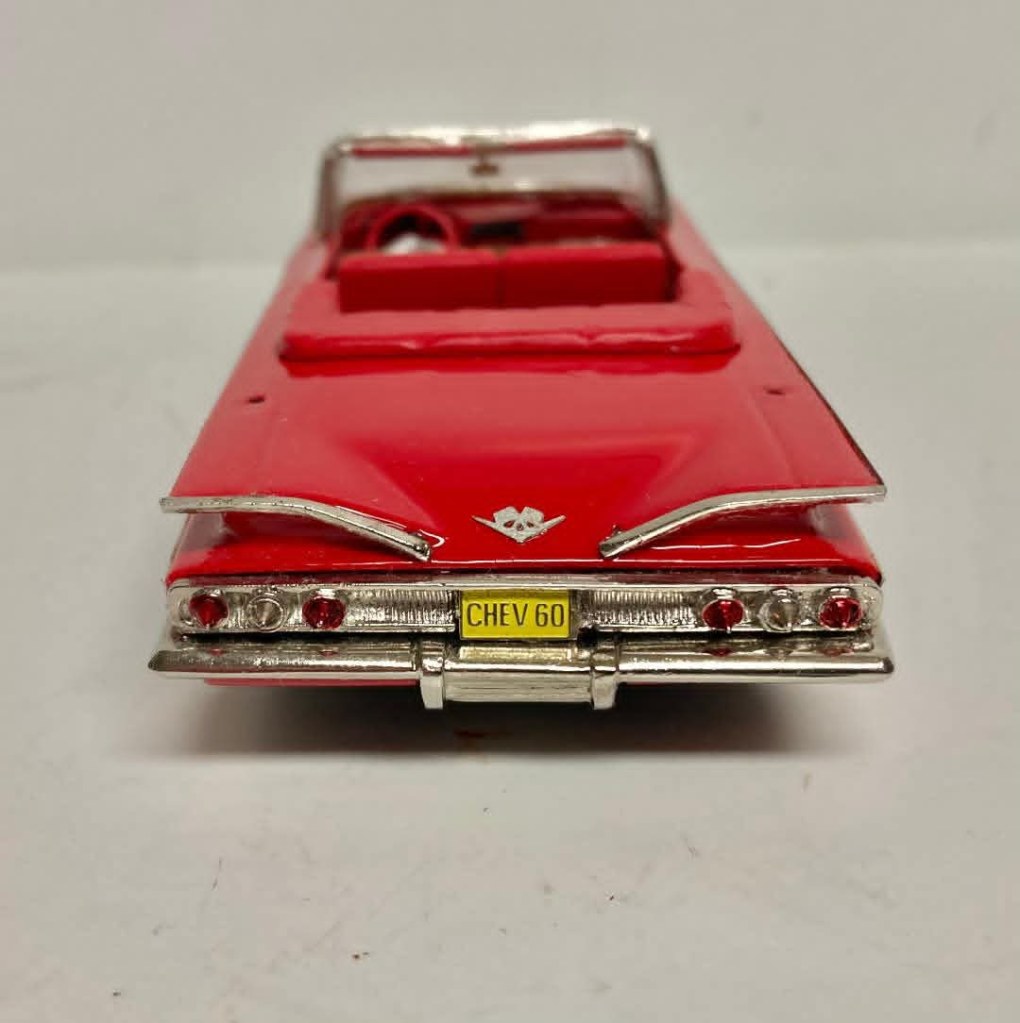
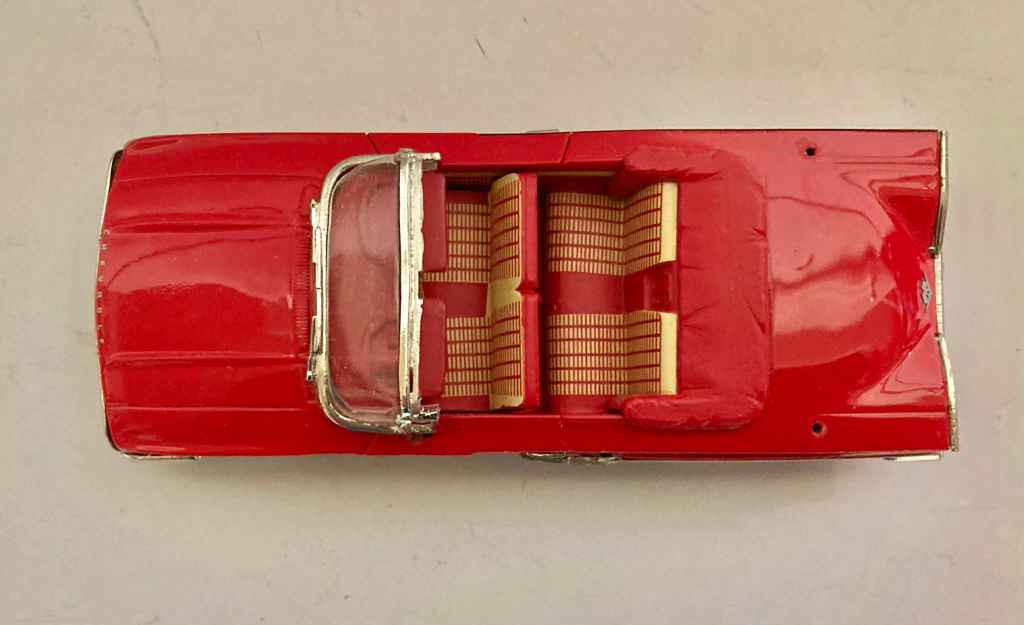
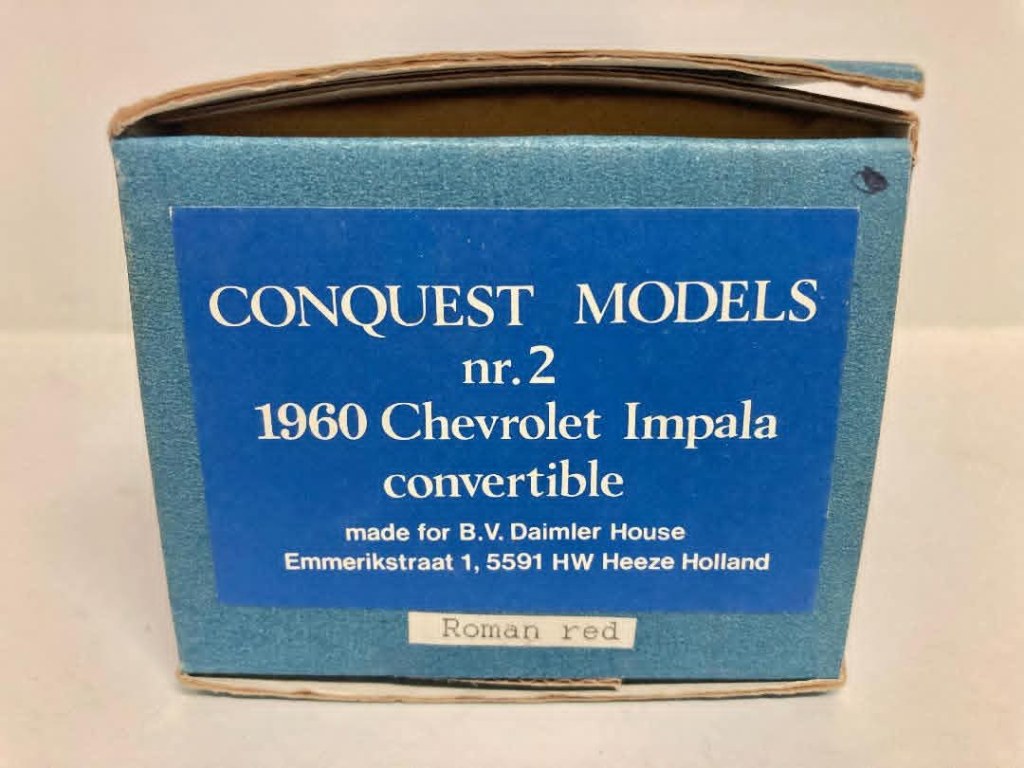
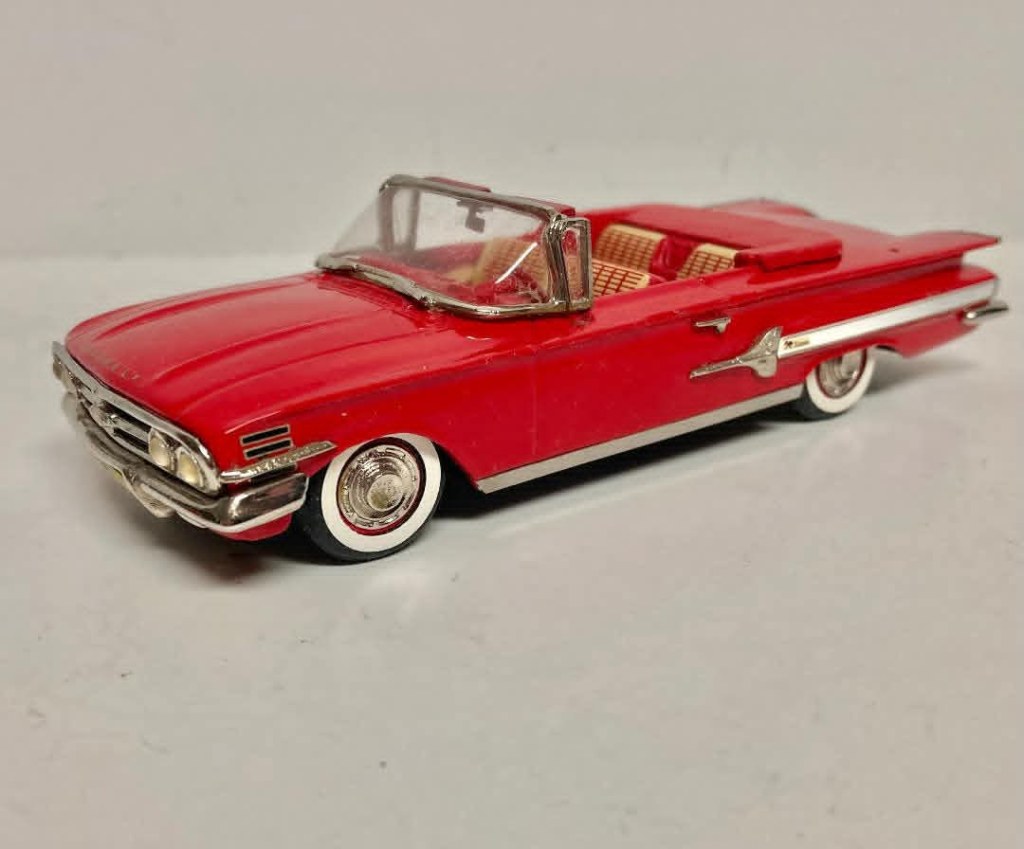
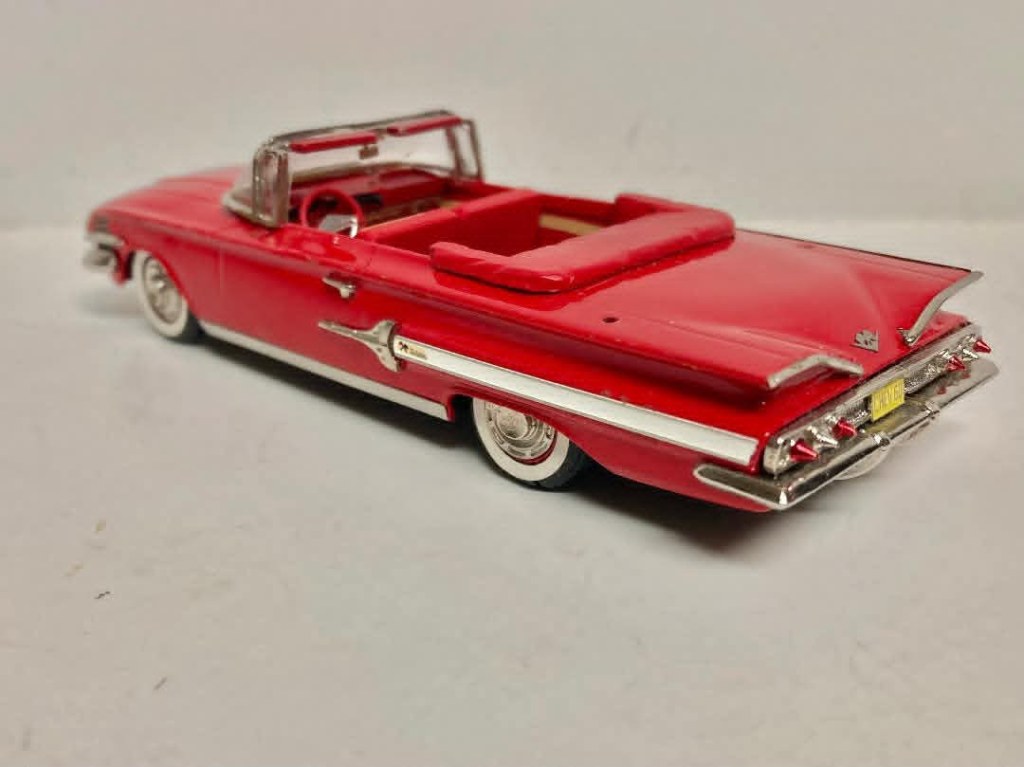
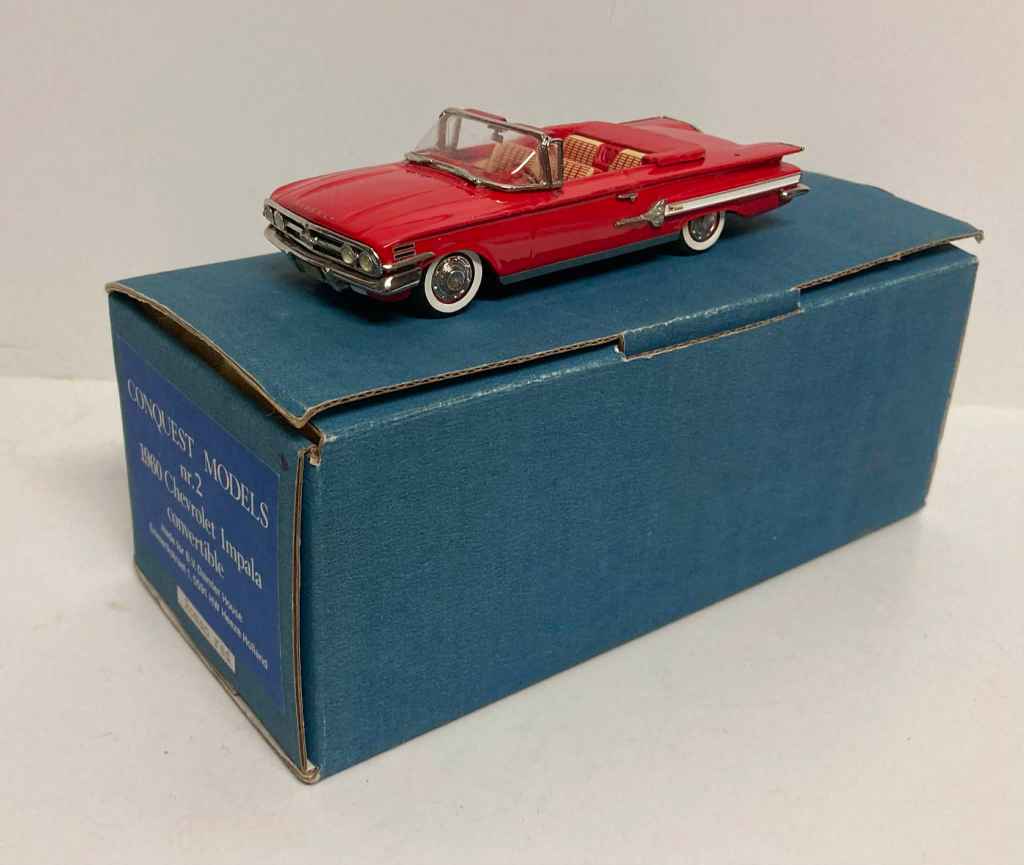
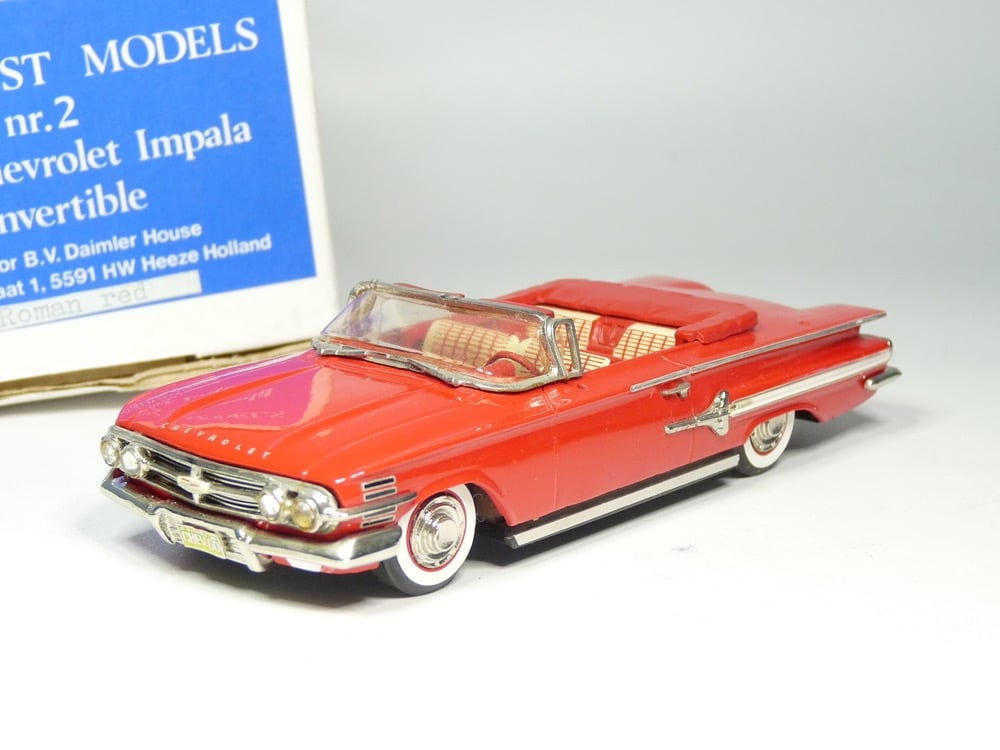
Nr. 2, the 1960 Chevrolet Impala Convertible Top Down, was released in 1988. This model reflects the new design trends that emerged after the 1958 Eisenhower recession, when manufacturers began to move away from Detroit baroque styling and increasingly embraced aviation-inspired motifs. The 1960 Impala featured elegant rear fins and twin headlights integrated into the radiator grille. Engine options included a 3.9-litre six-cylinder producing 135 hp, as well as several V8s, the most powerful of which delivered 335 hp. The Impala became the most expensive Chevrolet, although Chevrolet remained the most democratic—that is, lowest-priced—brand within the GM corporate line-up, and naturally even the most powerful Impala never approached Cadillac or Buick pricing.
The model was available in Roman Red, Ermine White, and Horizon Blue. From Nr. 2 onward, Fa. Daimler House began offering some models in alternative versions. Naturally, the convertible top-up version was also designed, although production only began in 1991. For this variant, catalogue number Nr. 2A, the available colours were Ermine White and Red Top.
Model nr.2 (photos by Tim Musselman)
Nr. 3, the 1955 Buick Super Riviera, was added to the Conquest range in 1989. These remarkable hardtops helped Buick secure third place in production volume in 1955 – an excellent result – and, strictly speaking, hardtop versions enjoyed much stronger customer demand than traditional sedans. In fact, the 1955 Buick shared the C-body platform with other GM divisions, namely Oldsmobile and Cadillac. For example, the Oldsmobile 98 previously released in the Conquest range shared many structural features with Buick, although the styling was, of course, entirely different.
The model, based on a master created by Pete Kenna, became highly successful, and in the future this pattern would be used for other mid-1950s Buick versions. Colour variants included Cherokee Red/Carlsbad Black, Victoria Blue Metallic/Cameo Beige, and the three-tone Metallic Windsor Grey/Dover White with Carlsbad Black roof.
Models nr.2, 3 and 4 (photos by Albert Kopans)
From 1990 onward, Henk van Asten significantly expanded his business. First, SMTS was able to increase production volumes and provide Daimler House with approximately 200 units per month. As a consequence, instead of introducing just one model per year, three to four models were now being added to the range annually. Despite the high prices, demand continued to grow steadily, and Henk ultimately decided to leave his teaching career and concentrate entirely on the model car business.
Daimler House launched a separate Conquest series devoted to European cars, while Madison Models were no longer positioned as a cheaper alternative to Conquest. As a result, Madison acquired all the masters of the Conquest range, and there were no meaningful differences between them anymore. Conquest and Madison nevertheless continued as separate ranges of American cars from the 1930s to the 1960s, without duplication between the two ranges.
At the same time, Daimler House also became a dealer for other white metal brands such as Kenna, Goldvarg, and Motor City USA.
Initially, Henk did not equip his miniatures with whitewall tyres, but approximately a year after production began he started using circular white decals. These were replaced in 1990 when a special master was created, enabling SMTS to fit models with proper whitewall tyres. There were two types of whitewalls: one for 1950s models and another for 1960s models.
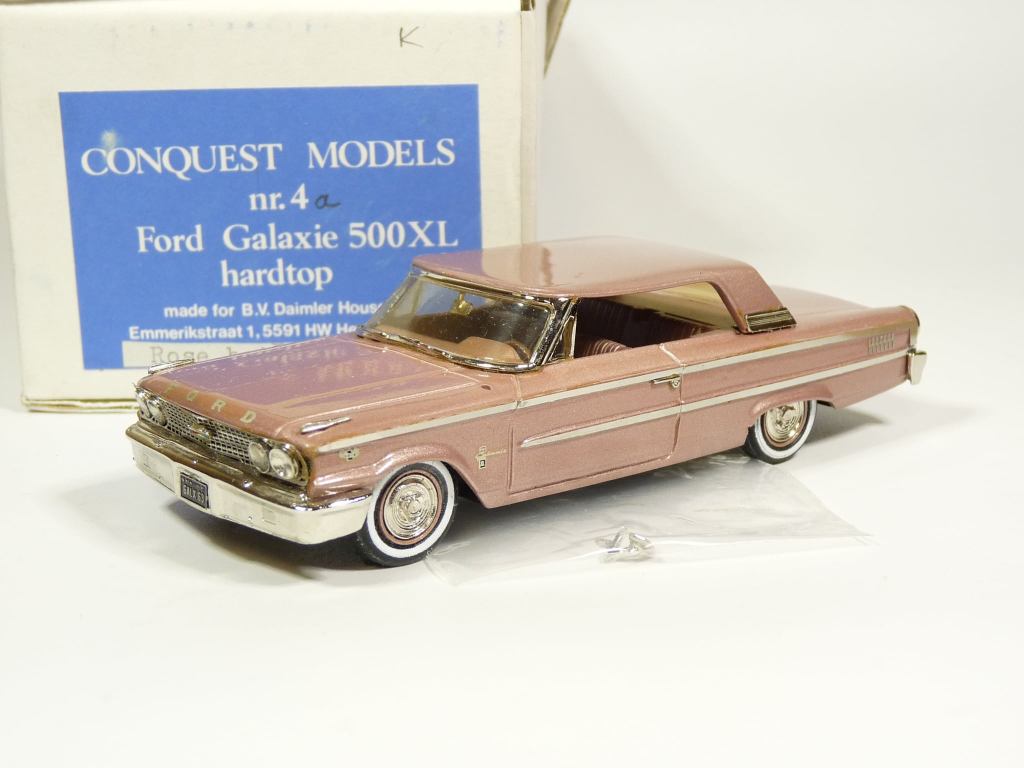
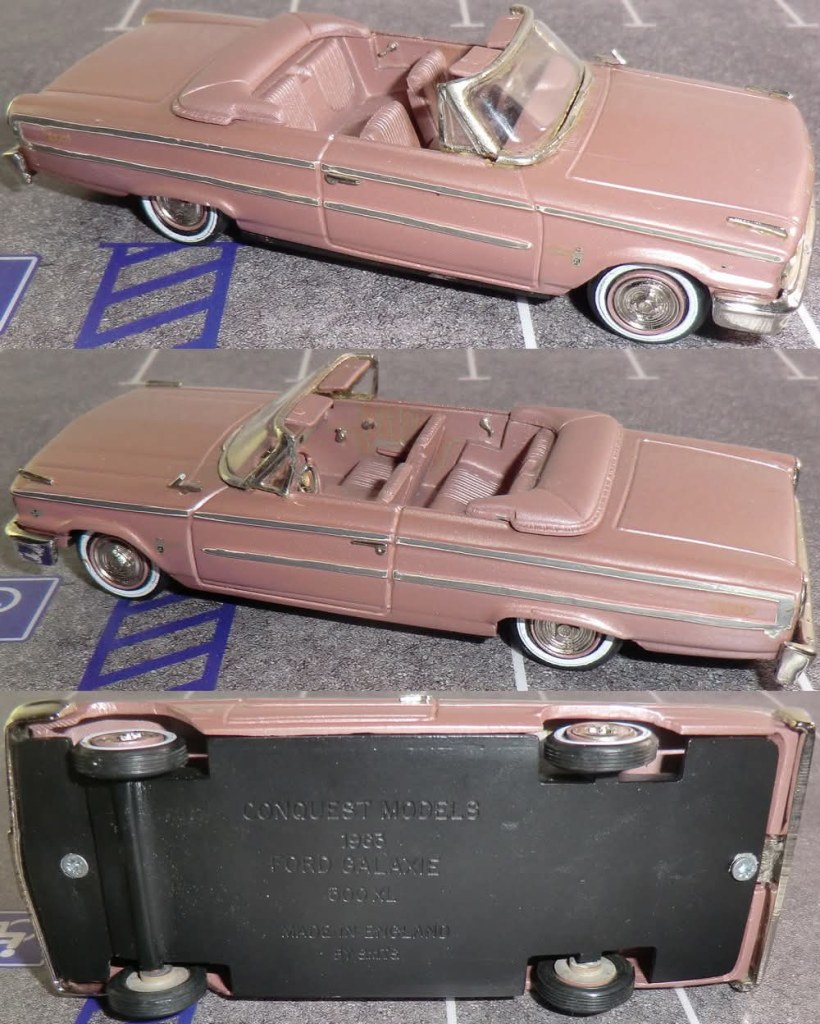
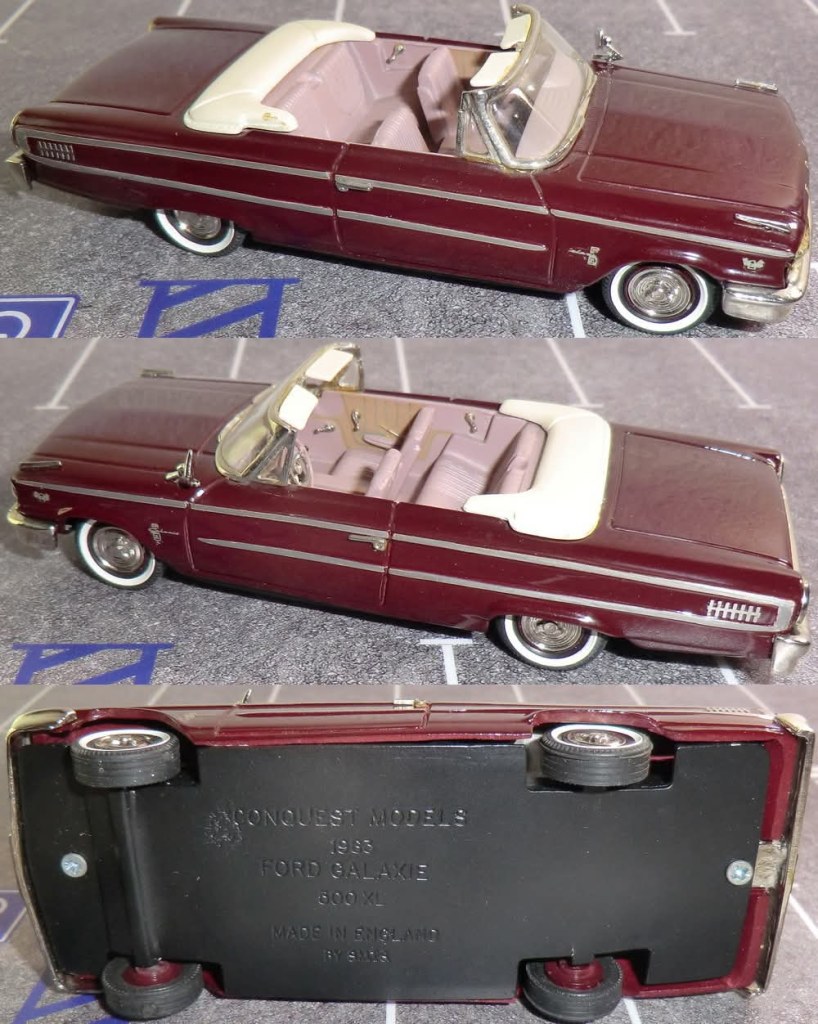
1990 became the first fully busy year for Daimler House, when four models were added to the Conquest range: Nr. 4, the 1963 Ford Galaxie 500 XL Hardtop; Nr. 4A, the Convertible; Nr. 5, the 1954 Oldsmobile 98 Holiday two-door Hardtop; and Nr. 6, the 1957 Imperial Crown four-door.
With the Galaxie 500 XL Hardtop and Convertible, Henk finally turned his attention to another major corporation besides GM, namely Ford Motor Company. By the early 1960s, the full-size Galaxie range had almost replaced the Fairlane. The 1963 model chosen for reproduction did not differ dramatically from the previous 1962 version. The 500 XL versions were available with a 6.4-litre V8 producing 300 hp and represented the most powerful versions in the 1963 Galaxie range. The styling was relatively restrained yet very elegant, with large round tail lights reminiscent of jet engine exhausts. The convertible version was called the Sunliner, while the hardtop was known as the Club Victoria. Nr. 4 was available in Rose Beige Metallic and Oxford Blue, while Nr. 4A came in Rose Beige Metallic and Heritage Burgundy. These models were so highly detailed that even the bolts on the bumpers were visible.
Nr. 4A (photos by J.Ceejay Nakamoto)
The 1963 Galaxie proved highly suitable for modelling, and a year later Henk added Nr. 9, the Country Squire Station Wagon, to the range. Incidentally, the Galaxie also competed successfully in NASCAR, and many years later SMTS reused these patterns for their Racing Line series.
Nr.5 (photo by Henk van Asten)
Nr. 5, the 1954 Oldsmobile 98 Holiday two-door Hardtop, was one of the previously mentioned cars in this family and a logical companion to Nr. 1. Several colour variations were released: Willow Green Metallic/Saratoga White, Turquoise Metallic/Maire Cream, and a special edition for E.W.A. Miniature Cars USA painted in Turquoise Metallic/Polar White. The Oldsmobile 98 range would have been almost completely covered after the later introduction of Nr. 19, a four-door Holiday hardtop.
From left to right: Nr.1, Nr.5, 1956 Oldsmobile Super 88 2- dr Hardtop by 43 Avenue. Photos by Paul Friend
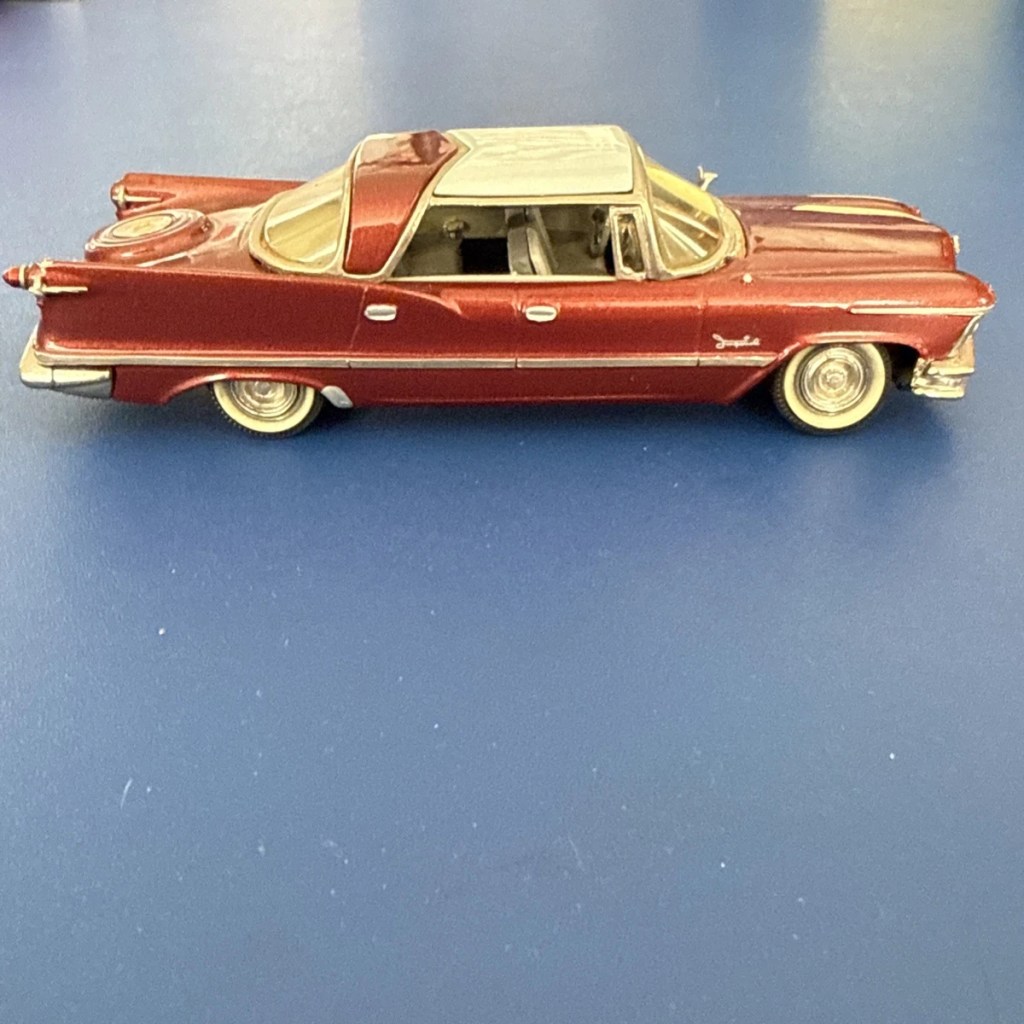
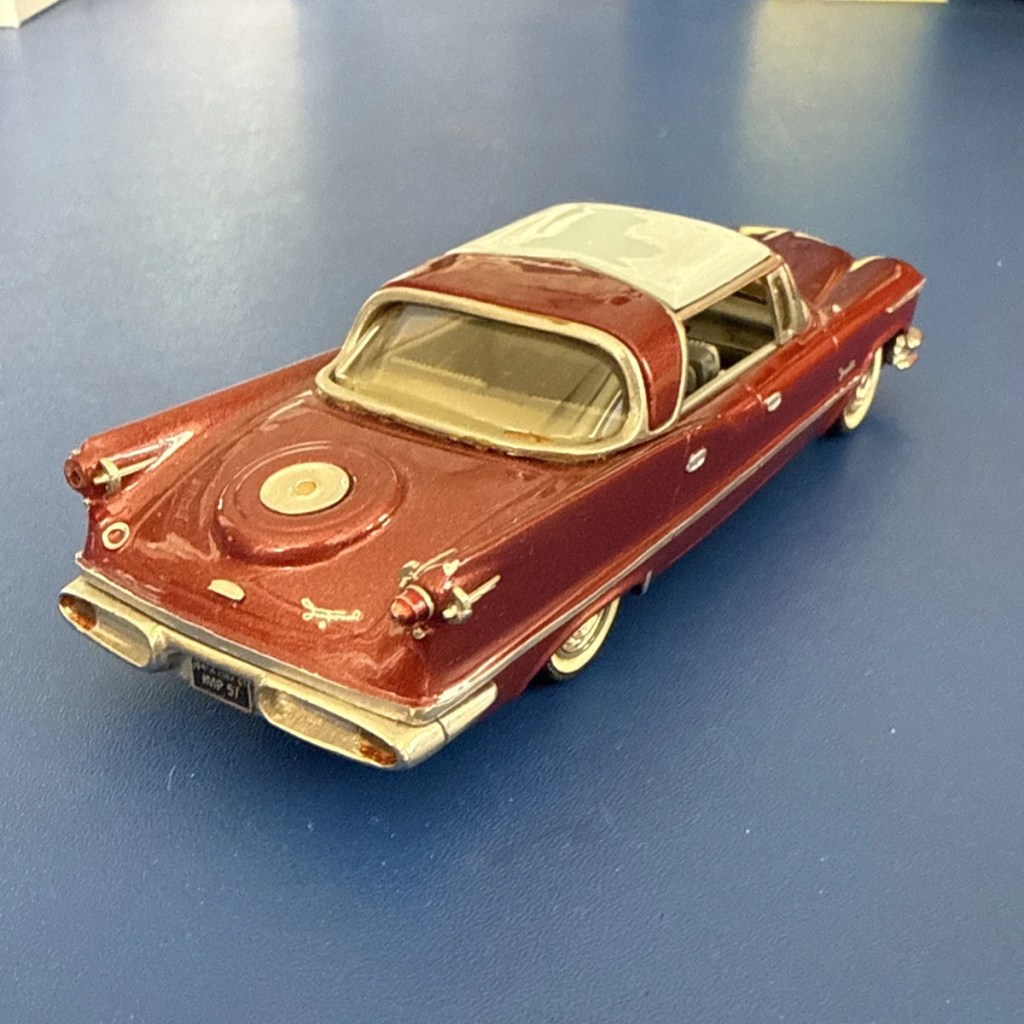
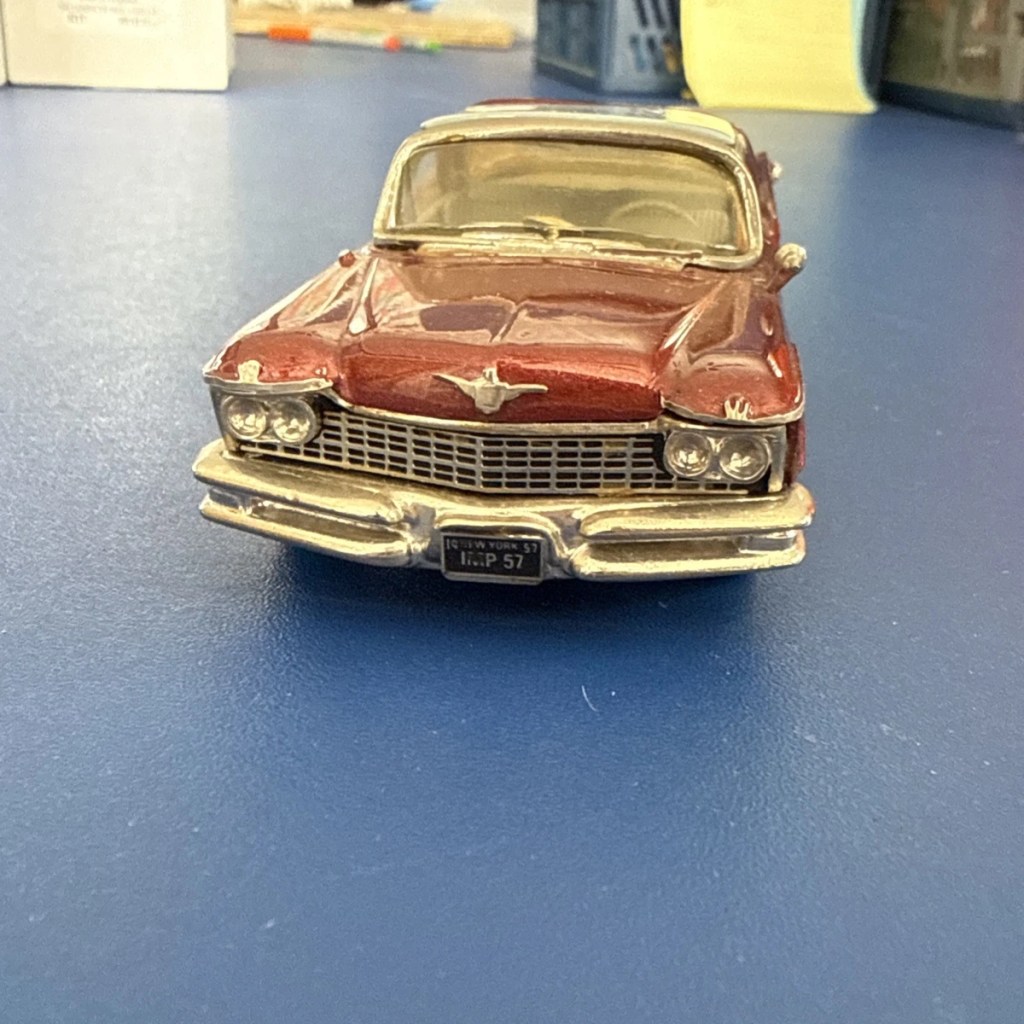
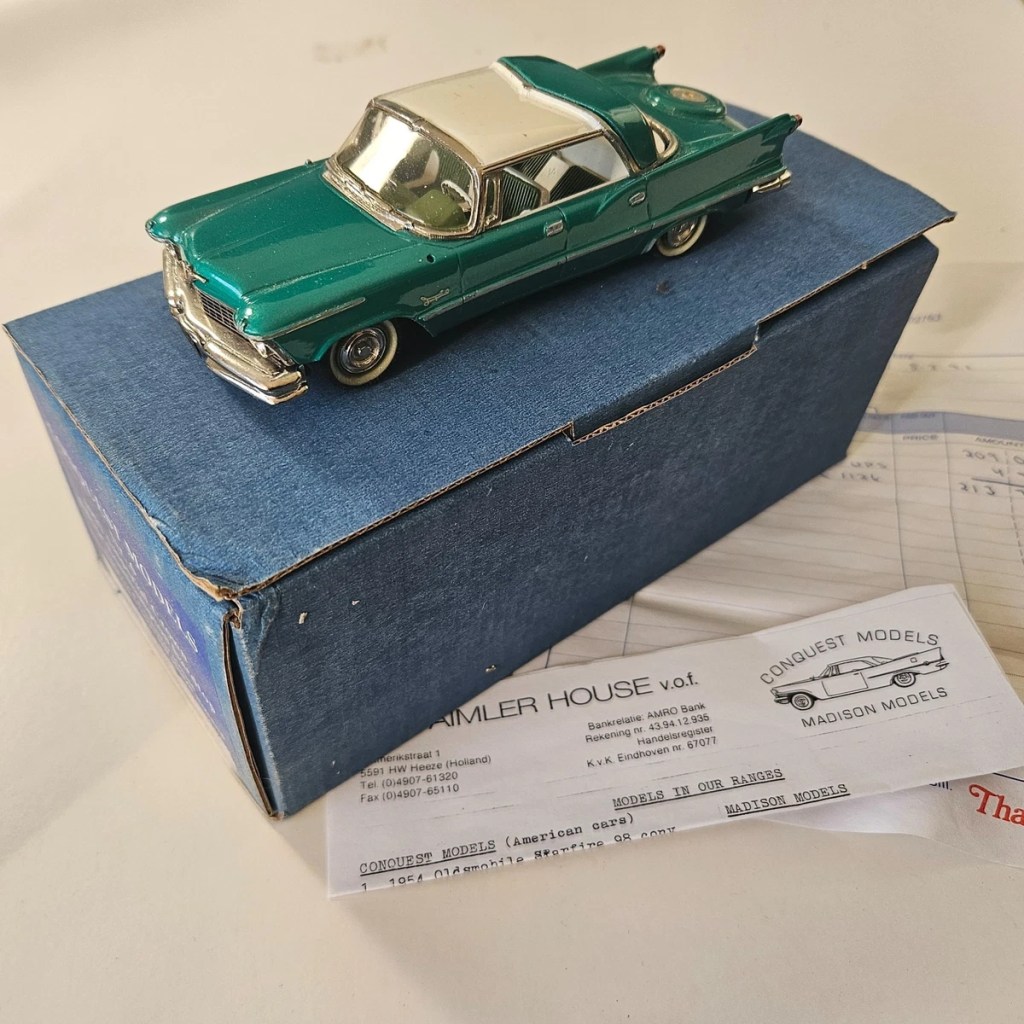
Nr. 6, the 1957 Imperial Crown four-door Southampton Hardtop, reminds us of a time when Chrysler Corporation maintained its own premium marque, just as GM had Cadillac and Ford had Lincoln. The 1957 model represented the second generation of Imperial, with the Crown designation applied to hardtops. Virgil Exner created a new styling direction called “Forward Look,” which was fully embodied in the new Imperial. Here he combined two distinct design inspirations: jet aircraft forms and elements drawn from 1930s vintage cars.
The car was equipped with a 6.4-litre V8 producing 325 hp, a three-speed automatic gearbox, and Torsion-Aire front suspension. Most of its details were unique and not borrowed from other Chrysler Corporation products. Customers, who could choose from 121 exterior and interior colour combinations, greatly appreciated the new model, purchasing approximately 37,000 units in 1957 – the same number sold by Lincoln.
In addition to hardtops, the 1957 Imperial range also included standard saloons and convertibles. Many years later, taking advantage of this fact, Henk expanded the 1957 Imperial selection with Nr. 33, a two-door Hardtop, and Nr. 34, the Convertible.
Nr.6 (source: eBay)
For Nr. 6, three colour combinations were selected: Champagne Gold/Charcoal Grey Metallic, Deep Ruby Metallic/Mist Grey, and Parade Green Metallic/Cloud White. These truly spectacular miniatures featured extensive chrome detailing, and all window surrounds were chromed. Even the Imperial emblem was embossed on the seat backrests. The front seat consisted of four separate pieces, while the rear seat was made up of three.
Many thanks to Henk van Asten for answering questions, and to Albert Kopans and Tim Musselman for photographs of the models from their collections.
A Parigi, il maggio del 1968 era caldo, caldissimo, non in termini climatici bensì sociali e politici. In quel mese, entrato nella storia come “maggio francese”, scoppiarono violente proteste di studenti e operai che misero a ferro e fuoco la capitale, con auto date alle fiamme e negozi di lusso distrutti.
Un clima certamente non ideale per organizzare un evento, ma Citroën aveva deciso una data per il lancio della sua “Dyane 6 Méhari”, come si chiamava all’epoca la nuova vettura, e nulla avrebbe cambiato questa decisione. Così, di buon’ora, alla stazione di Parigi, i giornalisti dell’auto invitati all’appuntamento furono fatti accomodare su un treno riservato diretto alla stazione di Trouville-Deauville, in Normandia, dove sarebbe avvenuta la presentazione ufficiale della nuova vettura.
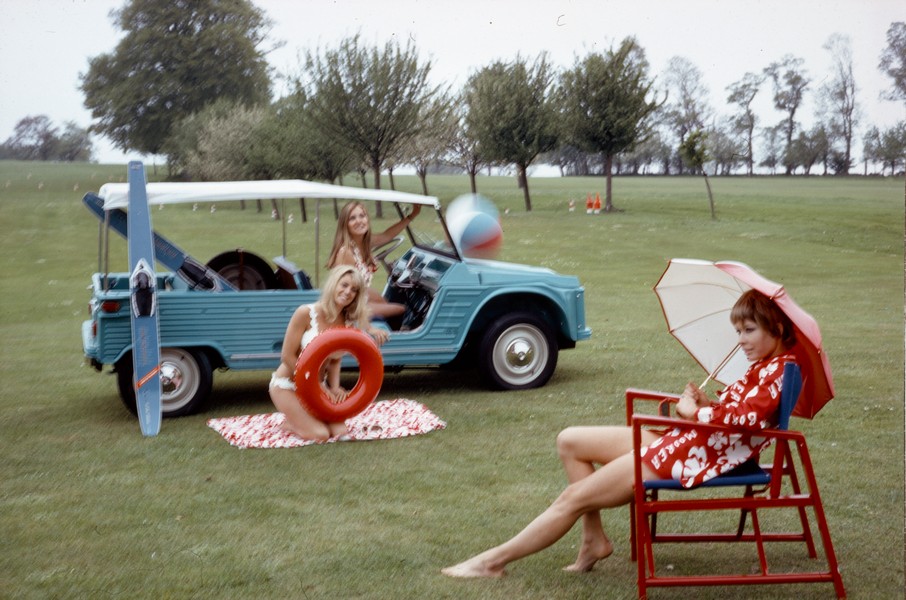
Una giornata fredda, ma colorata Meteorologicamente parlando, quel maggio era insolitamente freddo e la mattina del 16 non faceva eccezione: la colonnina del termometro raggiunse i 10 gradi di temperatura massima solo nella seconda metà della mattinata, ma le venti ragazze dell’agenzia Catherine-Harlé erano abbigliate adeguatamente alla presentazione di una “spiaggina”: le più fortunate indossavano una tuta di pelle rossa, quelle meno si proteggevano dal freddo solo grazie ad uno striminzito bikini.
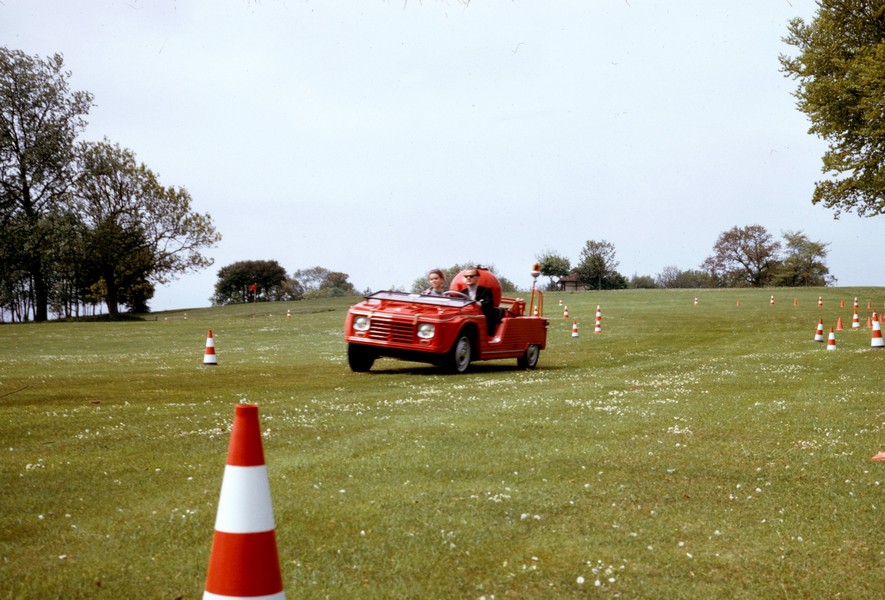
L’evento prese il via nella tarda mattinata e metteva in scena otto delle circa venti Méhari di preserie – la vettura sarebbe stata omologata solo nel successivo mese di luglio –, che rispetto alle vetture di serie erano verniciate con colori sgargianti come il blu elettrico, il rosso vivo, il turchese ed un inedito grigio metallizzato.
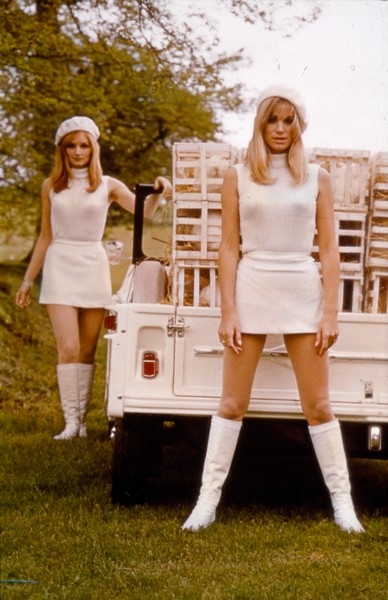
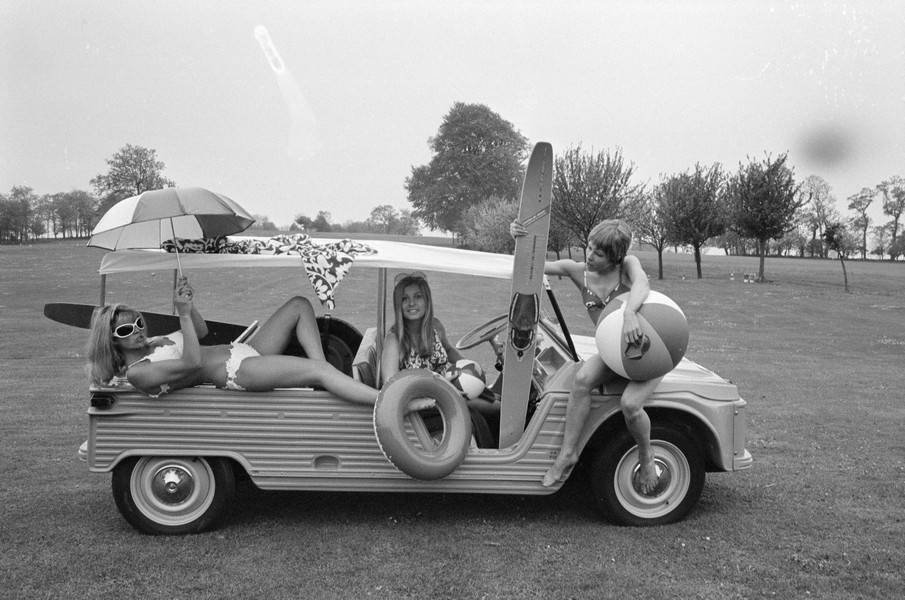
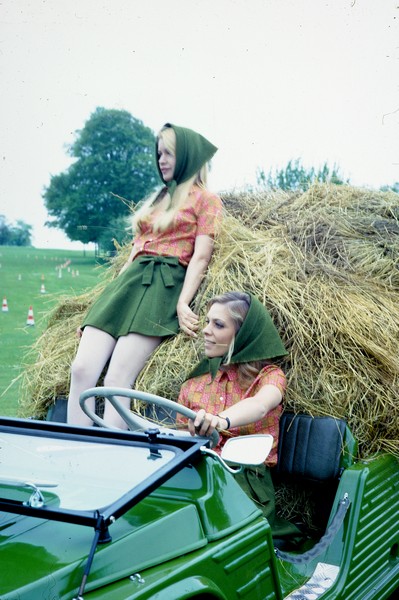
Una Méhari per ogni circostanza In varie situazioni, le infreddolite fanciulle interpretavano diversi personaggi: in costume da bagno, accanto ad una Méhari turchese, mimavano persone in spiaggia; con abitini e stivali bianchi, di fianco a una Méhari dello stesso colore, rappresentavano allevatrici con le loro gabbie piene di conigli. Le fortunate che indossavano la tuta in pelle rossa erano accanto alla Méhari del medesimo colore come improbabili pompieri, la Méhari verde era carica di paglia e fieno per le contadine di Normandia, le “figlie dei fiori” si spostavano su una Méhari grigia, le giocatrici di golf con quella gialla, la Méhari beige portava delle fanciulle a caccia, mentre le inflessibili poliziotte viaggiavano a bordo di Méhari blu con tanto di lampeggiatore.
Un evento di successo per una carriera di successo Com’era consuetudine per gli eventi organizzati da Jacques Wolgensinger, all’epoca Direttore della Comunicazione Citroën, la presentazione fu un successo e la carriera del piccolo “cammello di plastica” – il nome Méhari è mutuato da quello di una razza di cammelli da corsa e da combattimento – cominciò nel migliore dei modi: con una giornata divertente e fuori da ogni schema, che aveva offerto ai numerosissimi giornalisti presenti una pausa dalla dura realtà parigina, alla Citroën un ottimo ritorno in termini di consenso e alle venti ragazze un discreto raffreddore.
Citroën Méhari l’auto trasformista: da pick-up a berlina 4 posti Quando De la Poype immaginò la Méhari, pensò alla possibilità di costruire una vettura adatta a molti usi diversi, dal divertimento al trasporto di cose o attrezzi da lavoro; il designer Jean-Louis Barrault aveva come unico vincolo le misure della piattaforma AK, quella del piccolo veicolo commerciale Citroën.
Dal progetto uscì la vettura base che era una cabriolet a due porte e due posti, sulla cui parte posteriore era possibile ricavare una “buca” per le gambe dei passeggeri da sistemarsi su un sedile pieghevole che quando non utilizzato formava un piano di carico unico dal paraurti posteriore sino agli schienali dei sedili anteriori.
Il parabrezza – abbattibile – conteneva gli ancoraggi per due ferri che si univano ad un arco (smontabile) che sormontava i sedili di conducente e passeggero anteriore. Su questa struttura si poteva montare un tettuccio in tela che creava un abitacolo per i passeggeri anteriori. Estendendo il telaio si arrivava a coprire anche i passeggeri posteriori ed il bagagliaio, ottenendo così una berlina a quattro posti. Nel mezzo, infinite combinazioni con porte in tela o rigide, pannellature laterali in tela o anche carrozzerie in plastica rigida totalmente modulabili, disponibili nei colori della Méhari.
Una vettura per fare tutto, ovunque, con qualunque clima, con passeggeri o senza, sulla strada asfaltata, quella sterrata o senza alcuna strada.
A proprio agio ovunque A proprio agio a Saint-Tropez o nel centro di Parigi, la Méhari è stata prodotta in quasi 150.000 unità per circa vent’anni: dal 1968 al 1987, comprese le straordinarie 4×4 che hanno servito l’esercito francese, anche in versione “paracadutabile” e svolto il ruolo di “ambulanze veloci” alla Parigi-Dakar del 1980, dove diedero prova di incredibile efficacia, capaci di andare e tornare facilmente tra le dune, senza insabbiarsi.

 PITLANEITALIA